

Introduction: A Decade of Industrial Simulation
In the landscape of mobile gaming, few titles manage to capture the meticulous satisfaction of industrial management quite like the Reactor series. First introduced in March 2016, Reactor – Energy Sector Tycoon became a sleeper hit within the indie community, drawing in players who craved deep, systemic gameplay without the intrusive monetization often found in the genre. Now, ten years after the inception of the original, developer RSGapps has returned to the franchise with Reactor 2: Nuclear Tycoon. This sequel represents not just a technical update, but a complete reimagining of the energy tycoon experience, blending the familiar mechanics of heat management and grid optimization with a sprawling, living world that reacts to the player’s every move.
Main Facts: The Core of the Experience
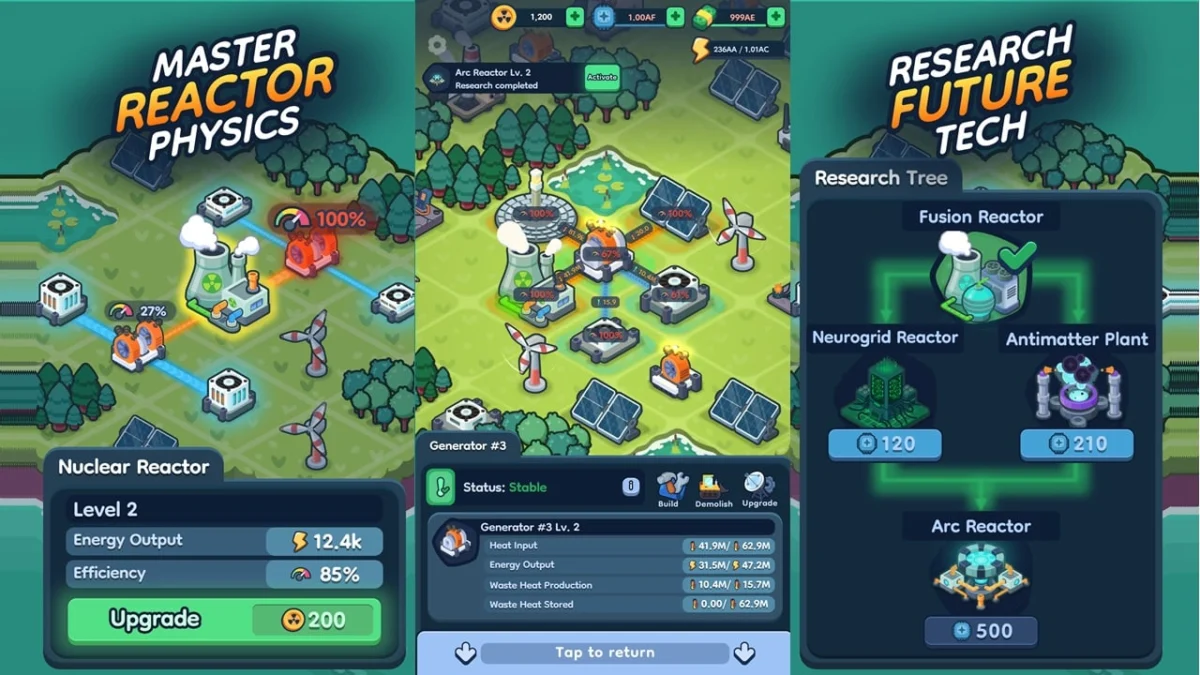
At its heart, Reactor 2: Nuclear Tycoon remains a game about the delicate balance of power. Players begin their journey as small-scale energy providers, utilizing rudimentary wind turbines to power a modest local grid. The progression loop is classic tycoon: manage thermal output, convert that heat into electricity, and maintain the structural integrity of your power plants.
The gameplay loop is built around a "cooling" mechanic. Unlike other disaster-heavy management simulations where a single failure leads to a catastrophic loss of progress, RSGapps has maintained a player-friendly design philosophy. If a reactor overheats, production simply halts. The facility enters a "cool-down" phase, forcing the player to pause, analyze their layout, and re-engineer their grid for better efficiency. This creates a low-stress, high-satisfaction environment that encourages experimentation over anxiety.
The game is categorized as an "idle" or "incremental" game, meaning it continues to generate resources even when the application is closed. This "set it and forget it" design is perfectly complemented by its offline capability, making it an ideal title for mobile users who want to engage with complex systems during commutes or downtime without requiring a constant cloud handshake.
Chronology: The Journey from 2016 to 2025
The history of RSGapps is marked by a consistent focus on "chain" and "management" simulations. Following the success of the original Reactor, the studio expanded its portfolio with titles such as Production Chain Tycoon and Technopoly. These games helped refine the studio’s signature aesthetic: clean, readable pixel art paired with high-performance engines capable of tracking thousands of individual resource movements simultaneously.
- 2016: The release of Reactor – Energy Sector Tycoon. It established the baseline for the "thermal management" genre on mobile, emphasizing simple visuals and complex math.
- 2017–2023: RSGapps spent these years developing auxiliary titles like Production Chain Tycoon, which introduced the concept of interlinked resource nodes—a feature that would eventually inform the structural complexity of Reactor 2.
- 2024: The studio began teasing the development of a sequel, focusing on "living world" mechanics and a more robust narrative-driven quest system.
- March 2025: The official launch of Reactor 2: Nuclear Tycoon on the Google Play Store, marking the ten-year anniversary of the franchise.
Supporting Data: The Technological Ladder
One of the primary drivers of player retention in Reactor 2 is the sheer scale of the research tree. The game is structured into distinct tiers, each offering a shift in the player’s relationship with energy production:
1. The Renewable Era
Early game focus centers on sustainability. Solar panels, wind turbines, hydro-dams, and tidal energy collectors serve as the foundation. This tier is designed to teach players about spatial management, as each energy source has specific placement requirements and environmental dependencies.
2. The Nuclear and Fusion Transition
As players accumulate capital, they shift into high-density energy production. This is where the game’s core heat-management mechanics become critical. Nuclear reactors require massive cooling arrays, and the transition from fission to fusion represents the "mid-game" difficulty spike, requiring players to optimize their infrastructure to avoid constant downtime.
3. The Sci-Fi Frontier
The late-game content is where RSGapps leans into high-concept science fiction. Once players have mastered terrestrial energy, they unlock the ability to harness:
- Antimatter Reactors: High-output, high-risk systems.
- Black Hole Reactors: The pinnacle of energy density, necessitating specialized containment fields.
- HyperSpace Cores: The final stage of the research tree, which effectively removes the traditional constraints of early-game physics.
Official Responses and Developer Intent
In discussions surrounding the launch, the team at RSGapps highlighted their commitment to the "Free-to-Play" model without the "Pay-to-Win" stigma. By ensuring the game is fully playable offline, the developers are catering to a demographic that values privacy and accessibility.
"The goal with Reactor 2 was never to replicate the stress of real-world energy crisis management, but to provide the satisfaction of building a massive, functioning machine," a representative for the studio noted. "We wanted to ensure that the city living around your reactors felt like a participant in your success. When you grow, the city grows. When you fail, the city dims. It creates an emotional connection to the grid."
The shift to a "living city" model is perhaps the most significant change from the 2016 original. In the first game, the "customer" was an abstract number. In the sequel, the city acts as a visual manifestation of your progress. Players can watch as urban sprawl expands, skyline density increases, and the lights in the windows of distant skyscrapers flicker on—all powered by the energy the player manages.
Implications for the Idle/Management Genre
The success of Reactor 2 suggests a continuing trend in mobile gaming: the movement toward "smart idle" games. Players are increasingly turning away from "gacha" mechanics and high-pressure competitive games in favor of titles that reward long-term planning and logical problem-solving.
The Role of Narrative in Management
By introducing a chapter-based quest system, RSGapps is attempting to bridge the gap between "pure" idle games and narrative-driven simulations. These quests provide players with long-term goals that prevent the "stagnation" common in incremental games, where players often find themselves with nothing to do but wait for numbers to climb.
Aesthetic and Performance
The move to "refined pixel art" is a calculated design choice. By avoiding hyper-realistic 3D models, the game maintains a low battery-drain profile, which is essential for a game designed to run in the background. The performance improvements ensure that even when a player’s grid grows to include hundreds of interconnected reactors, the frame rate remains stable, ensuring that the interface remains responsive during high-intensity management sessions.
The Future of the Franchise
While Reactor 2 is still in its infancy, the roadmap for the game includes regular updates to the quest system and potentially new tiers of research. The integration of story-driven challenges indicates that RSGapps views this as a "live service" project that will grow alongside its player base.
For those who have been following the genre since 2016, Reactor 2 feels like a homecoming. It preserves the simplicity of the original while adding the layers of complexity that veteran players have been demanding for years. It is a testament to the fact that, in the world of game development, patience and a clear vision can lead to a sequel that respects its past while boldly looking toward the future of its digital universe.
Conclusion: Why You Should Start Your Grid
Whether you are a fan of the original 2016 title or a newcomer looking for a deep, meditative management experience, Reactor 2: Nuclear Tycoon offers a compelling package. Its blend of accessible mechanics, deep research trees, and a living, breathing city environment makes it a standout entry in the current mobile market.
By removing the "punishment" of total loss and replacing it with the "puzzle" of cooling and optimization, RSGapps has crafted a title that invites you to lose track of time. You aren’t just playing a game; you are building an empire of energy, one turbine—and eventually one black hole—at a time. The game is currently available for download on the Google Play Store, inviting players to see just how bright they can make their city shine.
For those interested in other gaming developments, we recently covered the latest update for FATE: Reawakened, which includes the Prometheus DLC and the implementation of full controller support, a significant milestone for fans of that classic dungeon-crawler experience.

