

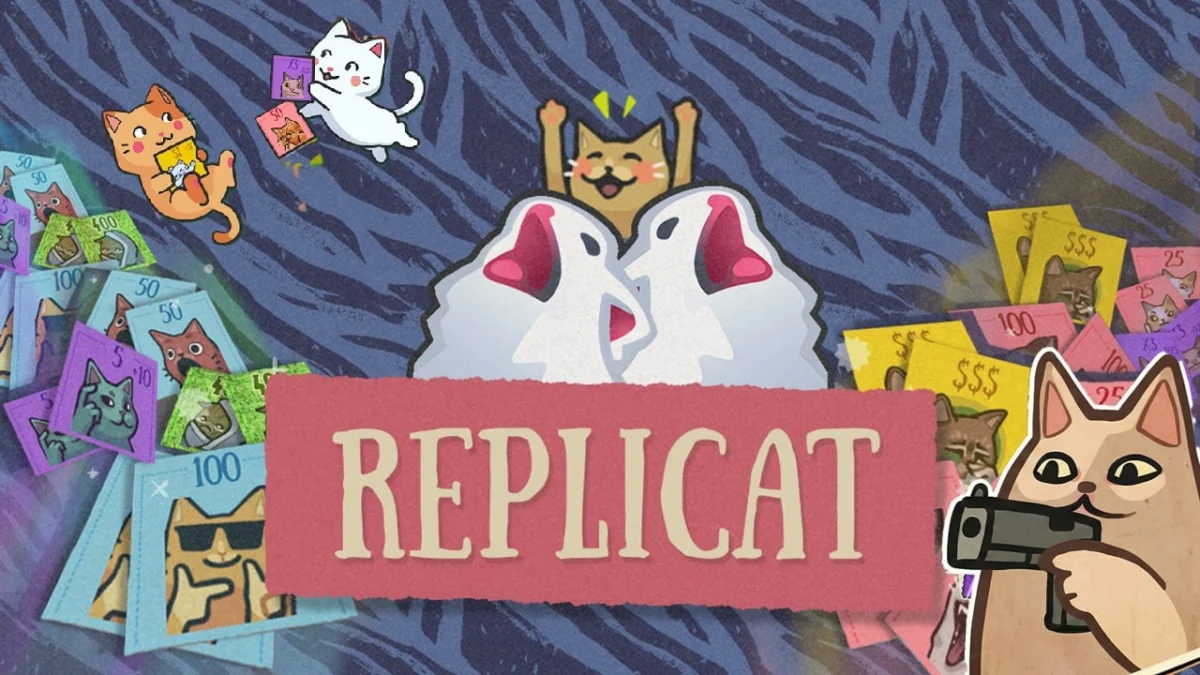
The mobile gaming landscape has long been saturated with clones of classic titles, yet rarely does a developer successfully marry the simplicity of a childhood pastime with the deep, recursive complexity of the modern "roguelike deckbuilder." Erabit Studio, known for its penchant for polished, accessible gameplay, has officially launched its latest title, Replicat, on the Google Play Store.
At first glance, Replicat presents itself as a charming, feline-themed memory-matching card game. However, beneath its adorable, meme-inspired aesthetic lies a sophisticated strategic engine that challenges players to abandon their reliance on rote memorization in favor of intricate deck-manipulation and rule-breaking synergy. Available now for a one-time purchase of $4.99, Replicat promises to redefine the "match-two" genre by transforming a simple test of brainpower into a dynamic, high-stakes tactical experience.
Main Facts: The Anatomy of a New Genre Hybrid
Replicat represents a bold pivot in the roguelike space. While recent hits like Balatro have brought poker-based deckbuilding to the forefront of the gaming consciousness, Replicat takes a different, arguably more accessible, route. The core loop remains rooted in the classic memory-matching mechanic: players flip tiles to find matching pairs of cats.
However, the game quickly evolves. As players progress through a run, they are tasked with "shaping" the game’s reality. By collecting Curios and Essences, players can systematically alter the fundamental rules of the board. Unlike traditional card games that rely on complex hands or combat stats, Replicat forces the player to consider spatial awareness and memory management alongside deck-building economy.
Key Features at a Glance:
- The Curio System: Much like the Jokers in Balatro, Curios provide passive, game-altering buffs. Crucially, players face no hard limit on how many Curios they can carry, leading to "runaway" builds that can become wildly powerful and unpredictable.
- Essence Enhancement: Rather than cluttering the player’s inventory with consumables, Replicat focuses on permanent card upgrades. Essences allow players to buff specific cards, effectively "tuning" their deck to perform better as the stages grow increasingly difficult.
- Strategic Depth: Players can manipulate the board state by keeping tiles face-up, revealing extra cards, utilizing wild Jokers, or converting "misses" into "hits."
- Massive Content Pool: With 90 unique cards, 80+ Curios, 10 distinct starter decks, and 21 increasingly difficult stages, the game offers substantial replay value.
Chronology: The Development and Evolution of Replicat
The journey of Replicat from concept to mobile release has been marked by a focus on "loop refinement." Erabit Studio identified a gap in the market: players enjoyed the casual accessibility of memory games but often found them lacking in long-term engagement.
Phase 1: The Foundation (Concept)
Early development focused on the core memory-matching loop. Developers realized that to make the game viable for a "roguelike" structure, they needed to introduce an element of progression. The initial prototype established the 5-color card system, where each color provides unique mechanical interactions, ensuring that players weren’t just matching images, but balancing color-coded strategies.
Phase 2: The "Rule-Breaking" Iteration
Midway through development, the team moved away from traditional card games to a more "unbound" ruleset. By introducing the ability to "burn" cards—a process of removing weaker cards from the deck to increase the probability of drawing powerful ones—the developers added a layer of deck-thinning strategy. This shifted the game from a reactive memory challenge to a proactive engine-building game.
Phase 3: The Polish and Launch
The final phase of development involved balancing the 10 starter decks to ensure that players of varying skill levels could engage with the game. With the integration of "boss modifiers"—conditions that change how the board behaves mid-run—Erabit Studio finalized the current iteration of the game, launching it to a global audience this week.
Supporting Data: By the Numbers
To understand the scope of Replicat, one must look at the sheer breadth of its systemic variables. Erabit Studio has provided a dense, content-rich experience that is designed to be played in both short bursts and extended sessions.
- 10 Starter Decks: Each deck is tiered by difficulty, allowing for a natural learning curve. These decks force players to adapt to different playstyles—some focused on explosive multiplier chains, others on defensive turn control.
- 90+ Cards: The diversity of cards ensures that no two runs feel identical. Because the game includes five distinct colors, players must balance their "deck" across different mechanics.
- 80+ Curios: This is the heart of the game’s variety. Curios act as the primary drivers of "builds." A player might prioritize a build based on "passive reveals" (where the board reveals cards for them) or "move economy" (where they gain extra turns for successful matches).
- 21 Stages: These stages are not just linear progressions; they feature unique boss modifiers that can lock tiles, shuffle the board, or penalize players for missed matches, ensuring that the final stages feel like a significant departure from the start of the game.
Official Responses and Design Philosophy
In discussions surrounding the release, the team at Erabit Studio emphasized their commitment to a "premium, fair experience." By opting for a one-time purchase model of $4.99, the developers have signaled a rejection of the predatory microtransaction models that often plague mobile puzzle games.
"We wanted to build a game where the player’s brain is the most important tool," a representative from Erabit stated during the launch window. "Memory is the starting point, but strategy is the destination. We didn’t want to create a game that forces players to pay to win. We wanted to create a game that forces them to play to learn."
The inclusion of meme-inspired cat artwork is also a deliberate stylistic choice. By blending the "serious" roguelike mechanics with a lighthearted, vibrant aesthetic, Erabit aims to lower the barrier to entry, making a complex strategic game feel approachable to casual players who might otherwise be intimidated by the "roguelike" label.
Implications: The Future of the Memory Genre
The launch of Replicat could signal a broader trend in the mobile gaming industry. For years, the memory-matching genre has been relegated to children’s apps or low-effort clones. Replicat proves that even the most "solved" and basic game mechanics can be revitalized through the application of roguelike systems.
1. The "Balatro Effect"
The industry is currently witnessing a surge in games that take simple, recognizable mechanics (poker, memory, solitaire) and overlay complex mathematical systems on top of them. Replicat is the latest beneficiary of this trend. If Replicat finds a sustained audience, we can expect to see more developers revisiting classic arcade and board game concepts with an eye toward deep, systemic strategy.
2. Premium Mobile Re-emergence
The one-time purchase price of $4.99 is a statement. In a market dominated by Free-to-Play (F2P) titles that rely on advertisements and energy timers, Erabit’s decision to offer a complete, uninterrupted experience is a win for the pro-consumer mobile gaming community. It suggests that there is a viable, sustainable market for premium indie games on mobile, provided the content is sufficiently deep and replayable.
3. Accessible Complexity
Perhaps the most significant implication of Replicat is its successful balance of accessibility and complexity. By using a familiar memory-matching interface, the game bypasses the complex UI hurdles that often make modern strategy games inaccessible to casual players. This "Trojan Horse" design—using a simple, known mechanic to deliver a complex, hidden strategy game—is a masterclass in modern mobile game design.
Conclusion
Replicat is more than just a memory game with cats. It is a robust, well-engineered strategy title that rewards patience, planning, and a willingness to break the rules. By allowing players to manipulate the deck, stack unpredictable Curios, and engage with a deep, systemic progression, Erabit Studio has created a title that transcends its humble origins.
Whether you are a fan of the roguelike genre looking for your next obsession, or a casual player seeking a polished, ad-free experience, Replicat offers a depth of gameplay that is rare on the mobile platform. Its blend of adorable visuals and cutthroat, strategic deckbuilding creates an experience that is as addictive as it is satisfying. As the mobile gaming community continues to evolve, titles like Replicat stand as a testament to the fact that when it comes to game design, a little bit of creativity can turn a simple game of memory into an unforgettable strategic journey.
For those interested in exploring the world of Replicat, the game is available for immediate download on the Google Play Store. It is a rare example of a title that respects both the player’s intelligence and their time, ensuring that every flip of a card feels like a step toward a masterfully constructed victory.

