

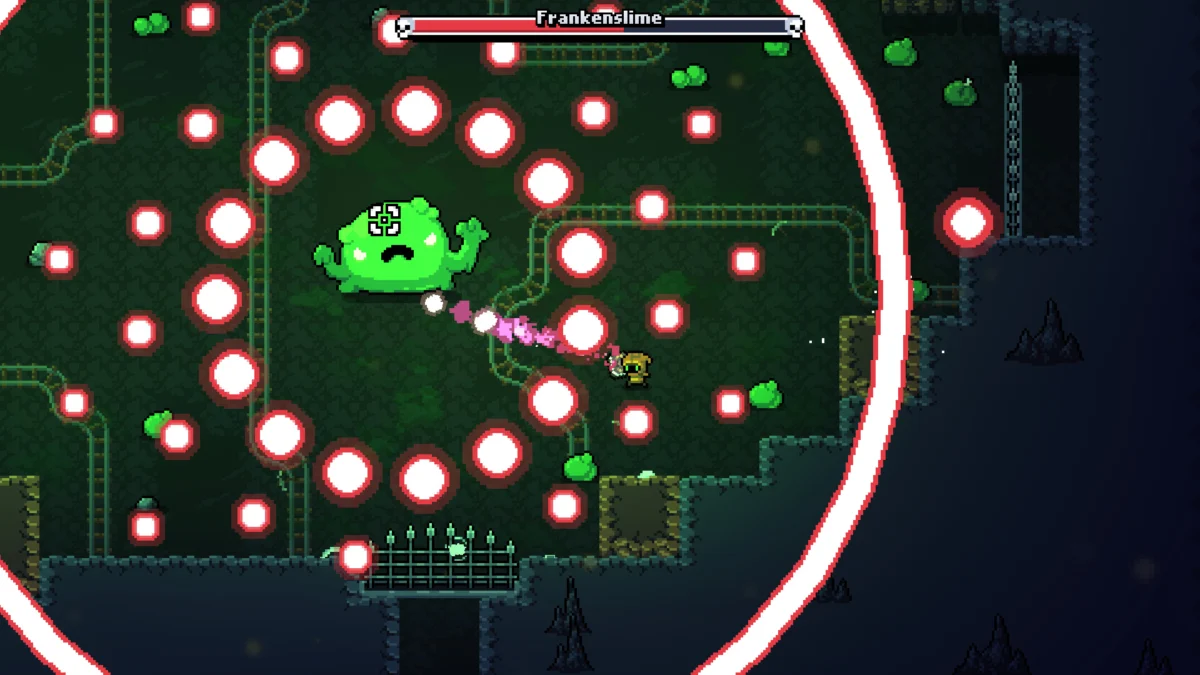
As the curtains draw on what has arguably been one of the most prolific and transformative years in the history of independent game development, the landscape remains cluttered with hidden gems that demand attention. Among the final arrivals of 2021, Archvale emerged as a startlingly cohesive fusion of two seemingly disparate genres: the deep, character-driven progression of the Role-Playing Game (RPG) and the high-octane, reflex-testing intensity of the "bullet hell" shooter. Developed by Idoz and Fishwind, Archvale arrived on December 23, 2021, serving as a reminder that the most compelling innovations in modern gaming often occur in the space between established conventions.
The Core Concept: Where RPG Meets Bullet Hell
At its heart, Archvale is an ambitious experiment in mechanics. The "bullet hell" subgenre—characterized by screen-filling projectiles and a requirement for near-perfect pattern recognition—is traditionally solitary and twitch-based. Conversely, RPGs prioritize long-term character investment, gear optimization, and strategic choice. Merging the two creates a gameplay loop that is as punishing as it is rewarding.
In Archvale, the player is thrust into a kingdom once held under the iron grip of a malevolent king. As the world’s sole remaining hope, the player must embark on a quest to reconstruct the titular "Arch" to confront the ultimate evil. The game does not hold the player’s hand; instead, it offers a semi-open world structure that invites exploration, provided the player has the fortitude to survive the escalating difficulty of each region.
Chronology of a Cult Classic
The trajectory of Archvale began with its quiet entry into the Steam ecosystem. While it did not have the massive marketing budgets of AAA titles, the game gained rapid traction through word-of-mouth within the indie community.
- Pre-Release Anticipation: The title was initially teased through developer dev-logs and trailers that highlighted its vibrant, pixel-art aesthetic and the frantic nature of its combat.
- The Launch (December 2021): The official release on December 23 acted as a holiday treat for genre enthusiasts. Reviewers were quick to note that the game’s polish—particularly the tight controls required for bullet-dodging—was far beyond what is typical for a small indie production.
- Post-Launch Reception: In the weeks following, the community coalesced around the game’s deep weapon-crafting systems. Players began sharing "meta" builds, discussing the most effective ways to tackle late-game bosses, and, notably, celebrating the inclusion of the game’s most beloved NPC: a frog chef who provides much-needed levity amidst the chaos.
Supporting Data: Why the Mechanics Work
The success of Archvale lies in its granular approach to character customization. While many bullet hell games rely on fixed movement sets, Archvale allows for dynamic shifts in playstyle.
The Weaponry and Build System
The game features an extensive arsenal that caters to different combat philosophies. Players can experiment with:
- Long-range precision: Weapons that require careful positioning to land shots while weaving through dense patterns.
- Area-of-effect tools: Gear designed to clear swarms of smaller enemies, providing breathing room in more chaotic encounters.
- Customizable "Badge" System: This serves as the game’s class-less progression engine. By equipping different badges, players can augment their health, movement speed, or damage output. This allows for a "fluid" build strategy; a player might swap to a high-mobility setup for a boss fight and pivot to a high-damage, glass-cannon build for clearing dungeons.
The Difficulty Curve
The game employs a "region-based" difficulty scale. Players are free to explore the world in almost any order, but the game signals its challenges through environmental design. As one travels further from the hub, the bullet patterns become more intricate, forcing the player to master the "dash" and "dodge" mechanics. This creates a satisfying learning curve: the game feels difficult not because it is unfair, but because it acts as a mentor, demanding mastery of its systems.
Official Perspectives and Development Philosophy
While the developers at Idoz and Fishwind have remained relatively private, their approach to the game’s design is evident in its execution. In various community forums and developer notes, the intent was clearly to move away from the "static" feeling of traditional RPGs. By forcing players to interact with the environment during combat, the developers ensured that no two encounters feel identical.

The choice of pixel art was also a calculated aesthetic decision. By using a vibrant, high-contrast palette, the developers made it significantly easier for players to track individual projectiles against the background—a critical requirement for a bullet hell game. This visual clarity is a hallmark of good design, ensuring that when a player dies, they know exactly which mistake they made, minimizing frustration and maximizing the "one more try" mentality.
The Broader Implications for Indie Gaming
The success of Archvale offers a significant lesson for the industry: genre-blending is the frontier of modern indie development. As the market becomes increasingly saturated, players are looking for experiences that subvert their expectations.
Innovation through Constraints
Archvale proves that you do not need a massive open world or hyper-realistic graphics to provide a AAA-level gameplay experience. By constraining the scope to a focused, tight combat loop, the developers created a game that feels "complete." The industry is currently seeing a trend of smaller, more focused titles outperforming bloated, "service-model" games.
The Longevity of "Hard" Games
Furthermore, the game reinforces the enduring popularity of high-difficulty experiences. The Souls-like trend paved the way for games that treat the player as an active learner rather than a passive consumer of content. Archvale takes this philosophy and applies it to the top-down shooter, proving that even niche subgenres can find a massive, dedicated audience if the core "feel" of the game is polished to a mirror sheen.
Conclusion: A Must-Play Experience
Looking back at the landscape of 2021, Archvale stands as a testament to the power of design-first thinking. It is a game that respects the player’s intelligence, rewards their persistence, and charms them with its personality—yes, including the frog chef.
For those who missed this title amidst the holiday rush, it remains a quintessential example of how indie developers are carrying the torch of innovation. It provides a blueprint for how to balance the complex systems of an RPG with the raw, adrenaline-fueled excitement of a bullet hell shooter. Whether you are a fan of the Zelda style of exploration or a veteran of the Touhou school of bullet-dodging, Archvale offers a unique, challenging, and profoundly satisfying experience that deserves a permanent spot in your digital library.
As we move further into the future of gaming, we can expect to see more titles following in the footsteps of Archvale, proving that the most memorable games aren’t necessarily the biggest ones—they are the ones that dare to combine the best parts of everything else.

