

[CITY, STATE] – [DATE] – Advanced Micro Devices (AMD) has officially announced a significant expansion of its high-performance computing portfolio, introducing the AMD X100 series of embedded APUs, derived from the formidable Strix Halo architecture. These new processors are specifically engineered to power the burgeoning field of "physical AI," targeting demanding embedded applications such as industrial robotics, autonomous systems, and advanced edge computing infrastructure. With a focus on rugged 24/7 operation and an extended 10-year lifecycle, the X100 series marks AMD’s strategic move to solidify its presence in critical industrial sectors, directly challenging established players like Intel and Nvidia.
Main Facts: Powering the Intelligent Edge
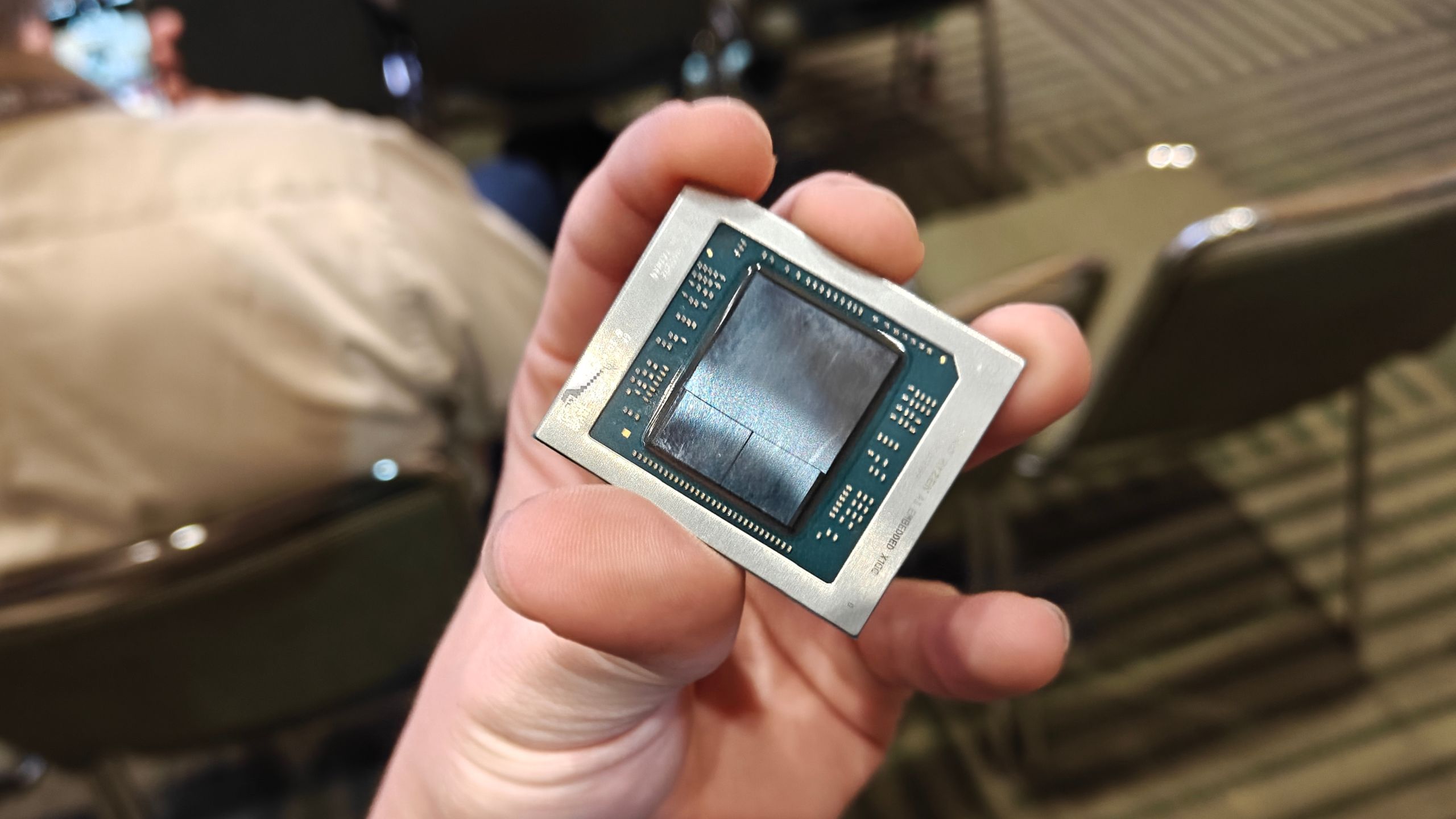
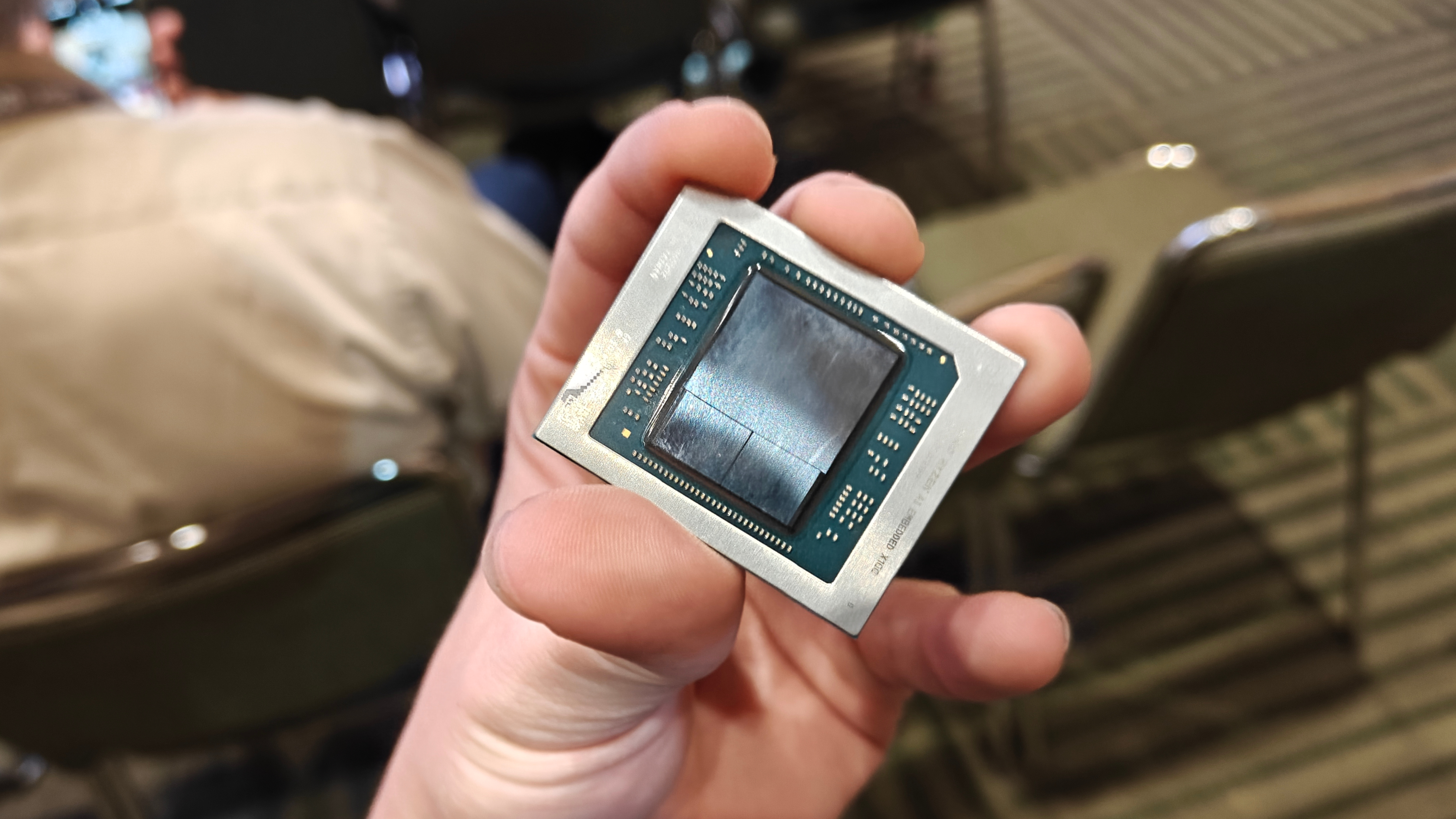
AMD’s X100 series APUs are a specialized variant of the company’s highly anticipated Strix Halo architecture, which has garnered considerable attention in the client device market through its Ryzen AI Max models. However, unlike their consumer counterparts, the X100 processors are meticulously crafted for the unforgiving environments and stringent reliability requirements of embedded systems. This includes an impressive operating temperature range from -40 degrees Celsius up to 105 degrees Celsius, underscoring their suitability for diverse and extreme conditions.
The initial lineup comprises three distinct SKUs: the flagship X199, the mid-range X188, and the X168. These processors integrate AMD’s cutting-edge Zen 5 CPU cores, RDNA 3.5 graphics processing units (GPUs), and a dedicated XDNA 2 Neural Processing Unit (NPU), all unified on a single System-on-Chip (SoC). This integrated design is crucial for minimizing latency and maximizing data throughput, which are paramount for real-time AI inference and control in physical AI applications.
The X100 series boasts a configurable Thermal Design Power (TDP) ranging from 45W to 120W, allowing system designers to balance performance and power efficiency based on specific application needs. Furthermore, the ability to support up to 128 GB of unified memory is a significant advantage, enabling complex AI models and large datasets to be processed directly on the edge device without relying on external memory hierarchies, thereby enhancing both speed and efficiency.
Chronology: From Client to Industrial Edge
The journey of the Strix Halo architecture from a high-performance client APU to a robust industrial solution highlights AMD’s agile development strategy. The original Strix Halo models, initially unveiled for laptops and other client devices, were designed to offer a compelling blend of CPU, GPU, and NPU performance. Recognizing the substantial potential of this integrated design for accelerating AI workloads at the edge, AMD adapted the core architecture for embedded use.
Initial Client Launch: The foundation of the X100 series lies in the Strix Halo architecture, which was first introduced for consumer-grade Ryzen AI Max processors. These chips quickly established a reputation for their powerful integrated graphics and dedicated AI acceleration capabilities.
Targeting Embedded Markets: The transition to the X100 series involved rigorous engineering to meet the unique demands of embedded systems. This includes hardening the chips for continuous 24/7 operation, ensuring a longer product lifecycle (10 years), and extending the operational temperature range. These adaptations are critical for industrial adoption, where long-term stability and reliability far outweigh rapid generational upgrades.
Product Lineup Unveiling: AMD’s official announcement of the X100 series details the three specific SKUs:
- X199: The top-tier offering, featuring 16 Zen 5 CPU cores and 40 RDNA 3.5 Compute Units (CUs). This SKU is designed for the most compute-intensive AI and robotics tasks, where maximum processing power is required.
- X188: A balanced option with 12 Zen 5 CPU cores and 32 RDNA 3.5 CUs, providing a strong performance-per-watt profile for a wide array of embedded applications.
- X168: The entry-level variant, equipped with 8 Zen 5 CPU cores and 32 RDNA 3.5 CUs, offering a cost-effective yet powerful solution for less demanding or power-constrained scenarios.
While detailed specifications for each model beyond core and CU counts are still pending, AMD has confirmed that the series can achieve boost clocks of up to 5.1 GHz.
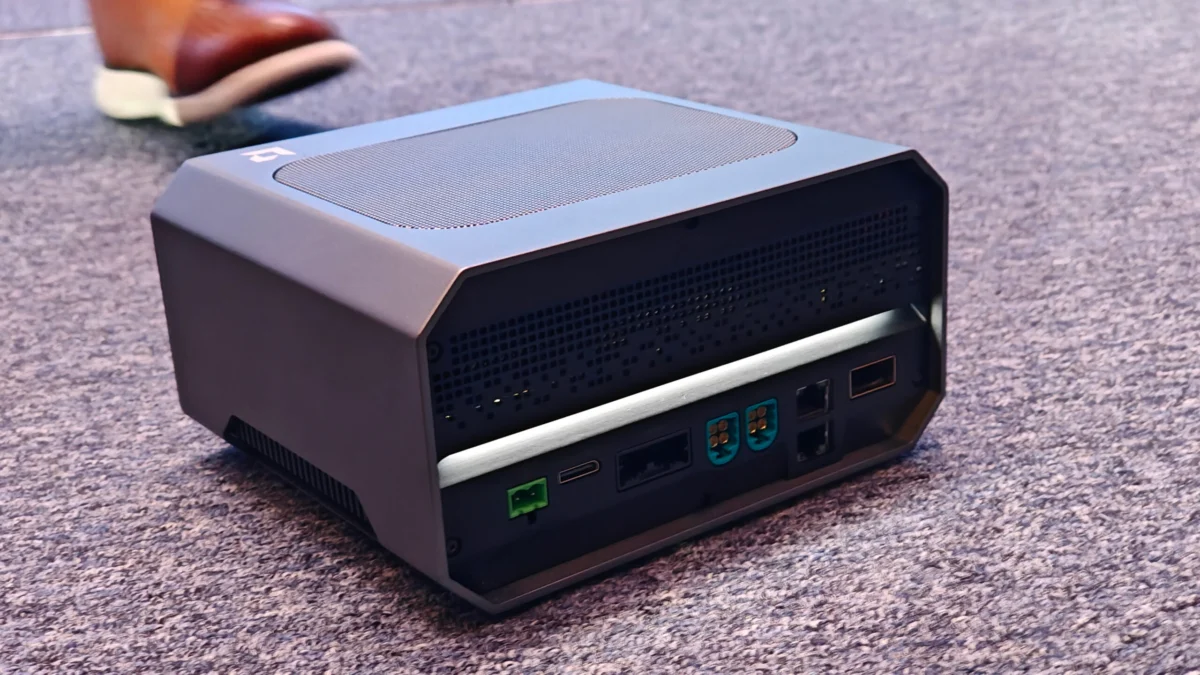
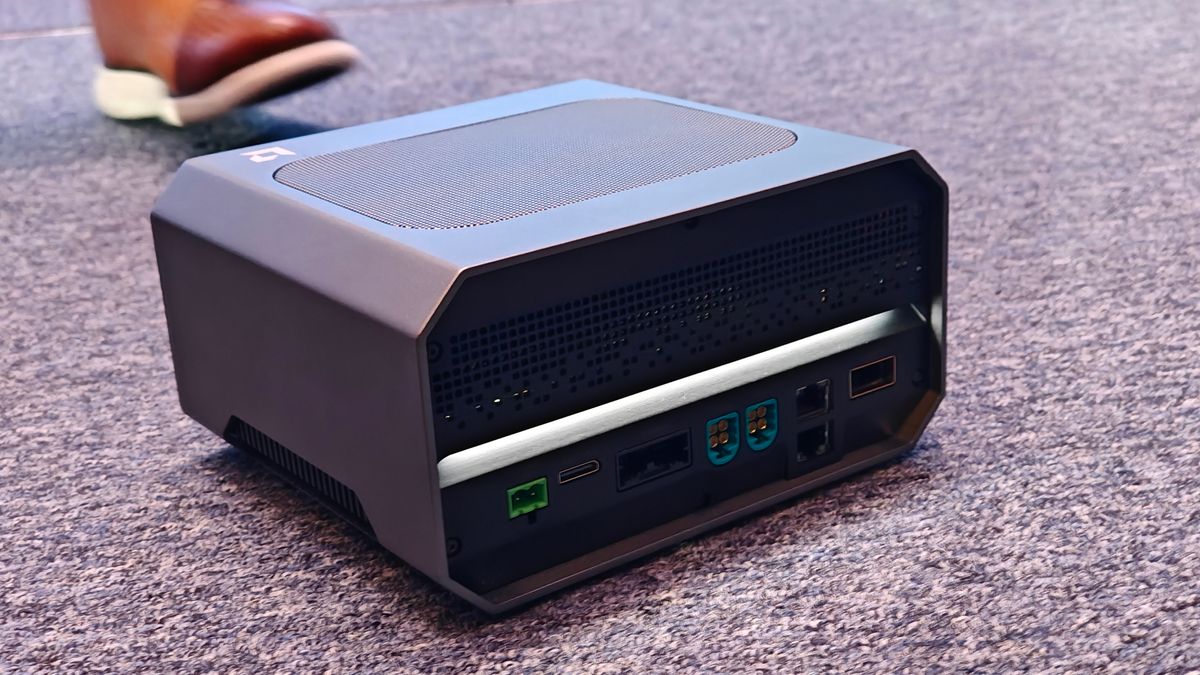
Developer Platform Availability: Concurrently with the chip announcement, AMD also unveiled the Kria System-on-Module (SOM) and a comprehensive robotics developer platform built around the X100 series. The Kria X100 board, adhering to the standardized COM-HPC form factor (120mm x 120mm), provides a modular solution for integration. The fully integrated Kria AI robotics developer platform, leveraging the X100 Kria SOM alongside an AMD Spartan UltraScale+ FPGA baseboard, is currently in early access and is slated for full production in Q4 of this year. This platform aims to offer a "turnkey" solution, simplifying development for robotics engineers with specialized connectivity for cameras, industrial networking, and various robotic sensors.
Supporting Data: Specifications and Performance Claims
The technical prowess of the AMD X100 series is built upon a foundation of advanced silicon and architecture:
Core Architecture Breakdown:
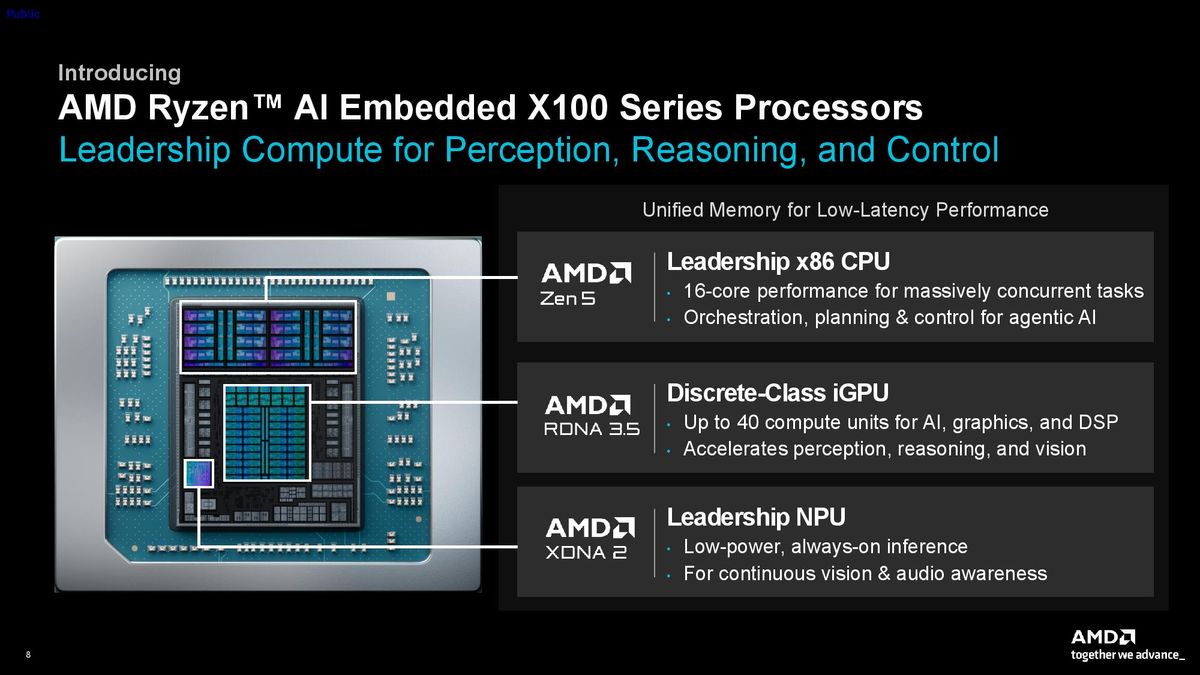
- Zen 5 CPU Cores: Representing the latest iteration of AMD’s CPU microarchitecture, Zen 5 cores deliver significant improvements in IPC (Instructions Per Cycle), efficiency, and multi-threaded performance. This is critical for executing complex control algorithms, operating systems, and general-purpose computational tasks within a robotic system.
- RDNA 3.5 Graphics Compute Units (CUs): The integrated GPU based on the RDNA 3.5 architecture provides substantial parallel processing capabilities. This is vital for tasks such as real-time sensor data processing (e.g., LiDAR, camera feeds), rendering sophisticated human-machine interfaces, and accelerating specific AI workloads that benefit from GPU parallelism.
- XDNA 2 Neural Processing Unit (NPU): The dedicated AI accelerator, XDNA 2, is the cornerstone of the X100 series’ AI capabilities. With up to 50 TOPS (Tera Operations Per Second) of AI performance, the NPU is optimized for efficient execution of neural networks, machine learning models, and other AI inference tasks at the edge, offloading these computations from the CPU and GPU to improve overall system efficiency and latency.
Key Specifications:
- SKUs: X199 (16 Zen 5 cores, 40 RDNA 3.5 CUs), X188 (12 Zen 5 cores, 32 RDNA 3.5 CUs), X168 (8 Zen 5 cores, 32 RDNA 3.5 CUs).
- Boost Clock: Up to 5.1 GHz.
- Unified Memory: Up to 128 GB, offering high bandwidth and low latency access for CPU, GPU, and NPU.
- NPU Performance: Up to 50 TOPS (XDNA 2).
- Configurable TDP: 45W to 120W, providing flexibility for diverse power envelopes.
- Operating Temperature: -40°C to 105°C, ensuring reliability in harsh industrial environments.
- Lifecycle: 10 years, crucial for long-term industrial deployments.
Performance Claims and Caveats:
AMD presented several benchmarks comparing the flagship X199 against Intel’s Core Ultra X7 358H and Nvidia’s Thor T5000. While these benchmarks showcase AMD’s competitive positioning, it is imperative to approach them with a "massive dash of salt" due to the methodology employed.
Versus Intel Core Ultra X7 358H:
AMD claimed leads in various synthetic and application benchmarks:
- CPU Performance: 1.2X lead in GeekBench 6.1, 1.3X lead in PassMark, and 1.5X lead in an unofficial SPECrate 2017 integer workload.
- Graphics Performance: 1.4X faster Vulkan and 1.7X faster OpenGL performance (GFXBench 5 on Ubuntu), and a 1.6X lead in Unigine Heaven Extreme.
- AI Performance: 1.4X improvement in Time to First Token (TTFT) and 3.5X faster tokens per second in Llama-bench, utilizing a Vulkan backend at a 45W TDP.
Critical Benchmark Analysis (Intel Comparison):
AMD’s testing methodology involved configuring a Ryzen AI Max 395+ to "reflect Ryzen AI Embedded X199 specifications" on a Maple reference board, running at a sustained 45W TDP. In contrast, the Intel Core Ultra X7 358H was tested in an MSI Prestige 16 Flip AI+ laptop with an enforced 30W TDP limit. AMD then "projected" the Intel chip’s 45W performance "using scaling factors derived from public benchmark data."
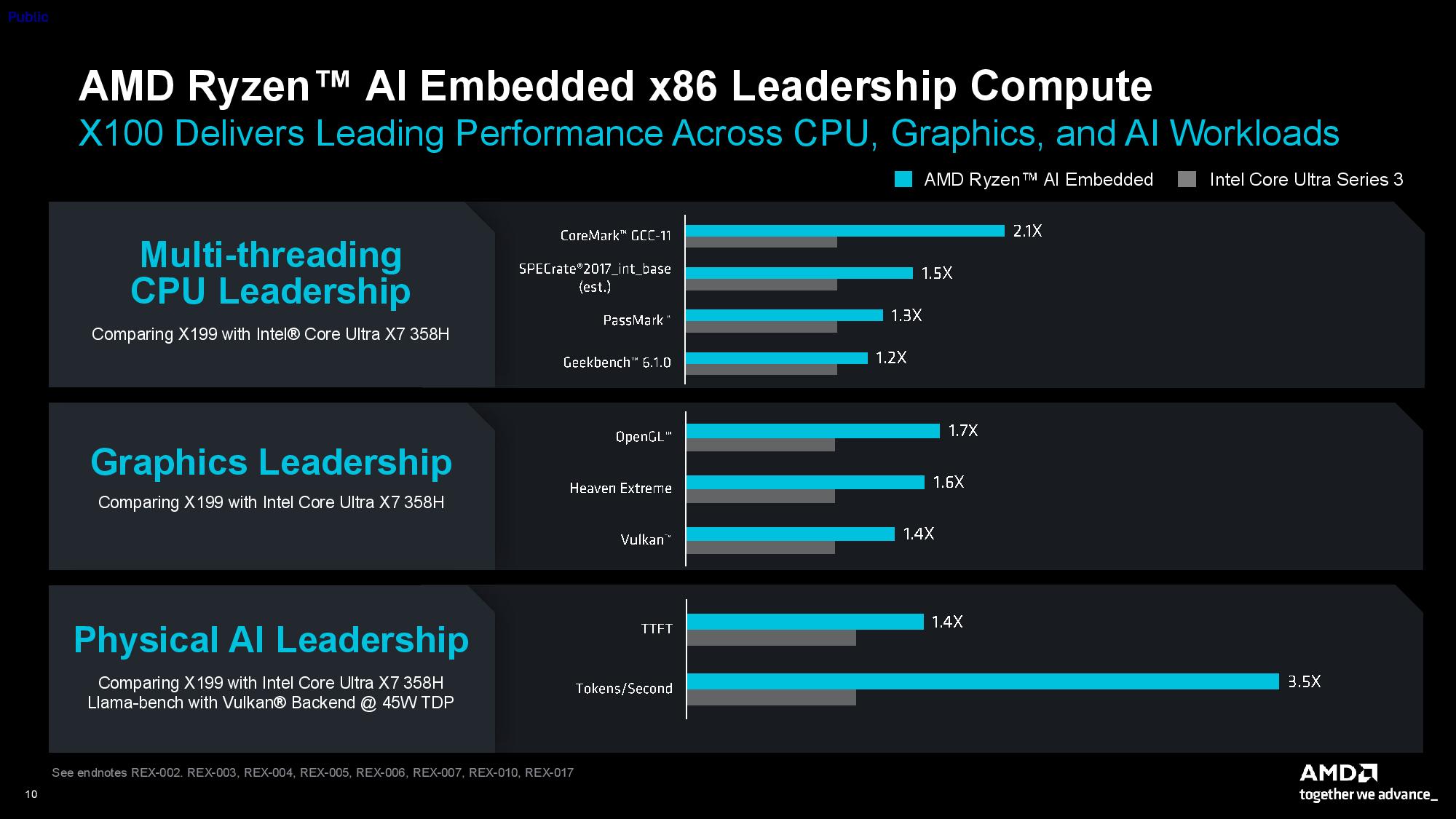
This is a significant methodological issue. Comparing a reference board running at its specified power limit to a laptop chip throttled to a lower TDP, and then extrapolating the competitor’s performance, does not constitute an "apples-to-apples" comparison. The thermal and power delivery systems in a reference board are often optimized for maximum sustained performance, which may not be representative of real-world embedded deployments, let alone a consumer laptop. Such projections introduce a degree of uncertainty and should be independently verified with identical hardware configurations and testing environments.
Versus Nvidia Thor T5000 (Kria Robotics Platform):
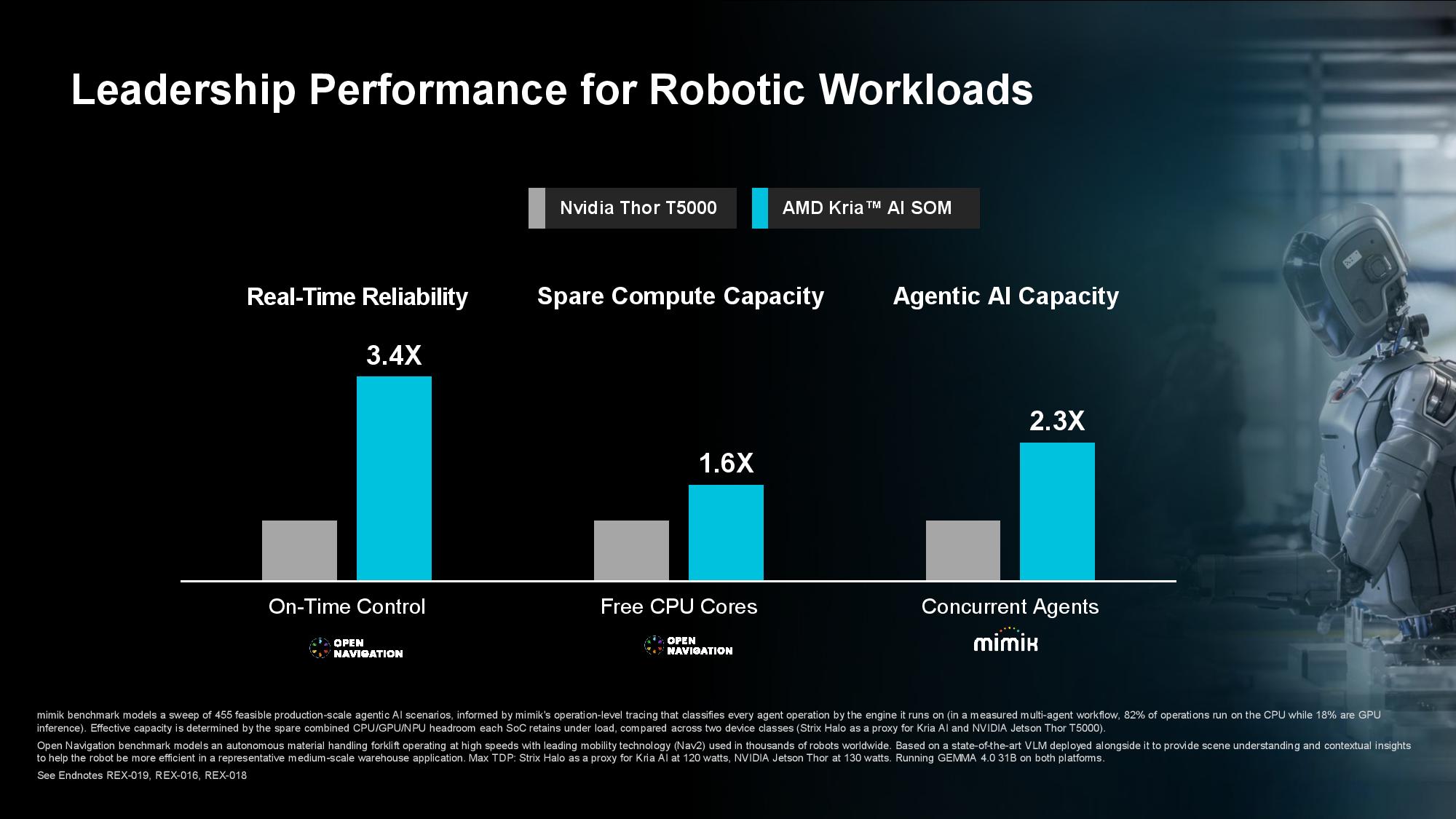
For the Kria platform, AMD commissioned benchmarks by Open Navigation and Mimix, comparing the X100 Kria against Nvidia’s Thor T5000. However, these tests did not use an actual X100 Kria board. Instead, they compared Nvidia’s Jetson AGX Thor developer kit to a GMKtech EVO-X2 AI mini PC housing a Ryzen AI Max+ 395 "configured to reflect Ryzen AI embedded x199 specifications."
Critical Benchmark Analysis (Nvidia Comparison):
Similar to the Intel comparison, this benchmark suffers from a non-direct comparison. A commercial mini PC, even if configured to match chip specifications, operates under different thermal and power constraints than a dedicated developer kit or the final Kria SOM. The Jetson AGX Thor is a highly optimized platform for edge AI, and comparing it to a consumer mini PC with a "configured" chip might not accurately reflect the performance an X100 Kria SOM would achieve in its final form. These results also warrant independent, rigorously controlled validation.
Software Ecosystem:
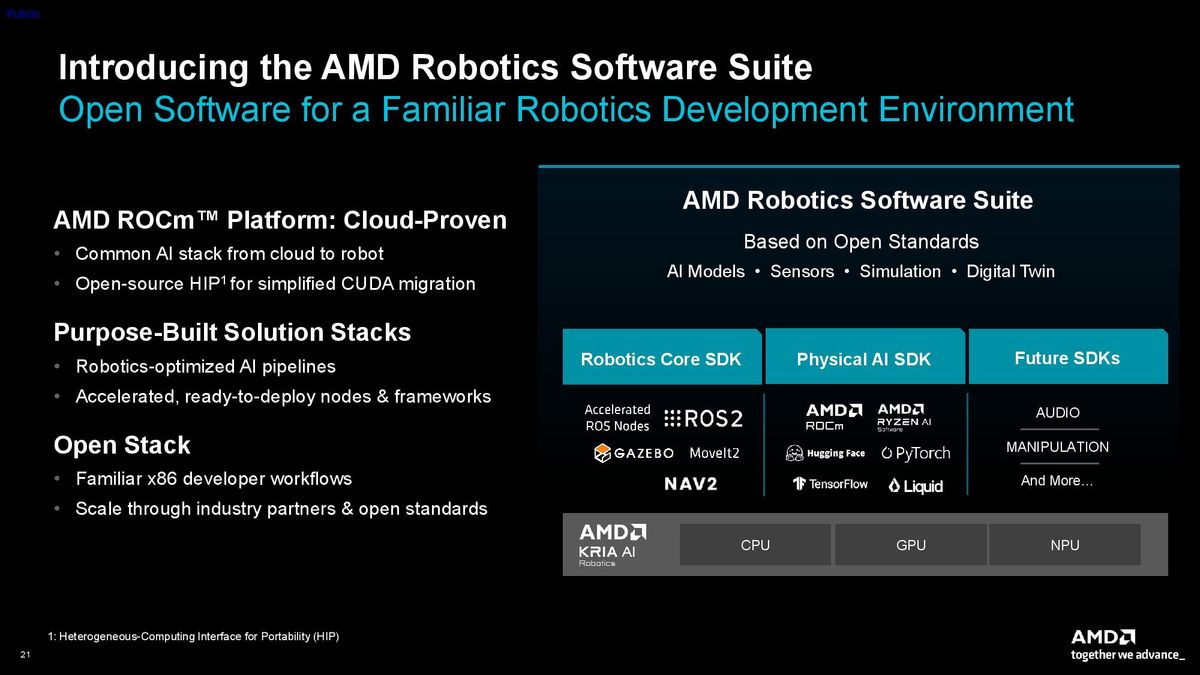
AMD is actively working to ease developer migration from competitor platforms. Its HIPIFY tool is designed to convert CUDA code to AMD’s HIP C++ portable code. AMD claims HIPIFY can handle 70-80% of the porting "effort," based on testing 15 CUDA applications (1,199 lines of code) on a Ryzen AI Max+ 395 configured to match X199 specifications. This is a critical effort, as Nvidia’s CUDA ecosystem has long been a significant barrier to entry for other hardware providers in the AI space. AMD’s broader software stack, including ROCm and Vitis, further supports development for its diverse hardware portfolio.
Official Responses: AMD’s Strategic Vision
AMD’s launch of the X100 series and the Kria robotics platform represents a clear, official statement of intent to aggressively pursue the high-growth embedded AI and robotics market. The company’s messaging emphasizes several key strategic pillars:
- Integrated Performance at the Edge: AMD argues that the integrated SoC approach, combining CPU, GPU, and NPU with unified memory, significantly reduces latency and improves efficiency compared to fragmented architectures. This holistic design is presented as ideal for the real-time processing demands of robotics and autonomous systems.
- Robustness and Longevity: By designing the X100 series for 24/7 operation, extended temperature ranges, and a 10-year lifecycle, AMD is signaling its commitment to meeting the rigorous industrial standards that are non-negotiable for embedded applications. This directly addresses the need for durable, reliable, and long-supported hardware in critical infrastructure.
- Developer Enablement: The introduction of the Kria SOM and the integrated robotics developer platform, along with tools like HIPIFY, showcases AMD’s dedication to building a comprehensive ecosystem. By offering turnkey solutions and facilitating code migration, AMD aims to lower the barrier to entry for developers and accelerate the adoption of its hardware.
- Competitive Challenge: The direct comparison with Intel’s Panther Lake SoCs and Nvidia’s Jetson AGX Thor platforms underscores AMD’s ambition to be a leading player in this space. While the benchmark methodologies require scrutiny, they clearly position AMD as a formidable alternative.
- End-to-End Solutions: AMD envisions the X100 Kria as the "brain" of complex robotic platforms, complemented by its other embedded FPGA and SoC products like Spartan UltraScale+, Zynq UltraScale+, and Versal AI Edge Gen 2. This suggests a strategy to offer a full spectrum of processing solutions, from sensor fusion and real-time control (FPGAs) to high-level AI inference (X100 APUs), enabling truly advanced humanoid-style robots and other intelligent systems.
Implications: Reshaping the Robotics and Embedded AI Landscape
The introduction of the AMD X100 series carries significant implications for several key industries and the broader embedded AI landscape:
1. Acceleration of Edge AI Adoption: The X100 series provides powerful, integrated AI processing capabilities directly at the edge. This is critical for applications where cloud connectivity is intermittent, bandwidth is limited, or latency is unacceptable (e.g., autonomous vehicles, factory robots, medical devices). By enabling more sophisticated AI models to run locally, AMD is contributing to the decentralization of AI and the proliferation of intelligent edge devices.
2. Intensified Competition in Embedded Processors: AMD’s aggressive entry with the X100 series intensifies the competition with Intel and Nvidia, who have also been vying for market share in embedded AI. Intel’s Panther Lake SoCs and Nvidia’s Jetson platforms are well-established, but AMD’s combination of Zen 5, RDNA 3.5, and XDNA 2 on a single chip, coupled with industrial-grade specifications, presents a compelling alternative. This competition is likely to drive innovation, improve performance-per-watt ratios, and potentially lower costs for end-users.
3. Advancements in Robotics and Industrial Automation: Robotics, particularly advanced industrial robots, collaborative robots (cobots), and autonomous mobile robots (AMRs), stand to benefit immensely. The X100’s processing power enables faster, more accurate object recognition, predictive maintenance, real-time path planning, and sophisticated human-robot interaction. The 10-year lifecycle and robust design are essential for industrial environments where equipment operates for decades.
4. Growth of the "Physical AI" Paradigm: The concept of "physical AI" — where AI directly interacts with and manipulates the physical world — is central to AMD’s strategy. This encompasses a wide range of applications from smart factories and logistics to agriculture and defense. The X100 series provides the computational muscle needed for these systems to perceive, reason, and act autonomously and intelligently.
5. Importance of Software Ecosystems: While hardware performance is crucial, the success of the X100 series will heavily depend on the maturity and ease of use of AMD’s software ecosystem. The HIPIFY tool is a good start, but continuous investment in developer tools, libraries, and frameworks (like ROCm, Vitis, and ROS integrations) will be critical to attract and retain developers who have historically gravitated towards Nvidia’s CUDA. A robust and well-supported software stack can significantly reduce development time and accelerate time-to-market for new robotic solutions.
6. Modularity and Standardization with COM-HPC: The adoption of the COM-HPC (Computer-on-Module High Performance Computing) standard for the Kria X100 SOM is a strategic move. This standardization promotes modularity, allowing system designers to easily upgrade or swap out processing units without redesigning the entire baseboard. This flexibility is highly valued in embedded systems, where customization and future-proofing are key considerations.
7. Democratization of Advanced Robotics: By offering a "turnkey" developer platform, AMD aims to democratize access to advanced robotics development. This could enable smaller companies and research institutions to innovate more rapidly, fostering a wider ecosystem of robotics solutions. The integrated FPGA on the developer platform also offers unique opportunities for custom hardware acceleration, critical for highly specialized robotic tasks.
In conclusion, AMD’s X100 series and Kria robotics platform represent a powerful new contender in the embedded AI and robotics space. While the company’s performance claims warrant independent verification, the underlying architecture, robust design philosophy, and commitment to a comprehensive ecosystem position AMD to capture a significant share of this rapidly expanding market. The coming years will reveal how effectively AMD can translate its raw processing power into widespread adoption across the diverse and demanding world of physical AI.

