Main Facts: A Bold New Chapter for the Avatar Franchise
The expansive universe of elemental bending is stepping into uncharted territory. With the release of Avatar: Seven Havens on Paramount Plus, creators Michael Dante DiMartino and Bryan Konietzko—alongside executive producers Ethan Spaulding and Sehaj Sethi—have charted a radically different course for a beloved franchise.
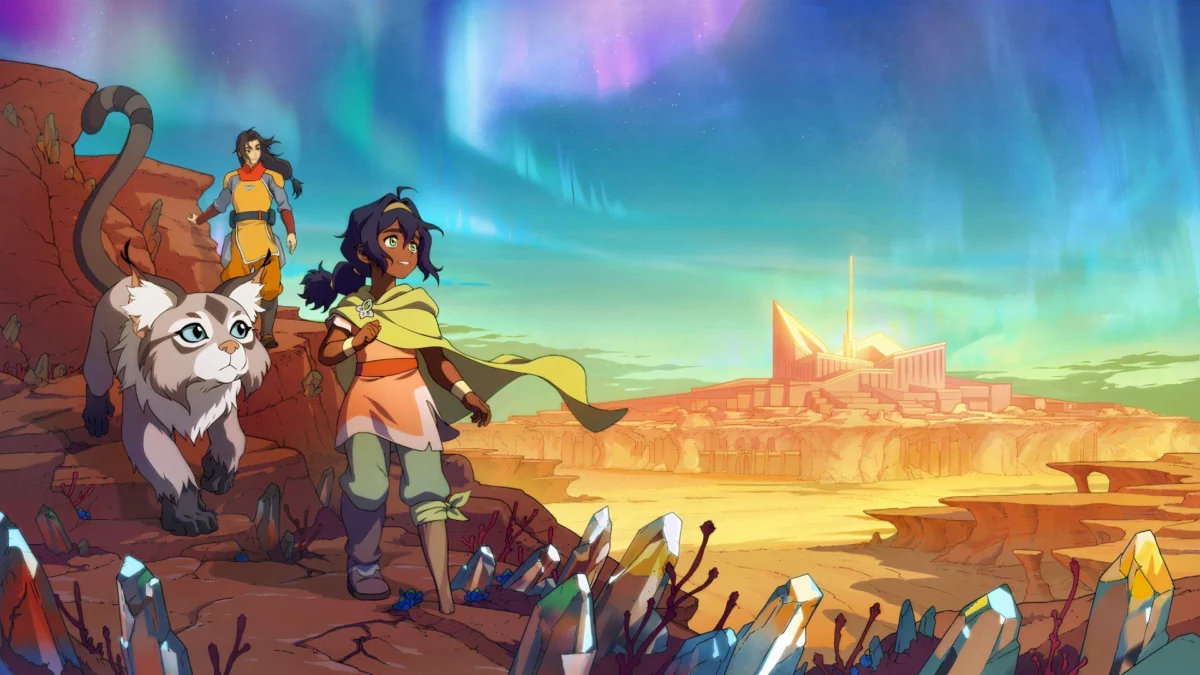
Set in the ruins of a civilization profoundly reshaped by a mysterious and devastating global catastrophe, Seven Havens breaks long-standing traditions. Most notably, the mantle of the Avatar is split for the very first time between twin sisters, Pavi (voiced by Saheli Khan) and Nisha (voiced by Aishu Devan). Together, they must navigate a fragmented post-apocalyptic landscape comprised of seven surviving sanctuaries.
Far from discarding the lore built across Avatar: The Last Airbender and The Legend of Korra, the new series deepens it. The creative team has pivoted its cultural compass firmly toward South Asian architecture, history, and philosophy. This deliberate choice brings foundational elements of the franchise—such as the concept of the Avatar and spiritual chakras—into a more explicit, culturally rich alignment.
Chronology: From 2008 Seeds to NYCC 2026 Premiere
The journey toward Seven Havens spans nearly two decades of conceptualization and evolution behind the scenes at Avatar Studios:
Post-The Last Airbender Era (circa 2008): Following the conclusion of Aang’s foundational story, co-creators Michael Dante DiMartino and Bryan Konietzko initially brainstormed the core seed of a post-apocalyptic world for the franchise. Though premature at the time, the concept of a broken, shattered world stayed with the creators.
Development and Network Pitching: As Avatar Studios sought ways to distinguish a new series from its predecessors, the network challenged the creators to reinvent the formula. The team dusted off their 2008 post-apocalyptic blueprint, coupling it with a significant time jump, an entirely new geography, and the unprecedented hook of twin Avatars.
New York Comic Con (NYCC) 2026: The creative team—including executive producers Ethan Spaulding and Sehaj Sethi—publicly detailed the cultural inspirations, artistic decisions, and thematic DNA driving Avatar: Seven Havens ahead of its premiere.
Present Day:Avatar: Seven Havens is streaming on Paramount Plus, inviting both longtime fans and newcomers to explore how bending evolves when civilization is forced to rebuild from rubble.
Supporting Data: Visuals, Settings, and Cultural Roots
The world of Seven Havens presents a jarring visual departure from the bustling modern metropolises of The Legend of Korra or the sprawling monarchies of The Last Airbender. Concept art and initial episodes reveal a rugged, melancholic environment defined by craggy orange mountains, vast arid deserts, and ominous green storms gathering on the horizon.
The Aesthetic of Decay
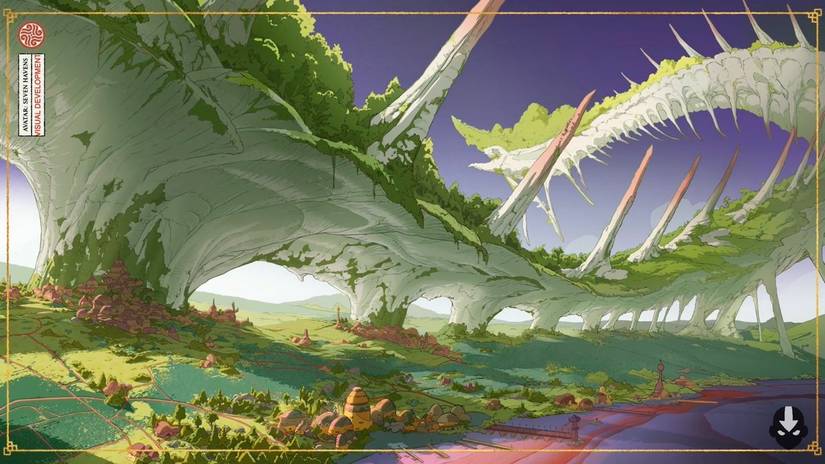
The art direction plays heavily on environmental juxtaposition. In one striking sequence, a colossal white architectural structure covered in thick moss initially appears to be a natural rock formation, only for viewers to realize it houses the skeletonized remains of an ancient, gargantuan creature. The landscape functions as a canvas of discarded remnants from a forgotten age.
Architectural and Historical Inspirations
The series draws deeply from South Asian history to construct its societies, particularly the primary haven of Ellora.
The Real-World Counterpart: Executive producer Sehaj Sethi noted that the name "Ellora" is directly inspired by the real-world Ellora Caves—an ancient underground complex carved directly into the basalt cliffs of the Charanandri Hills in Maharashtra, India.
Multi-Faith Synthesis: Just as the real caves feature overlapping Buddhist, Hindu, and Jain monuments, the fictional haven of Ellora acts as a melting pot. It serves as a sanctuary where bending philosophies, once rigidly segregated by historical nations, have blended together out of sheer necessity for survival.
Official Responses: Insights from the Creative Team
Speaking with press at NYCC 2026, the masterminds behind the bending universe opened up about the creative imperatives, inspirations, and accidental real-world parallels that shaped the show.
Expanding, Not Erasing
Addressing fan anxieties regarding whether the new series would stray too far from established canon, co-creator Michael Dante DiMartino reassured audiences that the series builds upon the past rather than erasing it.
"It’s more just adding to the world than taking anything from the other parts," DiMartino explained. "As we go into the other Havens, we’re gonna see all the different cultures represented."
The Climate Change Parallel
The omnipresent green storms and scenes of total ecological devastation naturally invite comparisons to real-world climate anxiety. However, Bryan Konietzko clarified that the post-apocalyptic premise originated long before contemporary climate discourse reached its current fever pitch, though he acknowledges the inescapable parallels.
"It wasn’t like a ripped out of the headlines, let’s do this. We actually had this kind of post-apocalyptic idea right after the original series," Konietzko said. "So the seeds of this series were from 2008… While it was not the kind of creative impetus, those parallels are impossible to ignore. It’s hard to do something like that without it reflecting what’s going on in our world."
Konietzko further emphasized the moral weight of the setting: "I think it is a worthwhile thing to look at. You can’t take society and civilization for granted, and you can’t take your environment for granted. And choices that humanity makes could have a really irreversible impact on your world."
Honoring South Asian Heritage
Bryan Konietzko and Sehaj Sethi also addressed the deliberate shift toward South Asian cultural integration. Konietzko admitted that past iterations of the franchise underutilized South Asian motifs, despite the very word "Avatar" deriving from Sanskrit.
"That was one of the earliest decisions: Pavi is going to be South Asian coded," Konietzko stated. "And we’re gonna go to a corner of the map that we haven’t spent a lot of time in other stories. The Avatar world is very big, and the Earth Kingdom’s huge. So it gave us a cool opportunity to dig into that stuff more."
Sethi added that because spiritual elements like chakras were integral to Aang’s spiritual awakening in the original series, grounding those concepts in their true cultural home was a vital step forward.
Implications: A New Paradigm for the Bending Universe
The arrival of Avatar: Seven Havens carries massive implications for the future of the franchise. By shifting the narrative away from a single, unburdened hero attempting to restore peace in a functioning world, Seven Havens forces its protagonists—and its audience—to confront the irreversible consequences of historical failure.
Redefining the Avatar’s Role: With Pavi and Nisha sharing the mantle, the psychological and physical toll of being the bridge between worlds is decentralized. The narrative dynamic between twin sisters handling dual spiritual burdens introduces interpersonal friction never before seen in the lineage of past Avatars.
Cultural Maturity: The franchise is signaling a maturation in how it handles global mythology. Moving beyond East Asian and Indigenous inspirations into deep South Asian historical synthesis broadens the cultural literacy of the series, offering a more inclusive sandbox for future storytelling.
The Continuity Question: As the series explores a shattered world, fans are left to piece together how humanity fell from the technological heights of The Legend of Korra to the tribal, sanctuary-based survivalism of Seven Havens. Furthermore, cryptic teasers from DiMartino regarding legacy figures—such as a potential appearance by Avatar Aang—keep the fandom actively speculating about the direct bridges connecting past eras to this grim future.
Ultimately, Avatar: Seven Havens proves that the world of bending is resilient enough to endure its own apocalypse, emerging transformed, haunted, and profoundly renewed.