


Main Facts: The Evolution and Launch of DLSS 5
Nvidia’s highly anticipated and deeply scrutinized DLSS 5 model is slated for release in a matter of days, launching directly alongside the company’s new line of RTX Spark chips and high-end gaming laptops. This new iteration of Nvidia’s neural rendering technology aims to solve the single largest hurdle that accompanied its initial rollout earlier this year: devastating performance overhead.
According to official metrics provided by Nvidia—which independent hardware reviewers will soon put to the test—the updated DLSS 5 model cuts the GPU performance penalty in half compared to the iteration launched in September. Furthermore, the new model introduces a 20% reduction in 4K Video Random Access Memory (VRAM) usage. These substantial efficiency gains were achieved by refining the underlying training datasets and trimming the model size down to approximately 118 million parameters, making it roughly 24% smaller than its predecessor.
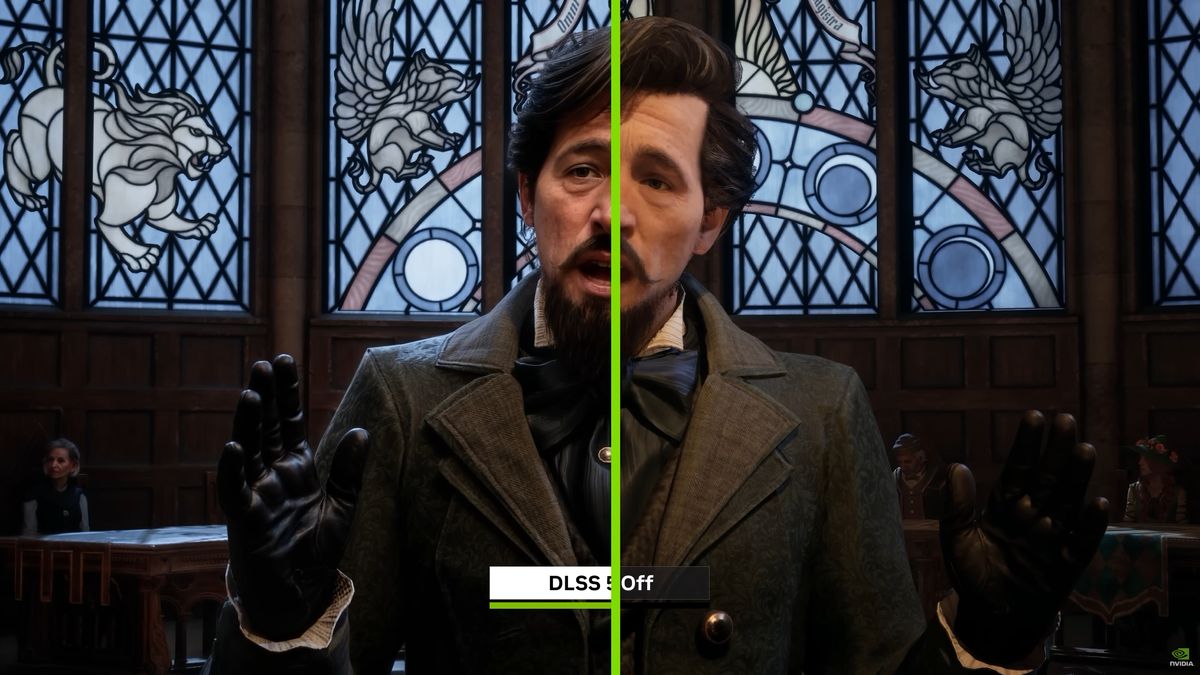
While the reduction in performance cost is a monumental win for the hardware ecosystem, the update also signals a major tactical pivot by game developers. Fearing the negative publicity and internet infamy that plagued early implementations—most notably the strange, hyper-smoothed facial alterations seen in characters like "Grace" during the March reveal—studios are now scaling back neural rendering on character models entirely, restricting DLSS 5 enhancements strictly to environmental lighting, materials, and atmospheric ambience.
Chronology: From the March Reveal to the November 5 Patch
March: The Initial Reveal and Early Backlash
Nvidia first unveiled DLSS 5 with grand ambitions, showcasing its neural rendering capabilities across several upcoming titles, including NBA 2K27, Resident Evil Requiem, and Hogwarts Legacy. However, the reveal was immediately overshadowed by bizarre visual artifacts on character models. Social media quickly seized upon these unintended aesthetic changes, dubbing the phenomenon "yassified" character smoothing. The severe visual critiques caused widespread hesitation among developers, leading to a noticeable delay in official DLSS 5 updates across most showcased titles.

September: The Feature Goes Wild
The technology officially hit the market with the launch of NBA 2K27. Enthusiasts quickly found ways to force DLSS 5 into nearly any compatible PC game using modding tools and workarounds. While the technical achievement of neural-rendering entire scenes on the fly was staggering, the real-world cost quickly became apparent. Early testing on high-end hardware like the RTX 5080 revealed performance drops as steep as 60% to 73% in games like NBA 2K27, rendering the feature impractical for all but the most extreme mega-rigs.
October: Developer Alignment and Model Optimization
Behind closed doors at recent hardware and developer events, Nvidia worked closely with studios to address the glaring performance bottlenecks. Recognizing that a 60% frame rate tax was unsustainable, Nvidia’s engineering teams finalized a streamlined model with a reduced parameter footprint, cutting the expected performance hit down to a much more palatable 30%. Concurrently, developers reviewed their asset pipelines, deciding to mask off character faces from the neural network to prevent a repeat of the March PR nightmare.
November 5: The Hogwarts Legacy Rollout
The newly optimized DLSS 5 model officially debuts on November 5, anchored by a massive update for Warner Bros.’ Hogwarts Legacy. Side-by-side comparisons released by Nvidia confirm that while the world lighting, stone textures, and global illumination receive a dramatic next-generation polish, character facial features remain entirely untouched, proving that developers have learned hard lessons from the technology’s rocky debut.
Supporting Data: Breaking Down the Metrics
To understand why the computing industry is closely monitoring the DLSS 5 update, one must examine the raw technical data provided by Nvidia and verified by early developer briefings:

- Performance Overhead Reduction: The initial September release imposed up to a 60% performance tax in titles like NBA 2K27. The new DLSS 5 model halves this impact, reducing the performance penalty to roughly 30%.
- Model Size and Footprint: By refining training data and optimizing algorithms, Nvidia reduced the parameter count to approximately 118 million parameters—a 24% reduction in overall model size.
- VRAM Efficiency: Alongside raw GPU cycles, the updated model yields a 20% reduction in 4K VRAM consumption, easing memory bandwidth pressures on high-resolution setups.
- Hardware Pairing: The launch of the refined DLSS 5 model coincides directly with the release of the RTX Spark chip series, which powers a new generation of expensive, high-performance gaming laptops designed to shoulder modern AI rendering workloads.
Official Responses and Developer Strategy
The rollout of DLSS 5 has forced a fascinating dialogue between hardware manufacturers and game developers. At its core, Nvidia’s marketing pitch has always centered on the future of neural rendering—the idea that AI can eventually supplement or replace traditional rasterization and ray tracing pipelines entirely.
However, the reality of game development requires pragmatism. Speaking with developers at recent industry showcases, it became clear that the immediate community backlash over altered character models fundamentally shifted how studios approach AI graphics integrations.
When DLSS 5 was first showcased in March, the technology attempted to globally process everything on screen, including complex human skin shaders, hair strands, and facial expressions. The result was uncanny valley territory. With the upcoming Hogwarts Legacy patch, and the forthcoming implementation in action-RPG Where Winds Meet (which has been confirmed for support "in the near future"), developers are taking a much more surgical approach.
By applying DLSS 5 exclusively to environmental lighting and material physics—where small AI-induced variances read as natural imperfections rather than creepy visual bugs—studios are successfully harnessing the performance and visual fidelity boosts of neural rendering while completely bypassing the "beauty filter" controversy that derailed the feature’s initial public reception.

Implications for the Future of PC Gaming Hardware
The refinement of DLSS 5 carries profound implications for the PC hardware market, particularly as gamers grapple with skyrocketing component costs and demanding system requirements.
1. The Viability of AI Rendering on Mid-to-High-End Rigs
When DLSS 5 launched with a 60% performance deficit, it created a paradoxical situation: gamers needed top-tier hardware to run the feature, yet enabling the feature crippled that very hardware to the point of unplayability. By cutting the performance tax down to 30%, Nvidia has made neural rendering a viable option for a much broader segment of the PC enthusiast community. In games like NBA 2K27, where the camera remains heavily zoomed out and players focus on structural court dynamics, a 30% performance cost is easily justified by the sheer leap in ambient lighting quality.
2. Shifts in Laptop Engineering and Pricing
The simultaneous launch of the RTX Spark chip architectures highlights Nvidia’s push to integrate localized AI acceleration directly into mobile form factors. As gaming laptops continue to grapple with thermal limits and power consumption constraints, reducing model footprints—such as DLSS 5’s 24% reduction in parameters—is vital. Smaller models require less silicon overhead and consume less power, making advanced AI rendering features feasible within the restrictive thermal envelopes of modern portable rigs. However, with the steep pricing attached to these new RTX Spark laptops, consumers will undoubtedly demand that features like DLSS 5 deliver tangible, frictionless visual upgrades without trade-offs.
3. A Cautious Industry Approach to Generative Tech
The overarching narrative of the DLSS 5 saga is a masterclass in the friction between technological ambition and artistic integrity. Developers have shown that while they are eager to leverage AI tools to enhance static game worlds, they remain fiercely protective of their character art direction. The decision to quarantine neural rendering away from human faces reflects a maturing industry standard: AI is welcomed as a powerful tool for world-building and lighting simulation, but human expression remains best left in the hands of traditional artistic pipelines.
As independent reviewers put the new DLSS 5 model through its paces following its imminent November 5 release, the PC gaming community will soon discover whether Nvidia has truly struck the elusive balance between bleeding-edge AI innovation and practical, real-world playability.

