


Main Facts
The intersection of wearable technology and mental wellness has entered a fascinating new phase with the introduction of Liminal: Walking Meditation. Developed by Liminal—a company widely recognized for its virtual reality applications centered around emotional states like calm, focus, and energy—this innovative new software marks the studio’s strategic expansion beyond closed headset ecosystems and directly into augmented smartglasses.
Revealed during the Developer State of the Union at Meta Connect 2026, Walking Meditation is an advanced application built using Meta’s Device Access Toolkit. Designed specifically for hardware like the Ray-Ban Meta glasses, the app utilizes the device’s integrated camera to capture real-time snapshots of the user’s immediate environment. These visual inputs are processed instantaneously to generate a dynamic, spoken meditation session tailored entirely to what the user is seeing as they walk through their neighborhood, park, or city streets.
Slated for an official release in October on both iOS and Android, the application will be offered via a subscription model priced at $9.99 per month or $99.99 annually. This subscription tier grants users 30 contextual, AI-driven walks per month, alongside unlimited access to traditional, offline scripted versions of each meditation theme. Rather than isolating users from the physical world—as traditional VR headsets often do—Walking Meditation leverages ambient computing to anchor individuals more deeply into their immediate physical reality.
Chronology
The genesis of Liminal: Walking Meditation traces back to the company’s foundational work in virtual reality, where co-founders Damian Moratti and Tin Nguyen spent years exploring how immersive digital environments could systematically influence human emotion. While the original Liminal VR application on Meta Quest specialized in total sensory substitution—transporting users to serene digital landscapes to escape the friction of daily life—the leadership team eventually began questioning how immersive design principles could be applied outward, enhancing the real world rather than replacing it.
The pivot toward smartglasses accelerated following the maturation of edge-AI processing and Meta’s release of the Device Access Toolkit. Early architectural and conceptual development began internally as the team experimented with how wearable cameras could interact with generative AI models.
By mid-2026, the company had entered rigorous closed-beta testing. Early iterations of the software offered valuable, albeit humorous, lessons in machine learning and environmental filtering. In initial prototypes, the AI lacked discernment regarding what constituted meaningful scenery; early builds notoriously obsessed over mundane objects, such as pointing out the user’s curbside garbage cans up to eight times during a single stroll, or generating enthusiastic, unintended narratives about glowing neon signs in commercial windows.

Recognizing these edge cases, Liminal refined the app’s cadence. Instead of relying on a resource-heavy, continuous photo stream, engineers programmed the system to capture distinct, intermittent snapshots of the scene as the user progressed. This chronological refinement culminated in the pre-release builds tested ahead of Meta Connect 2026, setting the stage for its commercial rollout in October.
Supporting Data and Technical Architecture
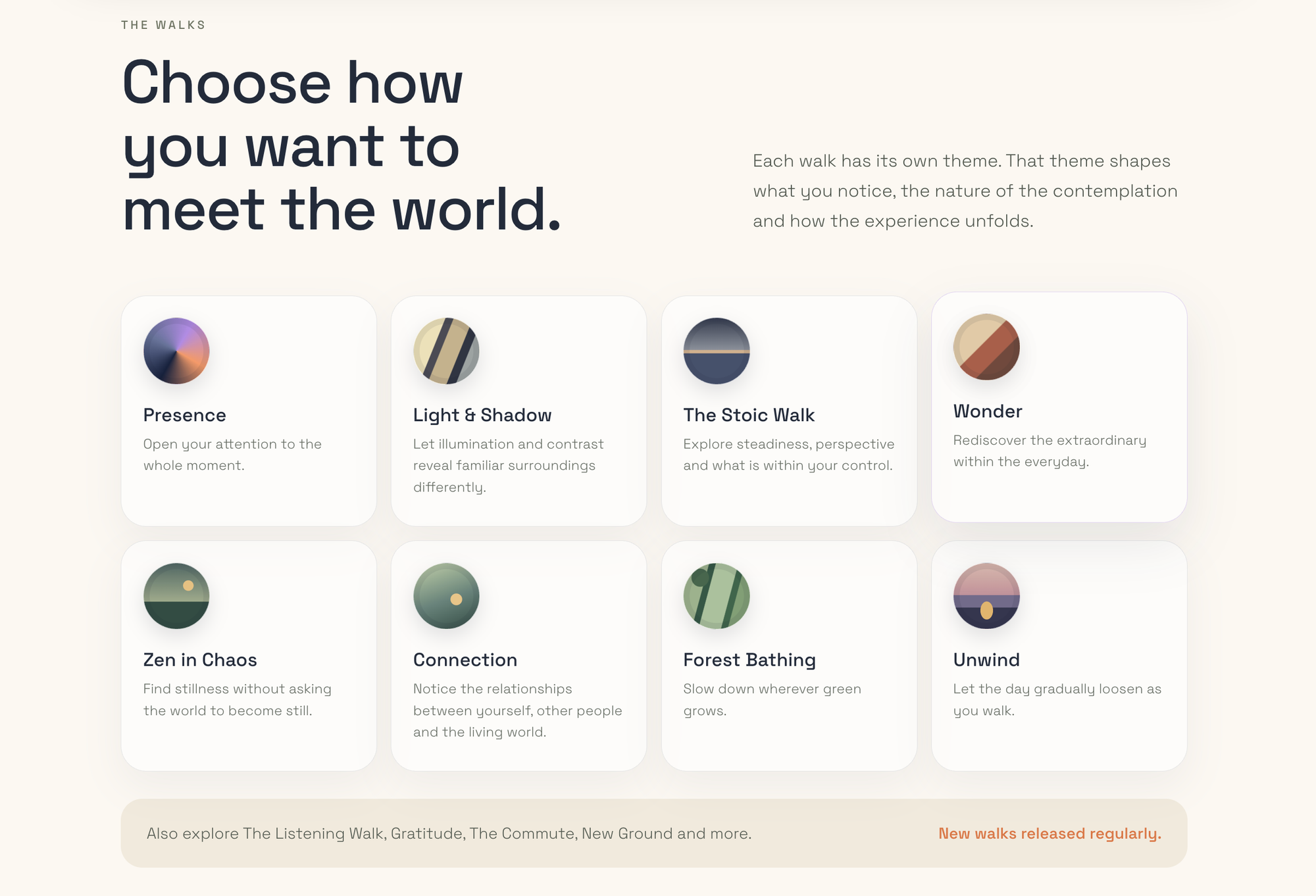
At its core, Liminal: Walking Meditation is a masterclass in balancing ambient technology with cognitive calm. Upon launching the companion smartphone app—which pairs directly with the Meta AI glasses during initial setup—users can customize their experience by selecting from twelve distinct meditation themes, eight voice options, and three pacing settings.
According to CTO Tin Nguyen, the pacing setting does far more than alter the temporal gaps between spoken sentences. It actively dictates the volume of narration and the structural length of the session. The shortest guided walks are engineered to last between 10 and 13 minutes, providing an accessible window for daily mental health routines.
The technical framework powering the experience relies on a strict zero-data-retention architecture. When the application requires contextual understanding of an environment, an image captured by the glasses is funneled through the smartphone to an external AI processing pipeline. Liminal currently utilizes Google Gemini for this image-to-text contextualization, with zero data retention protocols strictly enforced. Once the AI generates the relevant descriptive cues for the meditation, the temporary image file is permanently discarded.
Furthermore, Liminal made a definitive privacy-first architectural choice: the app requests zero access to the user’s microphone. This guarantees that private conversations held during or around the meditation session are never recorded, eavesdropped upon, or utilized as prompts for the AI model.
Official Responses and Creator Insights
The philosophy driving Liminal: Walking Meditation stems from a desire to redefine the utility of everyday wearable tech. In interviews detailing the software’s launch, Liminal Co-founder and CEO Damian Moratti emphasized that the company evaluated smartglasses through a singular lens: What can this technology genuinely add to human experience?
"Liminal has always used VR to create strong emotional responses through immersion," Moratti explained. "Smartglasses gave the team a chance to apply some of that thinking while keeping people engaged with the real world as well."
Addressing the technical hurdles of turning raw visual data into a peaceful mental health exercise, CTO Tin Nguyen noted that the design philosophy deliberately avoids overwhelming the user. "It’s more like single moments in time rather than a continuous photo stream," Nguyen said, describing how the app drops deliberate, well-spaced moments of silence between observations. This prevents cognitive overload and ensures that when a descriptive prompt arrives—such as noting the amber glow of a streetlight against a night sky or the way trimmed grass meets a concrete pavement—its emotional impact hits with resonant clarity.
Safety was another critical vector addressed during official development. Liminal made the conscious decision to deliberately exclude navigation, route guidance, or hazard-warning capabilities from the app. While the team initially weighed the feasibility of alerting users to physical street hazards, Moratti noted that building a reliable hazard-detection system proved counterproductive to the primary goal of the app. By completely divorcing the meditation software from navigational obligations, Liminal ensures that users remain focused entirely on mindful presence rather than turn-by-turn directions.
Implications for the Future of Wearable Wellness
The arrival of Liminal: Walking Meditation points toward a broader, more mature evolution in the smartglasses market. For years, the value proposition of camera-equipped glasses centered primarily on quick capture capabilities, hands-free media streaming, and rudimentary conversational AI assistants. By integrating targeted mental wellness applications, developers are unlocking entirely new dimensions of practical utility for everyday eyewear.
For users accustomed to standard mindfulness apps tethered exclusively to earbuds, the integration of real-time environmental context fundamentally alters the psychological texture of the practice. Instead of closing one’s eyes in a quiet room or listening to generic nature tracks while walking past urban construction sites, the user’s actual surroundings—the shifting shadows of trees, the architecture of neighboring homes, the fading light of dusk—are woven directly into the narrative framework of the meditation.
As hardware ecosystems like Meta’s Ray-Ban line continue to evolve, software solutions like Liminal demonstrate that spatial computing does not require fully enclosed, head-mounted virtual reality displays to be transformative. By anchoring cutting-edge generative AI to the gentle rhythm of a human footstep, Liminal is pioneering a future where technology doesn’t pull us away from the physical world, but rather helps us see—and appreciate—it with fresh eyes.

