

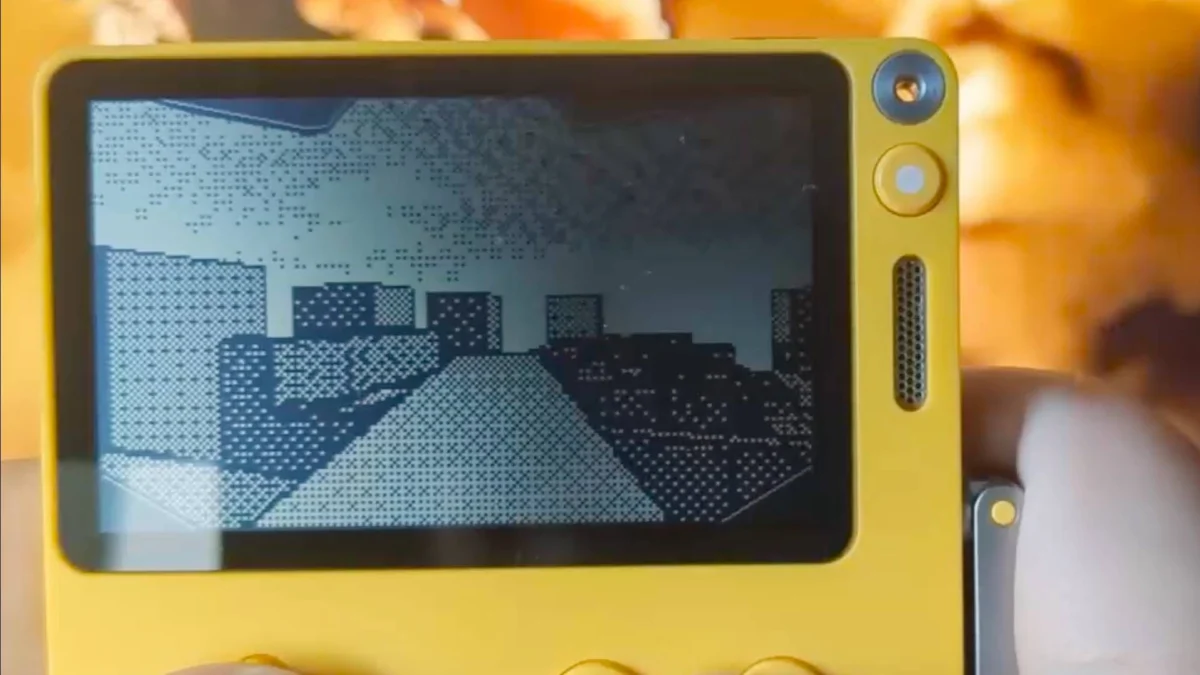
The Playdate, a diminutive, bright yellow handheld from Panic, has carved out a unique niche in the gaming world. Defined by its 1-bit monochrome screen, its tactile crank, and its commitment to low-fidelity indie charm, the device was never intended to be a powerhouse of three-dimensional graphics. However, the history of computing is defined by developers who refuse to accept "no" as an answer.
Developer Cristina Ramos, working under the moniker Saffroncr, has recently captured the attention of the gaming community by unveiling Katavatis, a first-person "Metroidbrainia" that brings 3D exploration and Mirror’s Edge-inspired parkour to the low-spec portable. By developing a custom "tiny" 3D renderer from the ground up, Ramos has not only expanded the technical vocabulary of the Playdate but has also challenged the perceived limitations of ARM-based micro-consoles.
Main Facts: The Breakthrough of Katavatis
At its core, Katavatis is an ambitious departure from the typical 2D side-scrollers and top-down puzzlers that populate the Playdate’s "Season" of games. It is a first-person exploration title that utilizes a custom-built engine to render 3D environments on a screen that officially only supports black and white pixels.
The project is significant for three primary reasons:
- Technical Innovation: The game runs on a bespoke 3D renderer designed to squeeze every ounce of performance out of the Playdate’s modest hardware.
- Genre Blending: Ramos describes the game as a "Metroidbrainia," a subgenre that combines the non-linear exploration of a Metroidvania with the knowledge-based progression of games like Outer Wilds or The Witness.
- Aesthetic Ambition: The game features outdoor cityscape platforming that draws direct inspiration from DICE’s Mirror’s Edge, translating the high-speed, vertical movement of a AAA title into a 1-bit, handheld format.
While Katavatis is being developed specifically with the Playdate in mind, the developer has also confirmed that the title will be coming to Steam and Itchio, ensuring that its unique aesthetic can be appreciated by a wider audience.
Chronology: From Skepticism to Proof of Concept
The development of Katavatis began not just as a game project, but as a technical challenge born of defiance. The Playdate community has long debated the feasibility of 3D graphics on the device. While some early experiments existed, the general consensus was that the hardware lacked the necessary "oomph" for complex, navigable 3D environments.
The Initial Challenge
The project’s timeline is punctuated by milestones of "proving the doubters wrong." In her initial communications on social media platforms like Bluesky, Ramos noted that she was frequently told that 3D was impossible on the Playdate. This skepticism served as the primary catalyst for the development of the custom renderer.
The Mirror’s Edge Milestone
Once a basic 3D framework was established, the next hurdle was environmental complexity. Navigating a boxy corridor is one thing; navigating an expansive, vertical cityscape is another. Ramos’s recent footage demonstrates "exterior" levels featuring rooftops and skyscrapers. By successfully implementing these scenes, she demonstrated that the renderer could handle distant draw distances and complex geometry without crashing the system’s limited memory.
The "Can It Run DOOM?" Test
In keeping with the long-standing tradition of software engineering, Ramos eventually used her renderer to run a version of DOOM. This served as a benchmark for the engine’s speed and efficiency. The successful port of the 1993 classic to the Playdate via her custom engine proved that the renderer was robust enough for real-time, fast-paced action.
Supporting Data: The Technical Constraints of the Playdate
To understand the magnitude of Ramos’s achievement, one must look at the technical specifications of the Playdate. The device was designed for simplicity and battery longevity, not polygons.
Hardware Specifications
- Processor: The Playdate is powered by an ARM Cortex-M7 chipset. This is a high-performance microcontroller, but it is still a microcontroller—typically found in embedded systems or high-end appliances, not gaming consoles.
- Memory: The device features only 16 MB of RAM. For comparison, the original PlayStation (1994) had 2 MB of main RAM and 1 MB of VRAM, but it possessed dedicated hardware for geometry transformation and rasterization. The Playdate has no dedicated GPU.
- Display: A Sharp Memory LCD with a resolution of 400×240. The screen is strictly 1-bit; there are no shades of gray, only black or white.
The Rendering Challenge
Because the Playdate lacks a GPU, every pixel must be calculated by the CPU. In a 3D environment, this involves complex trigonometry to project 3D coordinates onto a 2D plane, followed by rasterization (filling in the shapes).
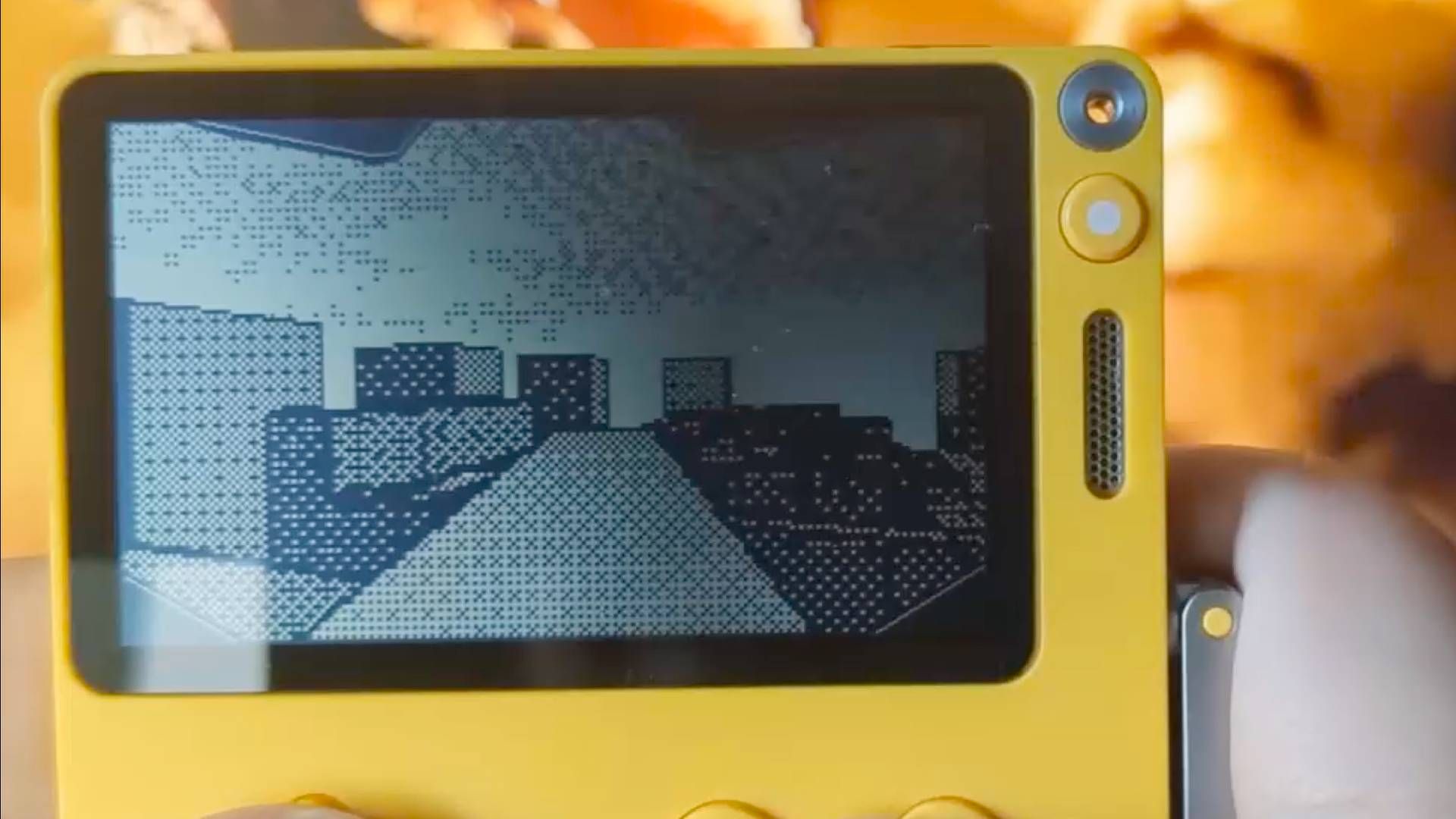
Ramos’s devlogs on Itchio provide a deep dive into how she overcame these hurdles. She describes the results as being roughly equivalent to the performance of a 3DO or a Sega Saturn—consoles that, while primitive by today’s standards, were the cutting edge of the mid-90s. Achieving this on a device with a fraction of the power consumption and no specialized video hardware is a feat of extreme optimization. To simulate depth and shading on a 1-bit screen, the renderer likely employs advanced dithering techniques, where patterns of black and white dots create the illusion of gray gradients.
Official Responses and Developer Commentary
The developer’s public updates have been characterized by a mix of technical transparency and a "punk-rock" attitude toward hardware limitations.
Defying the "Hoax"
In a notable Bluesky post, Ramos stated: "I was told you couldn’t do 3D on the Playdate, so I did it. Then I was told there was no way I could create exterior levels like those in Mirror’s Edge, so I proved them wrong again."
This defiance is mirrored in the game’s narrative themes. The "back of the box" synopsis for Katavatis includes the line "they told us climate change is a hoax," suggesting a thematic link between the skepticism Ramos faced as a developer and the denialism faced by scientists in the game’s apocalyptic setting.
The "Metroidbrainia" Philosophy
Ramos has been vocal about the design philosophy of Katavatis. Unlike traditional Metroidvanias where progress is gated by physical tools (like a double jump or a hookshot), a "Metroidbrainia" gates progress through the player’s understanding of the world. By placing this cerebral gameplay inside a 3D, first-person perspective, Ramos is attempting to create a sense of immersion that is rare in the 1-bit space.
Implications: A New Era for Low-Spec Development
The success of the Katavatis renderer has broader implications for the indie development community and the lifecycle of the Playdate itself.
Expanding the Playdate Library
For much of its first two years, the Playdate was seen as a "toy" for clever 2D experiments. Ramos has effectively shifted the goalposts. By proving that 3D is viable, she has opened the door for other developers to explore genres previously thought to be off-limits, such as first-person shooters, flight simulators, or complex 3D puzzle games.
The Rise of "Constraint-Based" Creativity
The project highlights a growing trend in the gaming industry: the embrace of extreme constraints. Much like the "Pico-8" fantasy console movement, the Playdate forces developers to prioritize clever engineering and strong art direction over raw graphical fidelity. Ramos’s work demonstrates that these constraints can actually drive innovation, forcing a developer to write a more efficient renderer than they might have for a more powerful system.
Educational Value
Ramos’s documentation of her journey—detailing the math behind 3D projections and the struggle of memory management—serves as a masterclass for aspiring engine developers. In an era where game development is often abstracted behind massive engines like Unity or Unreal, Katavatis is a reminder of the "bottom-up" approach to game design, where the software is built in perfect harmony with the silicon.
Future Outlook
As Katavatis nears a playable state, the anticipation within the Playdate community continues to build. Whether the game is played on the yellow handheld or via Steam, it stands as a testament to the idea that hardware is only as limited as the imagination of the person coding for it. The deep-sea facilities and monochrome skyscrapers of Katavatis are not just a game; they are a technical manifesto, proving that even in a 1-bit world, there is plenty of room for three dimensions.
As Katavatis prepares for its eventual launch on the Playdate Catalog, Steam, and Itchio, it remains one of the most technically significant projects in the history of the handheld. For those who enjoy the intersection of retro aesthetics and modern engineering, Cristina Ramos’s journey is one to watch closely.

