

A groundbreaking achievement by the hardware enthusiast community has shattered previous limitations, providing unprecedented access to the intricate thermal landscape of Nvidia’s latest GeForce RTX 50-series (Blackwell) graphics cards. Users can now monitor individual memory module temperatures alongside the recently exposed GPU hotspot sensor, marking a significant leap forward in user control, diagnostic capability, and performance optimization for some of the most powerful graphics cards available on the market.
For years, a certain mystique has surrounded the internal workings of high-performance graphics processing units (GPUs). While core GPU temperatures and general memory junction temperatures have been readily accessible, granular data on individual memory modules and the critical GPU hotspot remained largely guarded by manufacturers. This veil of secrecy has been lifted through the persistent efforts of skilled modders and community collaborators, spearheaded by Overclock.net (OCN) member asder00. Their collective ingenuity has paved the way for a new era of thermal transparency, empowering users with the detailed insights needed to truly master their hardware.
This development is particularly relevant given the increasing power demands and thermal complexities of modern GPUs, especially within Nvidia’s cutting-edge Blackwell architecture and its predecessors. As graphics cards push the boundaries of performance, managing heat efficiently becomes paramount for stability, longevity, and achieving peak clock speeds. The newfound ability to pinpoint thermal inconsistencies at a per-module level transforms the landscape for enthusiasts, overclockers, and even average users seeking to understand and safeguard their significant hardware investments.
The Genesis of Transparency: Unlocking Hidden Thermal Data
The core of this breakthrough lies in the community’s ability to circumvent Nvidia’s intentional restrictions on certain sensor readings within its programming interface. Nvidia provides direct access to its graphics cards and drivers through the Nvidia API (NVAPI), a powerful tool primarily designed for game and software developers. NVAPI allows developers to harness a wide array of advanced features, from graphics rendering optimizations to real-time performance and thermal data retrieval. Monitoring tools, in particular, heavily rely on NVAPI to deliver the crucial statistics that users depend on to track their GPU’s health and performance.
However, not all data points within NVAPI are created equal. Nvidia, for various reasons including proprietary information protection and potentially simplifying the API for broader developer use, has historically kept specific sensor readings hidden from public-facing developers and, consequently, from most third-party monitoring software. These "hidden" sensors often include highly granular thermal data, such as the exact temperature of individual memory chips or the hottest point on the GPU die (the "hotspot"). This withholding of data has long been a point of contention and curiosity within the enthusiast community, driving a persistent quest to unlock these elusive metrics.
The community’s success in accessing these previously inaccessible sensors is a testament to their dedication and collaborative spirit. It represents a significant step beyond standard monitoring capabilities, moving from a generalized overview to a microscopic examination of a GPU’s thermal behavior. This granular control is especially vital for the high-end GPUs like the GeForce RTX 50-series, which often feature advanced cooling solutions and are pushed to their limits by demanding applications and games.
A Chronicle of Community Ingenuity: From NVAPI to Hotspot.dll
The journey to this level of thermal transparency has been a progressive one, built on earlier successes and the continuous exploration of Nvidia’s software interfaces.
Nvidia’s NVAPI: A Double-Edged Sword
NVAPI serves as Nvidia’s official gateway for software to interact with its hardware. For game developers, it enables specific optimizations like DLSS, Reflex, and advanced ray tracing features. For utility developers, it provides hooks to read telemetry data such as GPU utilization, clock speeds, fan speeds, and core temperatures. However, Nvidia maintains tight control over which specific sensor data is exposed through NVAPI for public consumption. This control is often cited as a measure to protect intellectual property, prevent potential misuse of data, or simply to streamline the API for its primary developer audience.

This selective exposure created a "walled garden" effect, where certain critical data points, particularly those that could reveal minute thermal inefficiencies or provide an edge in competitive overclocking, remained out of reach for general users and most monitoring applications. The enthusiast community, however, views such data as essential for truly understanding, optimizing, and troubleshooting their hardware.
The Precedent: Unveiling the Hotspot Sensor
The current breakthrough for individual memory module monitoring stands on the shoulders of a prior significant achievement: gaining access to the GPU hotspot sensor. The hotspot temperature represents the single hottest point on the GPU die, which can often be significantly higher than the average GPU core temperature. This metric is crucial because it often dictates when a GPU begins to thermally throttle, reducing performance to prevent damage.
Initially, this hotspot data was only accessible via Nvidia’s internal diagnostic tools, such as MODS (Module-Oriented Diagnostic System). This meant that while Nvidia engineers could precisely diagnose thermal issues, end-users were left to infer problems from more generalized temperature readings. Resourceful modders eventually found methods to tap into this hidden sensor, often through reverse engineering or exploiting overlooked pathways in driver communication. Once discovered, this information was rapidly integrated into popular third-party monitoring tools like HWiNFO and AIDA64, providing users with a vital piece of the thermal puzzle they previously lacked. The exposure of the hotspot sensor set a powerful precedent, demonstrating that with enough collective effort and technical prowess, the community could indeed break through Nvidia’s safeguards.
The Latest Breakthrough: Per-Module Memory Monitoring
Building on this legacy of community-driven discovery, the focus shifted to the memory modules themselves. Modern GPUs, especially high-end models, feature numerous high-speed GDDR (Graphics Double Data Rate) memory chips that generate substantial heat. While a "memory junction temperature" typically provides an average reading for all memory, it doesn’t reveal if a single module or a cluster of modules is running significantly hotter than the others, potentially indicating poor thermal paste application, an inefficient cooling pad, or a defect.
This is where OCN member asder00 entered the scene, developing the plugin aptly named Hotspot.dll. This plugin is the direct result of a collaborative effort involving several prominent figures in the hardware modding and software development communities. Key contributors include:
- Alexey "Unwinder" Nicolaychuk: The renowned developer behind MSI Afterburner, one of the most widely used and respected GPU monitoring and overclocking utilities. His expertise was crucial in understanding how to integrate such a plugin into a sophisticated application.
- Olealgoritme: Known for his work on the open-source Linux GDDR6/GDDR6X temperature reader, which likely provided foundational insights into how memory module temperature data could be extracted.
- Paulo Gomes: A respected Brazilian hardware modder whose practical experience and deep understanding of GPU hardware undoubtedly contributed to the effort.
- Martin "Mumak" Malík: The creator of HWiNFO, another indispensable tool for hardware monitoring. His work would have been instrumental in validating the data and exploring direct integration pathways.
This synergistic collaboration underscores the power of a dedicated community united by a common goal: unlocking deeper insights into their hardware. The Hotspot.dll plugin specifically targets MSI Afterburner because, as an Nvidia partner, MSI cannot legally poll sensor data not officially exposed through NVAPI without an intermediary solution. The plugin acts as that intermediary, translating the raw, hidden sensor data into a format Afterburner can display.
Deep Dive into the Data: Tools, Compatibility, and Technical Significance
The new Hotspot.dll plugin and the direct integration into other monitoring software offer a wealth of previously inaccessible thermal data, providing a comprehensive overview of a GPU’s thermal state.
Hotspot.dll: Bridging the Gap for MSI Afterburner
For users of MSI Afterburner, Hotspot.dll is the key to unlocking these new metrics. The plugin works by tapping into the same hidden data streams that asder00 and his collaborators identified. Because MSI, as an Nvidia partner, must adhere to certain agreements regarding NVAPI usage, Afterburner itself cannot directly implement the polling of these unofficial sensors without potentially violating those terms. The plugin elegantly bypasses this by providing the functionality externally, feeding the data to Afterburner, which then processes and displays it. This allows Afterburner users to benefit from the enhanced monitoring capabilities without MSI officially endorsing or integrating "unauthorized" NVAPI calls.

HWiNFO and AIDA64: Direct Integration and Comprehensive Reporting
Unlike MSI Afterburner, which operates under partnership constraints, independent third-party software solutions such as AIDA64 and HWiNFO are not bound by the same agreements with Nvidia. This freedom allows them to integrate the newly discovered sensor polling methods directly into their applications. The speed at which this has been adopted highlights the importance of this data.
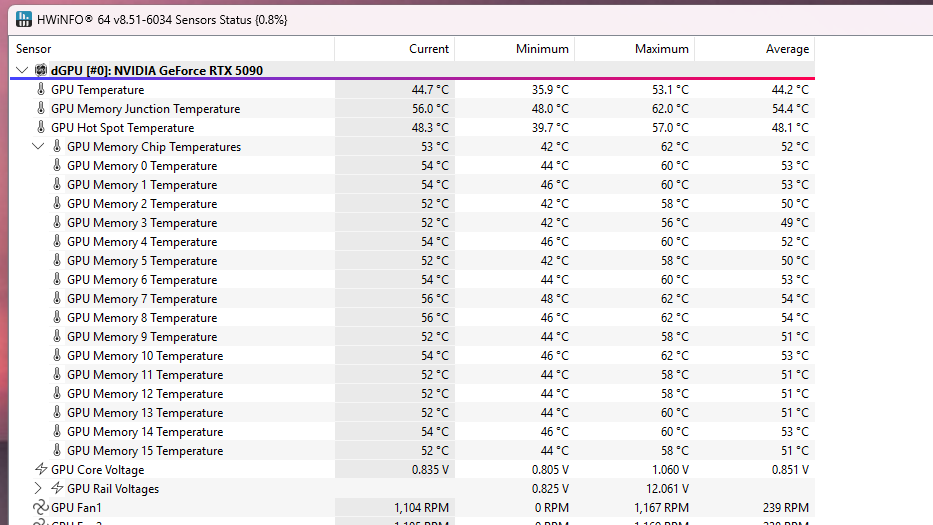
Indeed, the latest beta version (v8.51-6304) of HWiNFO has already incorporated this functionality. Initial reports and tests, including those by Tom’s Hardware, confirm that HWiNFO seamlessly reports the temperature of all memory modules. For instance, a GeForce RTX 5090, equipped with 16 GDDR7 memory modules, can now have each of its individual memory chips monitored for temperature, providing an unprecedented level of detail. This direct integration means users of these tools can immediately benefit from the advanced thermal insights without needing to install separate plugins.
The Full Spectrum of Thermal Insight
The Hotspot.dll plugin, and by extension, the direct integration in HWiNFO and AIDA64, reveals a comprehensive array of thermal data points crucial for advanced users:
- GPU Hotspot Temperature: The single hottest point on the GPU die, critical for identifying localized overheating and thermal throttling.
- Die Thermal Channel Readings: More granular temperature readings from different sections of the GPU die, offering a detailed thermal map.
- Average Die Temperature: The traditional, more generalized GPU core temperature reading.
- GPU Memory Junction Temperature: The average temperature across all VRAM modules, a previously common metric.
- Per-Chip DRAM Thermal Data: The most significant new addition, providing individual temperature readings for each GDDR memory module. This allows users to identify specific modules that might be running hotter due to uneven cooling, poor thermal pad contact, or inherent variances.
Broad Compatibility Across Generations
While the initial focus of asder00‘s development was primarily on the bleeding-edge Blackwell architecture (RTX 50-series), the underlying principles of GDDR memory temperature monitoring are broadly applicable. The Hotspot.dll plugin and the direct integrations are compatible with all major GDDR memory types: GDDR6, GDDR6X, and the latest GDDR7.
This broad compatibility means the benefits extend beyond just the newest GPUs. Users of previous generations of GeForce RTX graphics cards, including the RTX 40-series (codenamed Ada Lovelace) and the RTX 30-series (codenamed Ampere), can also leverage these advanced monitoring capabilities. This makes the breakthrough impactful for a vast segment of the PC gaming and enthusiast market, allowing a wider range of users to gain deeper insights into their existing hardware.
Nvidia’s Stance and the Community’s Drive
Nvidia has not issued an official statement regarding the community’s success in accessing these previously hidden sensors. This silence is typical for hardware manufacturers when such "unofficial" access is achieved. From Nvidia’s perspective, these sensors might be deemed internal diagnostic tools, not intended for end-user exposure, or they might prefer to control the narrative around performance and thermal behavior through their own official channels and software. Revealing such granular data could also expose minor manufacturing variances or design choices that Nvidia might prefer to keep internal.
The Unofficial Dance: Manufacturer vs. Modder
This dynamic highlights a continuous "cat and mouse" game between hardware manufacturers and the modding community. Manufacturers design their products with specific interfaces and levels of access, often prioritizing stability, ease of use, and protection of intellectual property. The enthusiast community, driven by curiosity, a desire for ultimate control, and the pursuit of maximum performance, constantly seeks to push these boundaries.
While Nvidia might not officially sanction these methods, they often tolerate them, especially when they do not lead to widespread system instability or security vulnerabilities. The benefits of such community-driven transparency often outweigh the risks, as it fosters a deeper understanding of the hardware and can even provide valuable, unofficial feedback to manufacturers regarding thermal performance under real-world, extreme conditions. The widespread adoption of these monitoring capabilities by reputable third-party tools like HWiNFO suggests that the methods are robust and reliable enough for general use, further solidifying their place within the enthusiast toolkit.
Profound Implications for Users and the Industry
The availability of per-module memory temperature monitoring, coupled with hotspot data, opens up a new realm of possibilities and carries significant implications for both individual users and the wider hardware industry.
Empowering the Enthusiast and Overclocker
For the hardcore enthusiast and overclocker, this data is nothing short of revolutionary. Overclocking GPUs involves pushing clock speeds and voltages to their limits, which inherently generates more heat. Previously, overclockers relied on general memory junction temperatures and core temps, often encountering stability issues without knowing precisely which component was overheating.
Now, with individual memory module temperatures, overclockers can:
- Identify Thermal Bottlenecks: Pinpoint specific memory modules that are running hotter and limiting overall memory overclock stability.
- Optimize Cooling Solutions: Precisely adjust fan curves, modify thermal pad placement, or even plan for custom liquid cooling loops with targeted cold plates, knowing exactly where the heat is concentrated.
- Safely Push Boundaries: Overclock with greater confidence, knowing they have real-time, granular data to prevent damage from localized overheating.
- Competitive Benchmarking: Fine-tune their systems to extract every last bit of performance, giving them an edge in benchmark leaderboards.
Aiding Diagnostics and Longevity
Beyond performance tuning, these new sensor readings are incredibly beneficial for diagnosing problems and ensuring the longevity of a graphics card.
- Early Problem Detection: Users can now detect subtle thermal anomalies that might indicate a manufacturing defect, poor thermal paste application, or a failing thermal pad on a specific memory module before it escalates into a major issue.
- Troubleshooting Stability Issues: When a GPU experiences random crashes or artifacts, the detailed thermal data can help identify if memory overheating is the root cause, leading to more targeted solutions.
- Informed Maintenance: Knowing which parts of the GPU run hottest can guide users on where to focus their cleaning efforts or when to consider replacing thermal interface materials.
- Warranty Concerns: While not an official diagnostic, having detailed logs of individual component temperatures could provide valuable context if a user needs to submit an RMA for a faulty card.
Shaping Future GPU Design and Transparency
This community-driven push for thermal transparency could also have ripple effects on how future GPUs are designed and marketed.
- Pressure on AIBs: Add-in board (AIB) partners, who design custom cooling solutions for Nvidia GPUs, might face increased scrutiny from consumers. If users can easily identify poorly cooled memory modules or uneven thermal application, it could pressure AIBs to improve their thermal designs and quality control.
- Increased Transparency: Nvidia itself might eventually consider officially exposing some of this data through NVAPI or their own software, driven by user demand and the realization that the community will find a way regardless. This could lead to a more open ecosystem.
- Innovation in Monitoring Tools: The breakthrough will undoubtedly spur further innovation in monitoring software, as developers integrate these new data streams and create more sophisticated analysis and visualization tools.
In conclusion, the ability to monitor every thermal aspect of Nvidia’s GeForce RTX 50-series and previous generations represents a monumental achievement for the hardware enthusiast community. Through collaborative effort and ingenious workarounds, users have gained unprecedented control and insight into their high-performance graphics cards. This enhanced transparency empowers individuals to optimize performance, diagnose issues with greater precision, and ultimately extend the life of their valuable hardware, setting a new standard for user-hardware interaction in the PC ecosystem. The ongoing dance between manufacturer controls and community ingenuity continues to push the boundaries of what’s possible, much to the benefit of PC enthusiasts worldwide.

