

In an era where the educational landscape is increasingly fragmented and often under-resourced, former NASA engineer and viral YouTube sensation Mark Rober is undertaking what may be the most ambitious philanthropic project in the history of creator-led education. Rober has officially launched Class CrunchLabs, a comprehensive, standards-aligned STEM curriculum spanning grades 3 through 8, backed by a staggering $55 million investment. The project, which aims to provide high-quality, engaging, and entirely free educational content to classrooms worldwide, has now secured a formal partnership with YouTube, signaling a major shift in how the platform intends to position itself as an academic resource.
The Genesis of Class CrunchLabs: A Mission to Educate
The story of Class CrunchLabs began in the mind of a creator who spent his career bridging the gap between complex engineering and mass-market entertainment. Rober, known for his high-production-value videos—ranging from glitter bombs that deter porch pirates to massive, Rube Goldberg-style contraptions—realized that he possessed a unique set of tools: the ability to command attention and the resources to execute high-concept demonstrations.
During his appearance on Tubefilter’s Creator Upload podcast, Rober articulated the philosophy behind his massive financial commitment. "We’re doing a full science curriculum from third to eighth grade," Rober explained to hosts Joshua Cohen and Lauren Schnipper. "We’ll have videos like the one I did with Ronaldo, MrBeast, cameos from all the kids’ favorite creators. But then I’ll be ‘hiding the vegetables,’ teaching the actual principles."
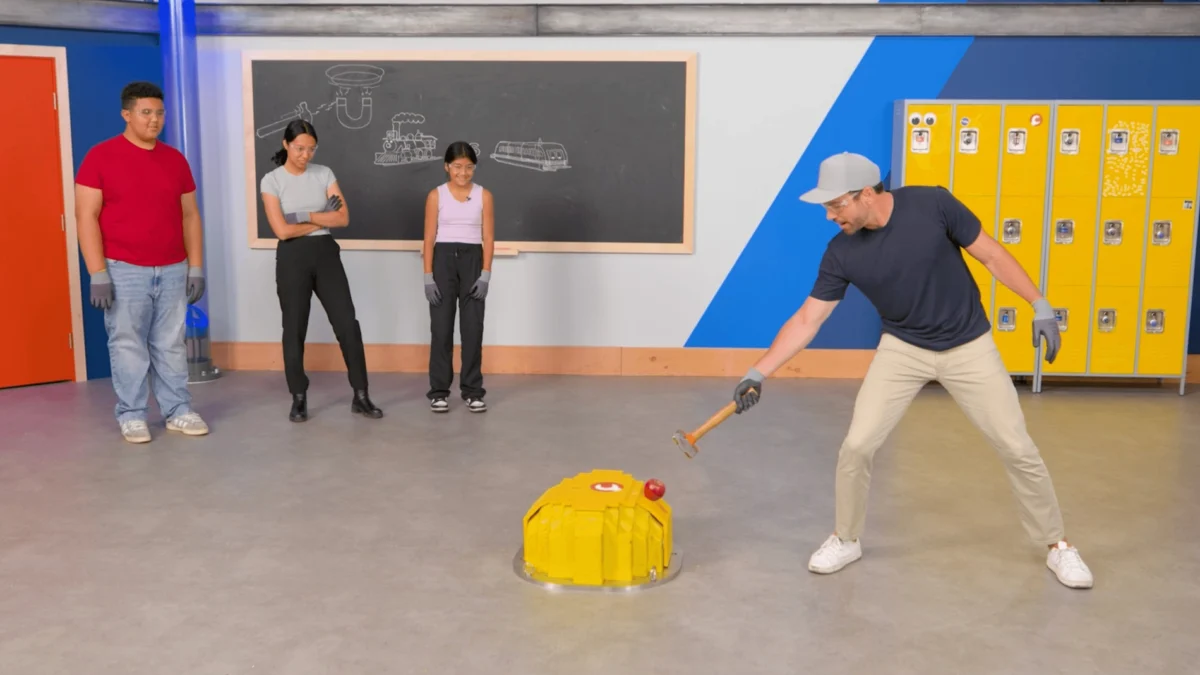
This "hide the vegetables" strategy is the cornerstone of the Class CrunchLabs pedagogical model. Rober leverages his expertise in audience retention to hook students with "banger" content—spectacular, curiosity-inducing experiments—before seamlessly transitioning into the core scientific principles. He illustrates this with a characteristic example: "I put a watermelon inside an MRI machine, then hold a 10-pound hammer. Then I’m like, ‘By the power of Thor!’ and this hammer just rips out of my hand and demolishes the watermelon. Now that I have your attention, I can teach you about invisible magnetic waves."
Chronology: From Concept to Global Classroom
The development of Class CrunchLabs has been a meticulous, multi-year process. While Rober had hinted at the project in various appearances, it officially entered the public consciousness as a formalized entity in 2024.
- Initial Development (2023-2024): Rober began assembling a team of educators, curriculum designers, and videographers. Working in tandem with the National Science Teaching Association (NSTA), the project focused on aligning content with modern educational standards.
- Production Phase (2025): Throughout the calendar year, the team engaged in a grueling production schedule. As of October 2025, Rober confirmed they were finalizing the third unit of the curriculum, balancing this monumental task with his ongoing YouTube career.
- The YouTube Partnership (2026): In a major strategic move, YouTube officially threw its weight behind the initiative. Recognizing the potential for its platform to serve as a hub for legitimate, high-quality learning, the company announced its partnership, providing the infrastructure to host the content.
- The Launch (Fall 2026): The initial wave of content, covering key topics such as gravitational force, electric and magnetic forces, and contact forces for grades 6-8, was released in 34 different languages to ensure accessibility for a global audience.
Supporting Data and Curriculum Architecture
The scope of Class CrunchLabs is designed to address the specific pain points of modern public education. Teachers are often forced to rely on outdated, uninspired materials, or worse, pay out-of-pocket for supplemental resources that lack rigor.
The Content Pipeline
The curriculum is planned as a 40-unit sequence, each designed to foster "hands-on" learning. When the project reaches completion, the repository will house:
- 1,000+ "Banger" Videos: High-energy, professionally produced demonstrations.
- Hundreds of Hands-on Challenges: Lab-style experiments that encourage students to apply what they’ve learned.
- Comprehensive Teacher Support: Full suites of teacher guides, student workbooks, handouts, and supply lists.
Collaborative Expertise
The curriculum is not merely a collection of YouTube videos; it is a peer-reviewed educational tool. By partnering with the NSTA, Rober ensured that the content adheres to rigorous academic standards. Furthermore, the inclusion of prominent creators like Emily Zhang, EpicSpaceman, AstroChuie, Astroathens, Sorcerer, ElectroBOOM, and NASA astronaut Jonny Kim serves a dual purpose: it increases engagement while providing students with relatable, diverse role models in STEM fields.
Official Responses and Strategic Implications
The partnership between Mark Rober and YouTube is more than a philanthropic gesture; it is a strategic repositioning of the platform. In a blog post, YouTube stated: "We’re partnering with engineer and creator Mark Rober to bring his signature hands-on science experiments directly into the classroom. Class CrunchLabs is a free, standards-aligned science curriculum… designed to spark student curiosity, build teacher confidence, and make science feel doable and fun."
YouTube emphasized that this is part of a larger initiative to transform the platform into a "go-to resource for high-quality academic content." By providing the server space and global distribution network for Class CrunchLabs, YouTube is positioning itself as a vital component of the modern classroom, effectively competing with traditional textbook publishers and digital learning platforms.
For Rober, the motivation is deeply personal. He candidly addressed the reality of modern education during his podcast interview: "These poor teachers, they actually pay money for content that’s not good. They’re paying their own money, and they don’t have much. So we’re just gonna put it out there." For a man with his level of financial success, the return on investment is not measured in currency, but in impact. "Having a mission, something to work toward, brings me a lot of fulfillment," he noted.
The Broader Implications for STEM Education
The launch of Class CrunchLabs represents a potential paradigm shift in educational content delivery.
Bridging the Engagement Gap
For decades, the "textbook-to-student" pipeline has suffered from a lack of dynamism. By applying the metrics of the creator economy—retention, engagement, and visual spectacle—to the science classroom, Rober is testing a hypothesis: that students are not disengaged from science, but rather from the way it is currently presented. If a 10-pound hammer and a watermelon can teach physics better than a static diagram, the implications for curriculum design are profound.
Democratizing Access
The decision to make all content free, forever, in 34 languages, is a radical move that bypasses the traditional pay-to-access models of most educational software companies. By removing the financial barrier to entry, Rober and YouTube are effectively leveling the playing field for underfunded school districts, ensuring that a student in a rural community has the same access to high-quality science demonstrations as one in an affluent urban center.
The Future of "Creator-Led" Learning
As more high-profile creators look for ways to leverage their platforms for social good, Class CrunchLabs serves as a blueprint. It demonstrates that the infrastructure of the creator economy—video production, audience building, and rapid iteration—can be redirected toward massive, systemic challenges.
Conclusion: A Legacy of Curiosity
As Class CrunchLabs continues to roll out its units, the focus remains on the ultimate goal: building the next generation of engineers, scientists, and curious thinkers. Mark Rober’s $55 million gamble is ultimately a bet on the students themselves. By treating them as an audience worthy of the highest quality entertainment, and simultaneously as scholars deserving of the highest quality education, Rober is attempting to engineer a future where science is not just a subject to be studied, but an adventure to be lived.
With YouTube’s global reach and the NSTA’s academic seal of approval, the project is poised to become a staple of 21st-century education. The "hidden vegetables" of scientific principle, served with the "banger" visuals of modern digital media, may well be the recipe required to revitalize science education for a new generation. For now, the global classroom waits, with lessons in gravitational, electric, and magnetic forces already live, signaling that the future of learning is not just being written—it’s being filmed.

