

In the rapidly evolving landscape of the video game industry, few companies have experienced as volatile a trajectory as Microsoft’s Xbox division. Once heralded as the pioneer of the "Netflix for games" model, Xbox now finds itself navigating a profound identity crisis. Despite a massive expansion through the acquisition of industry titans like Activision Blizzard and Bethesda, the division is currently weathering a storm of strategic uncertainty, characterized by staff layoffs, studio closures, and a confusing pivot in its core business model.
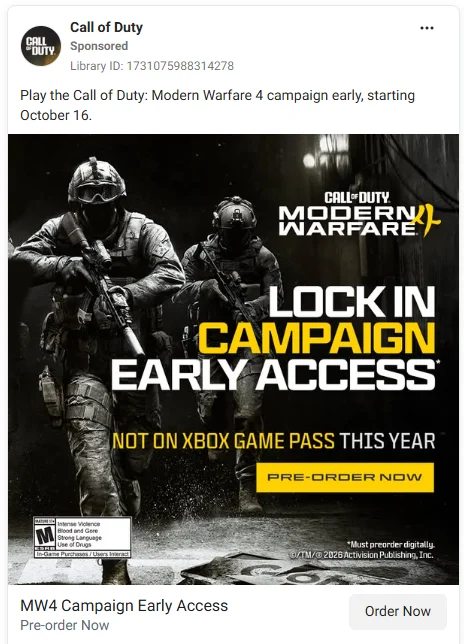
Nowhere is this malaise more visible than in a recent series of marketing materials for the latest Call of Duty entry. In an unprecedented move, official advertisements have begun featuring a blunt, tactical-style disclaimer: "NOT ON XBOX GAME PASS THIS YEAR." This jarring admission serves as a microcosm of the friction currently plaguing Microsoft’s gaming strategy—a collision between its legacy as a console hardware provider and its ambition as a platform-agnostic service provider.
The Chronology of a Strategic Pivot
To understand why Microsoft feels compelled to explicitly warn potential customers that their flagship service does not include its flagship game, one must look at the recent timeline of the company’s decision-making.
For years, Xbox Game Pass was marketed as the ultimate consumer-friendly value proposition: every first-party title would be available on the service the day it launched. This promise helped secure millions of subscribers and established Xbox as the primary destination for value-conscious gamers. However, the financial reality of this model began to set in as Microsoft’s library expanded to include the massive Call of Duty franchise.
- October 2023: Industry reports surface, suggesting that the inclusion of blockbuster titles like Call of Duty: Black Ops 6 in the Day-One Game Pass model was cannibalizing retail sales. Internal estimates pointed to a staggering $300 million loss in potential revenue.
- April 2024: Xbox officially pivots, announcing that future Call of Duty entries will no longer debut on Game Pass at launch. This signaled a major departure from the "all-access" philosophy that had defined the service’s growth phase.
- June 2024: Following the policy shift, the marketing machine begins to churn. Ad campaigns across Meta-owned platforms—Facebook, Instagram, and Threads—begin featuring the explicit disclaimer regarding Game Pass availability.
- Mid-2024 to Present: Under the tenure of new leadership, including CEO Asha Sharma, the division continues to face internal turbulence. Despite the pivot aimed at protecting premium sales, the messaging remains inconsistent, leaving consumers confused about the actual value of their subscription tiers.
Supporting Data: The Economics of Cannibalization
The tension between subscription growth and premium unit sales is not unique to Microsoft, but the scale of the Call of Duty franchise makes the conflict uniquely volatile. Call of Duty is not merely a game; it is an annual financial engine that consistently tops sales charts regardless of market trends.

Market data suggests that approximately 82% of Black Ops 6 copies were sold outside of the Game Pass ecosystem, yet the potential for "lost" revenue—users choosing a $15–$20 monthly subscription over a $70 standalone purchase—weighed heavily on Microsoft’s bottom line. By restricting day-one access, Microsoft is attempting to force a return to the traditional premium sales model.
However, the cost of this shift is brand equity. The service, which was once pitched as "the best deal in gaming," is now increasingly segmented by complex pricing tiers, restrictive library access, and higher subscription costs. When a company must explicitly disclaim what its service does not include in its own advertisements, it is a tacit admission that the "value" of the subscription has diminished in the eyes of the consumer.
The Regulatory and Internal Fallout
The internal instability at Microsoft is perhaps the most concerning element of this narrative. While executives speak of "flexibility, choice, and value," the ground-level reality involves significant layoffs and the shuttering of beloved studios. These developments have created a pervasive sense of anxiety within the industry.
The decision to exclude Call of Duty from Game Pass, while arguably "defensible" from a cold, profit-driven perspective, highlights a failure in brand communication. For a service that relies on the "all-inclusive" marketing hook, having to explicitly tell customers that the game they most want is not included feels like a defensive maneuver born of desperation.
Moreover, the brand identity of "Xbox" has become increasingly diluted. Through various initiatives, Microsoft has insisted that "everything is an Xbox," whether you are playing on a PC, a mobile device, or a console. While this increases the total addressable market, it paradoxically gives consumers fewer reasons to invest in the hardware itself, leading to a circular logic where the hardware division struggles to justify its existence against the software-as-a-service model.

Official Responses and the Corporate "Spin"
Microsoft’s public-facing stance remains one of optimism. When confronted with questions about price hikes and the exclusion of titles from Game Pass, the company often points to the "improved revenue growth" of the service. Executives argue that by decoupling the biggest titles from the subscription, they can ensure the long-term sustainability of their development studios.
Yet, this corporate language often rings hollow when juxtaposed with the reality of the consumer experience. The "tactical" disclaimer on advertisements for Call of Duty acts as an accidental "anti-marketing" strategy. Instead of focusing on the gameplay innovations, the weapons, or the narrative, the conversation is forced onto the transactional nature of the product. It reduces a creative work to a debate about billing cycles and subscription tiers.
The Implications: Where Does Xbox Go From Here?
The path forward for Microsoft’s gaming division is fraught with challenges. The current strategy appears to be one of "managed decline" for the console hardware, with a heavy emphasis on maximizing margins for software and services.
- The Erosion of Trust: By moving the goalposts on Game Pass, Microsoft risks alienating the core demographic that helped build the service. When the value proposition changes frequently, long-term commitment drops.
- Brand Fragmentation: The messaging that "Xbox is everything" has backfired. Instead of creating a ubiquitous platform, it has created a confused consumer base that no longer understands the unique selling point of the Xbox console compared to a standard gaming PC.
- Creative Stagnation: With layoffs and studio consolidation, the industry is watching to see if Microsoft can still produce the high-quality, singular titles that define a generation. A focus on subscription revenue and protective sales strategies can sometimes come at the cost of the creative risks that lead to breakout hits.
In conclusion, the "Not on Game Pass" disclaimer is not merely a piece of fine print; it is a symptom of a larger, systemic struggle within Microsoft. As the division attempts to pivot toward a more profitable, service-heavy future, it must grapple with the fact that it is losing the one thing that once set it apart: a clear, consistent promise to the player. Whether this new era of "tactical disclaimers" and cost-cutting will lead to a more stable bottom line remains to be seen, but for now, the Xbox brand finds itself at a crossroads where its messaging is as fractured as its internal operations.
As the gaming industry continues to evolve, Microsoft’s ability to reconcile its legacy as a platform holder with its future as a content service provider will determine whether it remains a leader in the space or continues to drift through a strategic malaise of its own making.

