

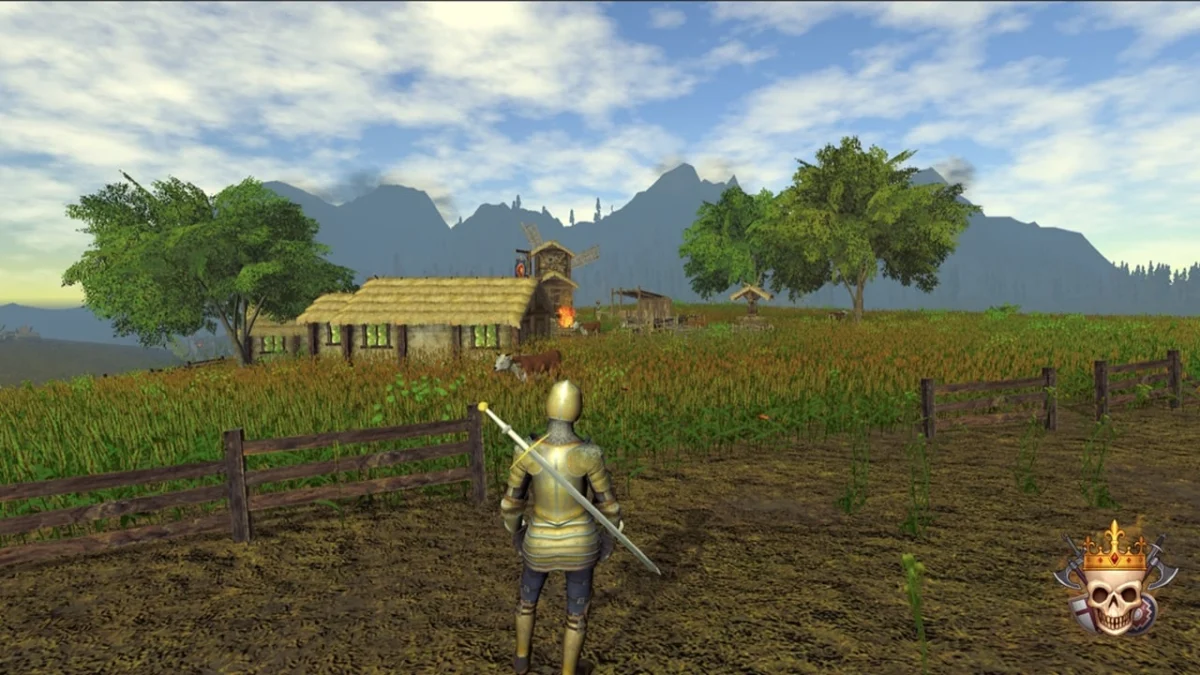
In an era dominated by live-service titles and aggressive monetization, the debut mobile offering from indie developer Skvork, Nine Crowns of Faenord, stands as a defiant throwback to the golden age of premium gaming. An expansive open-world action RPG that draws heavy inspiration from the survival-crafting sensibilities of Valheim, the grand strategy of Mount & Blade, and the immersive lore-building of Skyrim, Nine Crowns of Faenord has officially made its mark on the mobile landscape.
Available now on the Google Play Store, the game offers a refreshing, fully offline experience that eschews microtransactions, advertisements, and artificial progress-gating. For players seeking a deep, tactical campaign without the intrusion of "pay-to-win" mechanics, this title represents a significant milestone in mobile indie development.
Main Facts: A Kingdom at the Palm of Your Hand
Nine Crowns of Faenord transports players to the eponymous ancient island—a volatile, untamed territory where power is fluid and borders are defined by blood. Unlike traditional mobile RPGs that focus solely on the protagonist’s personal growth, Skvork’s debut is built upon the pillars of squad management, territorial control, and grand-scale conquest.
The premise is deceptively simple: you begin your journey with a rudimentary map, a loyal squad of followers, and an ever-expanding roster of adversaries. The overarching goal is to claim the Nine Crowns of Faenord, a task that requires navigating a complex web of diplomacy, military strategy, and tactical exploration.
The game’s primary features include:
- Squad-Based Progression: Players do not fight alone. You lead a warband that can be customized with up to 20 unique heroes, spanning traditional RPG archetypes such as warriors, rogues, and mages.
- Tactical Real-Time Combat: Battles unfold at a fluid 60 FPS, requiring players to balance direct melee and ranged engagement with real-time tactical commands issued to their warband.
- Dynamic World Map: The island is a sprawling sandbox featuring diverse biomes, including dense forests, mountain ranges, fortified keeps, and contested borderlands.
- Premium Philosophy: The game is entirely offline, free from timers, ads, and energy systems, favoring a traditional, uninterrupted player experience.
Chronology of Development and Release
The journey of Nine Crowns of Faenord from concept to storefront is a testament to the perseverance of independent studios. Skvork, operating as a lean development team, sought to bridge the gap between complex PC strategy games and the accessibility of mobile hardware.
Phase 1: Conceptualization and Prototyping
The development team initially set out to solve a specific problem: why are there so few mobile games that capture the feeling of "living" in a world that reacts to your presence? By looking at the emergent gameplay of Mount & Blade and the atmospheric exploration of Valheim, Skvork began drafting the world of Faenord. The focus was initially on the physics of combat and the AI routines of enemy factions, ensuring that the world felt alive even when the player wasn’t actively engaging in a mission.
Phase 2: Alpha and Beta Testing
During the closed development cycles, the focus shifted to optimization. Bringing a high-fidelity open-world action RPG to mobile devices requires significant resource management. The team spent months refining the engine to ensure a consistent 60 FPS experience. It was during this phase that the "Nine Crowns" narrative structure was finalized, providing a cohesive goal for players who might otherwise get lost in the game’s expansive map.
Phase 3: The Public Launch
After extensive polishing, the game launched on the Google Play Store. The release was strategically timed to offer a "pure" gaming experience, intentionally avoiding the current industry trend of "Early Access" perpetual cycles. By launching as a complete, single-player package, Skvork aimed to capture the demographic of players who have become disillusioned with the current state of mobile monetization.
Supporting Data: The Mechanics of Conquest
To understand the complexity of Nine Crowns of Faenord, one must look at the interplay between exploration and administration.
The Warband Hierarchy
Recruitment is the lifeblood of the player’s campaign. Each of the 20 available heroes is not merely a stat block but a tactical asset. Rogues provide high-mobility flanking, mages offer area-of-effect crowd control, and warriors serve as the frontline anchor. As these followers survive battles, they gain experience, allowing players to specialize their skills. This progression system ensures that losing a high-level unit in battle is a genuine strategic setback, raising the stakes of every skirmish.
The Strategic Loop
The game operates on a "Capture-Defend-Expand" loop:
- Exploration: Players must scout the frontier to identify enemy supply lines and fortresses.
- Siege and Skirmish: Once a target is identified, the player must decide whether to engage in direct combat or use tactical positioning to draw out enemy reinforcements.
- Consolidation: After taking a castle, the player must garrison it with their warband, defending it against counterattacks. This is where the game’s resource management comes into play, as you cannot be everywhere at once.
Environmental Influence
The terrain is not just for show. Forests provide cover for ambushes, while high-ground mountain passes offer defensive advantages for ranged units. Understanding the geography of Faenord is often the difference between a decisive victory and a demoralizing defeat.
Official Responses and Developer Intent
In various communications surrounding the launch, the developers at Skvork have been vocal about their opposition to the modern "Mobile Games-as-a-Service" model.
"The goal with Nine Crowns of Faenord was to provide a game that respects the player’s time," a spokesperson for the studio remarked. "We noticed that so many mobile players were looking for something they could sink their teeth into—a game that rewards skill and planning rather than how much money they can spend on gems or energy refills. By keeping the game offline and ad-free, we allow the player to set their own pace. Whether you want to play for five minutes or five hours, the game is exactly as you left it."
The studio also noted that the inclusion of diplomacy—specifically the ability to negotiate with the island’s elf factions and rally knights—was intended to add a layer of political intrigue that mirrors the unpredictability of human history.
Implications: A Shift in Mobile Gaming Standards?
The release of Nine Crowns of Faenord serves as an important case study for the mobile industry. For years, the prevailing wisdom has suggested that mobile users prefer short, bite-sized experiences heavily laden with social features and microtransactions. However, the rise of titles that offer deep, premium, single-player experiences suggests that there is a significant, underserved market of mobile gamers.
The Premium Renaissance
If Nine Crowns of Faenord finds sustained success, it could embolden other indie developers to pursue similar premium models. The "no-nonsense" approach—no ads, no timers, no pay-to-win—strips away the psychological manipulation often found in mobile games, allowing the quality of the gameplay design to stand on its own merits.
The Technical Bar
By delivering a 60 FPS experience on mobile that incorporates both real-time combat and wide-scale troop management, Skvork has set a high technical bar. As mobile hardware continues to improve, the expectation for console-quality experiences on handheld devices will only grow. Nine Crowns proves that the limitation of mobile gaming is often not the hardware itself, but the willingness of developers to build robust, standalone software.
The Future of the Franchise
While the current focus is on the successful deployment of the base game, the architecture of Nine Crowns of Faenord allows for significant expansion. With the "Nine Crowns" narrative hook, there is ample room for future updates that could introduce new regions of the island, additional factions, or more complex political mechanics.
Conclusion
Nine Crowns of Faenord is more than just a debut; it is a declaration of intent. It reminds the gaming community that mobile devices are capable of hosting deep, tactical, and immersive RPG experiences that demand more than just a quick tap of the screen. By prioritizing the player’s agency and providing a robust, offline world, Skvork has crafted a title that honors the best traditions of the RPG genre while carving out a unique space on the mobile platform. For those who yearn for the feeling of leading a warband through a dangerous, unpredictable landscape, the path to the Nine Crowns is now open.

