

In the ever-shifting landscape of extraction shooters, few mechanics are as polarizing or as vital as the "wipe"—a periodic resetting of player progress designed to level the playing field and maintain the tension of survival. For Embark Studios, the developers behind the atmospheric and high-stakes Arc Raiders, the challenge has been to find a rhythm for these resets that feels rewarding rather than punitive. With the announcement of the game’s "Fourth Expedition," it has become increasingly clear that the studio is still iterating on the fundamental philosophy of how player effort carries over from one season to the next.
This latest update marks a significant pivot in strategy: moving away from the incremental, often intangible benefit of extra skill points toward a more tangible, player-favored incentive system built around premium currency and persistent blueprints.
The Shift: From Skill Points to Tangible Assets
For seasons past, the primary reward for enduring the trials of an Expedition was a modest boost in skill points. While helpful for those looking to shave seconds off their response times or gain a slight edge in combat efficiency, the community response was tepid. Players have consistently signaled that in an extraction-based economy, "power" is rarely as valuable as "possessions."
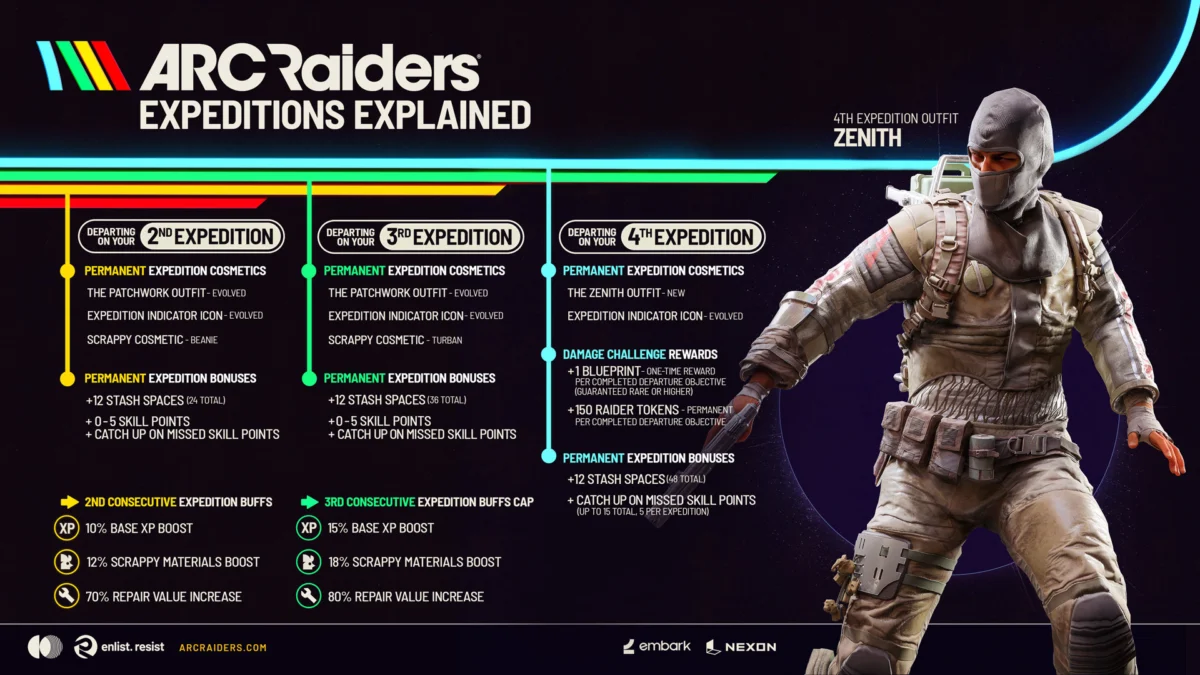
Embark Studios has listened. The Fourth Expedition, which officially kicks off on July 7th, completely abandons the skill point reward structure in favor of a hybrid system. By completing departure objectives, players will now be guaranteed 150 "Raider Tokens" and a single, high-value blueprint per objective.
This change is critical because it addresses the "utility vs. vanity" dilemma. Raider Tokens function as the game’s premium currency, providing a direct path toward the game’s cosmetic store. By offering 750 tokens—the total reward for completing all five departure objectives—Embark is effectively handing players approximately $7 worth of store credit. Given that standard store bundles typically range in price, this reward is substantial enough to feel like a genuine return on investment for the player’s time, while still encouraging further engagement with the game’s monetization loop.
Chronology: A Season of Iteration
To understand why this change matters, one must look at the timeline of Arc Raiders’ progression systems.

- Early Access/Beta Foundations: The game launched with the standard extraction shooter "wipe" model—everything resets, and players are thrust back to base stats to prevent veteran players from becoming insurmountable obstacles for newcomers.
- The Introduction of Expeditions: Recognizing that total resets can lead to player fatigue, Embark introduced Expeditions as a way to "bank" progress. Initially, these rewards were minor, focusing on marginal stat increases.
- The Vault Era: Recognizing that blueprints were the true currency of the game, the developers introduced the "Ermal" vault system. This allowed players to store items to be carried over into the next season, effectively creating a "carry-over" economy that rewarded long-term planning.
- The Fourth Expedition (Current): The latest iteration merges the currency-based incentives of the store with the utility of the blueprint system, creating a dual-layered reward structure that benefits both the casual collector and the hardcore tactician.
Supporting Data: Why Blueprints Reign Supreme
The decision to focus on blueprints is backed by community behavior. In Arc Raiders, the ability to craft specific gear is the heartbeat of the gameplay loop. A player who enters a new season with a set of blueprints for rare gear is exponentially more prepared for the dangers of the environment than a player who enters with a 5% increase in movement speed.
By allowing players to secure blueprints that survive the wipe, Embark is essentially creating a "legacy" for the player. With the new system, if a player completes all five objectives and utilizes the five vault slots provided by the NPC Ermal, they can begin a new season with a total of 10 persistent blueprints. This is a massive "head start" that significantly lowers the barrier to entry for the early-game grind, allowing veterans to reach the mid-to-late-game content much faster.
This design philosophy recognizes a fundamental truth of the genre: players are willing to accept the loss of their items (the "wipe") so long as they don’t lose the capability to recreate those items. Blueprints represent that capability.
Official Responses and the "New Player" Problem
While these changes are a boon for the veteran player base, they highlight a persistent tension within the game’s design: the "Catch-Up" trap. Embark Studios is acutely aware that by tethering rewards to a linear, season-specific sequence of Expeditions, they are inadvertently penalizing new players or those who missed a season.
In a recent blog post, the development team acknowledged the friction: "We understand the frustration of new players that are only now starting to do their Expeditions. We need to find the right balance of rewarding our veteran players but also give new players fair and fun ways to catch up and not feel like they are always behind."
This statement is the most candid admission to date that the current progression model is not yet finalized. The studio’s commitment to "continuous effort" suggests that they are moving toward a more flexible system—perhaps one where older Expeditions can be tackled asynchronously, or where "catch-up" mechanics are implemented to bridge the gap for late-joiners.

Implications for the Future of Arc Raiders
What does this mean for the future of the game? The implications are three-fold:
1. The Economy is Becoming "Sticky"
By integrating premium currency (Raider Tokens) into the gameplay loop, Embark is ensuring that players have a financial incentive to stay engaged throughout the entire duration of a season. It bridges the gap between the "grind" and the "store," making the act of playing the game feel like it is directly funding the player’s cosmetic aspirations.
2. Progression is Moving Toward "Knowledge"
By prioritizing blueprints over raw stats, the game is shifting toward a model where player success is defined by what you know how to build, rather than how high your numbers are. This is a healthier way to manage power creep, as it rewards the player for their history and strategic planning without breaking the game’s combat balance for newer players.
3. The End of "Season FOMO"
The acknowledgment of the "new player problem" suggests that Embark is looking for ways to mitigate the Fear Of Missing Out (FOMO). If the studio successfully implements a way for new players to access previous Expedition rewards, it will transform Arc Raiders from a "seasonal sprint" into a "long-term collection," which is far more sustainable for player retention.
Final Thoughts: The Road Ahead
The Fourth Expedition is a microcosm of the Arc Raiders development journey. It is a game defined by its willingness to dismantle its own systems in search of a better player experience. While the wipe mechanic will always remain a source of debate, the pivot toward rewarding players with transferable knowledge (blueprints) and tangible value (tokens) is a step in the right direction.
The Fourth Expedition window opens on July 7th at 1pm CEST (11am UTC/4am PT) and will run through July 21st at 10am CEST (8am UTC/1am PT). For those currently active in the game, it represents a unique opportunity to secure a significant advantage for the next cycle. For the developers, it is another vital piece of data in the grand experiment of building a persistent, evolving, and fair extraction shooter. As the game continues to evolve, the community will be watching closely to see if Embark can solve the catch-up dilemma without sacrificing the high-stakes intensity that makes Arc Raiders such a compelling experience.

