


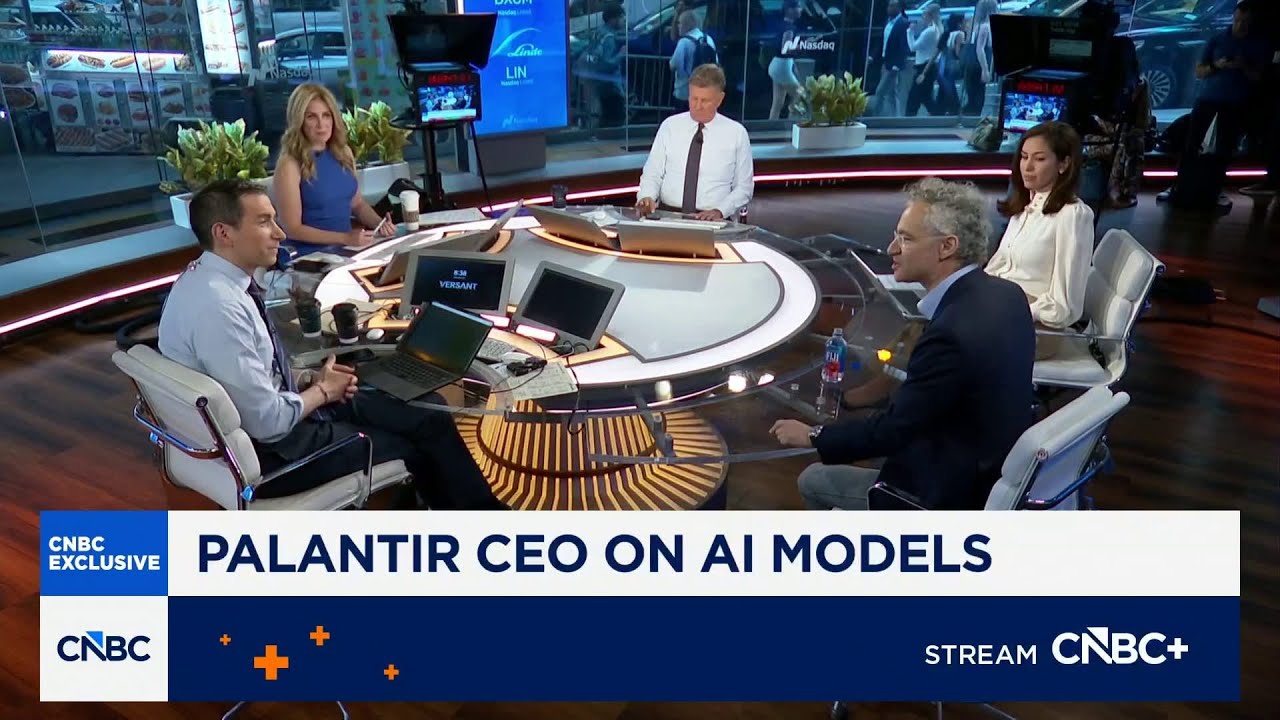
In a recent, high-energy appearance on CNBC, Palantir Technologies CEO Alex Karp delivered a blistering indictment of the current artificial intelligence industry. Departing from the polished, scripted rhetoric typical of Silicon Valley leadership, Karp suggested that the foundation of the modern AI market is structurally flawed, misleading, and potentially dangerous to both national security and corporate enterprise.
Karp’s comments, which quickly went viral, touched upon the industry’s reliance on "token-based" billing, the erosion of data privacy, and the dangerous prospect of outsourcing critical infrastructure to a handful of centralized technology firms. As Palantir deepens its collaboration with industry giants like Nvidia to deliver secure, open-model AI for government agencies, Karp’s critique serves as a foundational challenge to the status quo of the Generative AI boom.
The Core Argument: Why the Current AI Market is "Broken"
At the heart of Karp’s frustration is the prevailing monetization strategy used by most leading AI companies: selling access to models on a "per-token" basis. In the world of Large Language Models (LLMs), a "token" essentially represents a unit of text or data processed by the system. While this model has allowed consumer-facing startups to scale rapidly, Karp argues that it provides little tangible value to serious enterprise clients.
"Something has gone completely wrong," Karp stated during the interview. "The basic view among enterprises in this country is: ‘I’m going to chillax and waste my time with tokens. I’m going to get no value, and they’re going to get my IP.’"
Karp posits that the true value of AI lies not in the chat interface or the raw processing of tokens, but in the integration of specialized, closed-environment models with specific application layers and computing infrastructure. He argues that the current industry practice of charging for tokens is a "distraction" that masks a lack of genuine, profit-generating utility for the average corporation.
He challenged the industry’s pricing logic directly: "Let’s say I could make you a billion dollars tomorrow. Wouldn’t I say, ‘I’ll make you a billion dollars, and I want 30%’? Why are they charging for tokens if it’s so valuable?"
Chronology of the Controversy
The discourse surrounding Karp’s comments follows a series of strategic maneuvers by Palantir to solidify its position as the premier provider of AI for the U.S. government and defense sectors.

- September 2025: Palantir and Nvidia announce a strategic partnership. The collaboration focuses on deploying secure, open-source AI models (such as Nvidia’s Nemotron) for use by U.S. federal agencies, aiming to provide a high-security alternative to the black-box models common in the public sector.
- Late 2025 – Early 2026: Palantir continues to face scrutiny for its ongoing contracts with Immigration and Customs Enforcement (ICE) and other government bodies. Critics point to the company’s role in data surveillance, while Palantir argues that their software is essential for operational efficiency in high-stakes environments.
- July 1, 2026: Alex Karp appears on CNBC. His performance—characterized by high-intensity delivery and confrontational rhetoric—captures the attention of the markets. He explicitly denies any substance usage, addressing the "nervous energy" that social media commentators had been quick to label as a "breakdown."
- Post-Interview: The fallout continues as analysts attempt to reconcile Karp’s aggressive stance with Palantir’s growth trajectory. Karp claims to speak for a "silent majority" of American CEOs who are, according to him, "livid" about the current state of AI but are afraid to speak out publicly.
Supporting Data and Industry Context
To understand the weight of Karp’s claims, one must look at the shift from general-purpose AI to industry-specific applications. The current AI landscape is dominated by companies that act as "middlemen"—they provide the model, they host the data, and they charge for the compute time.
Karp’s critique centers on the "Data Sovereignty Gap." For a bank, a hospital, or a defense department, the "token" model is a non-starter because it often requires sending sensitive, proprietary, or classified data into a cloud environment owned by a third-party AI developer.
- Security Concerns: In the current paradigm, corporations often lose control over where their data is cached and how their prompts are used to retrain future models.
- The "Black Box" Problem: Karp argues that for AI to be useful in the real world—specifically in warfare or critical infrastructure—it must be transparent. The "consensus view in Silicon Valley," as he puts it, focuses on the model’s performance in a vacuum rather than its reliability, auditability, and security within a specific organizational context.
- Corporate Sentiment: While Karp’s assertion that "CEOs are livid" is anecdotal, there is a measurable trend of companies opting for "on-premise" or "private cloud" LLM deployments. Companies like IBM, Oracle, and even Palantir have seen increased interest from enterprises looking to avoid the risks associated with public-facing AI API services.
Official Responses and Strategic Shifts
Palantir’s official stance, as reflected in their recent press releases and the interview, is that the AI industry is currently in a state of "irresponsible overselling."
The company is positioning itself as the "adult in the room." By partnering with Nvidia, Palantir aims to bridge the gap between open-source research and hardened, mission-critical applications. By using open models, agencies can inspect the underlying code, ensuring that the technology cannot be manipulated or "transferred to an alphabet business" (likely an allusion to Google) without oversight.
The broader tech sector has remained largely silent regarding Karp’s specific attacks, though industry leaders have historically defended the token-based model as the only way to democratize AI access. For smaller companies, token pricing is predictable and scalable, whereas the custom-built, enterprise-wide deployments that Karp advocates for are significantly more expensive and difficult to implement.
The Broader Implications: A Changing Battlefield
Perhaps the most provocative aspect of Karp’s interview was his commentary on warfare. He warned against the "outsourcing of the battlefield" to the ideological consensus of Silicon Valley.
1. The Geopolitical Dimension
Karp argues that AI is not just a commercial product but a strategic asset. If American defense agencies rely on models designed and controlled by firms that prioritize commercial growth over national security mandates, the country faces an existential risk.
2. The Shift Toward Private/Sovereign AI
The implication of Karp’s rhetoric is clear: the era of "AI for everything" is ending, to be replaced by "AI for something." We are entering a phase where the market will bifurcate between consumer-grade, general-purpose models and "Sovereign AI"—models that are privately owned, highly secure, and tailored to specific business or government outcomes.
3. The "Nervous" Messenger
Karp’s intense delivery style has become a focal point of the conversation, potentially obscuring the validity of his arguments. However, he framed his intensity as a reflection of the gravity of the situation. By claiming that he is merely a channel for the "voice of American Business," he is attempting to rebrand his dissent as a patriotic imperative rather than a mere market rivalry.
Conclusion: The Path Forward
Whether one views Alex Karp as a visionary sounding the alarm or a corporate provocateur stirring the pot, his critique provides a necessary tension in the AI narrative. The industry is currently moving from the "hype phase" of generative AI into the "deployment phase."
As enterprises move from experimenting with chatbots to integrating AI into their core operations, the questions raised by Palantir will become unavoidable. Who owns the data? Is the model secure? And is the value proposition of the AI provider actually tied to the success of the business, or is it merely extracting a tax on compute?
As the industry matures, the market will likely punish those who continue to sell "tokens" without substance, while rewarding those who can prove that their AI models provide genuine, defensible, and secure value. For now, the debate remains open, and the race to build the next generation of enterprise-grade AI continues—but perhaps with a slightly more skeptical eye on the giants of Silicon Valley.

