

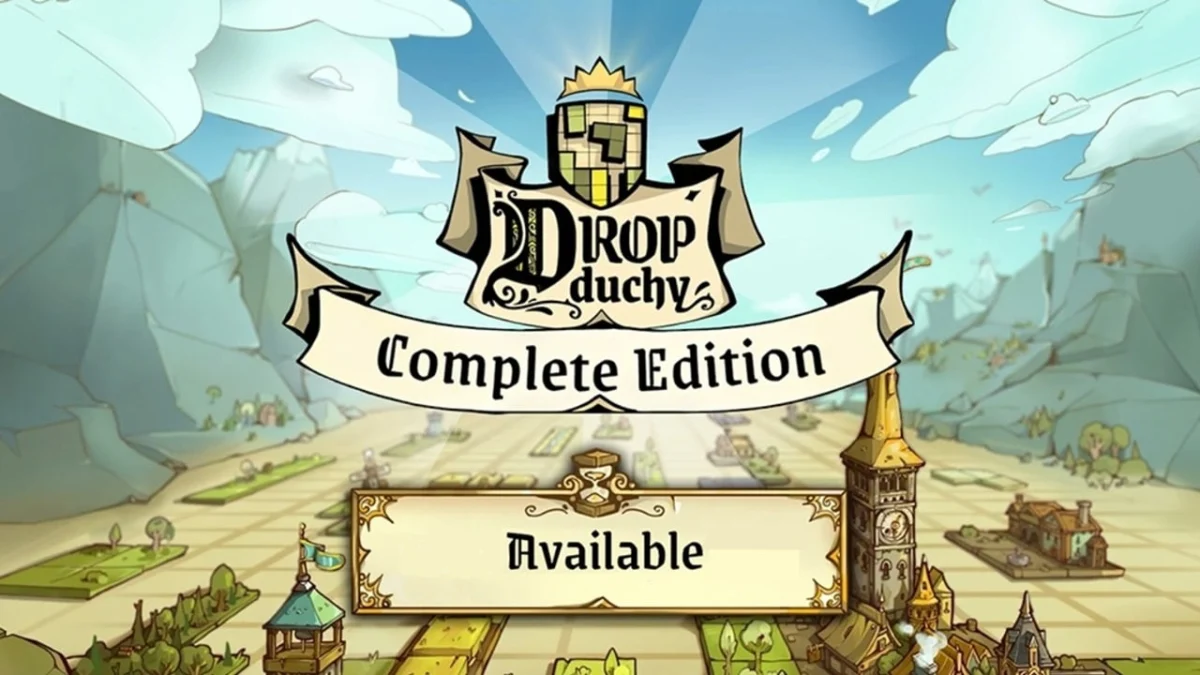
The landscape of mobile gaming is frequently criticized for its reliance on established tropes—endless runners, match-three clones, and hyper-casual iterations of classic concepts. However, every so often, a title arrives that challenges these conventions by hybridizing genres in ways that feel both intuitive and revolutionary. Drop Duchy, the critically acclaimed PC block-dropping puzzle game, has officially made the transition to mobile devices. Developed by the French indie outfit Sleepy Mill Studio and brought to mobile platforms by publisher Doghowl Games, Drop Duchy is not merely a port; it is a reinvention of the "falling block" genre, grafting the complexities of 4X strategy, deckbuilding, and rogue-lite progression onto the satisfying tactile loop of tile placement.
Main Facts: A Kingdom Built in the Drop Zone
At its core, Drop Duchy tasks players with a familiar mechanical objective: managing falling blocks. Yet, the resemblance to titles like Tetris or Lumines ends at the visual aesthetic. In Drop Duchy, clearing lines is no longer the ultimate goal; it is merely the engine that powers your geopolitical ambitions.
As players drop tiles, they are not just arranging shapes; they are constructing a functioning realm. Every block placement acts as a structural decision. Players must carefully consider terrain types—lush forests, wild rivers, and sprawling grassy plains—to optimize the efficiency of their budding civilization. Positioning structures adjacent to compatible terrain types provides essential bonuses, allowing for the rapid accumulation of resources. These resources are then funneled into the primary gameplay loop: raising an army, fortifying your castle walls, and eventually mounting an offensive to dismantle an opposing enemy fortress.
The game is currently available on the Google Play Store, marking a significant milestone for Sleepy Mill Studio as they bring their unique vision of "strategic puzzle-solving" to the portable market.
The Chronology of Development: From Concept to Console and Mobile
The journey of Drop Duchy began in the independent scene, where Sleepy Mill Studio sought to answer a niche but persistent question: "What happens to a puzzle game if the pieces are units of production?"
The PC Genesis
During its initial development phase on PC, the studio focused heavily on the synergy between the "stacking" mechanic and the "rogue-lite" economy. Early builds emphasized the satisfaction of a "clean drop," but playtesting revealed that players craved more long-term stakes. This feedback loop led to the integration of the deckbuilding system, where players could customize their "hand" of available structures and technologies before each run.
The Porting Process
The transition to mobile was handled by Doghowl Games, a publisher with an increasing footprint in the mobile strategy sector. The primary challenge during this phase was ensuring the game’s UI/UX remained intuitive on smaller touchscreens. Because Drop Duchy requires precise placement to maximize terrain bonuses, the developers implemented a refined touch-control scheme that allows for drag-and-drop precision, ensuring that the "tactician" aspect of the game is not compromised by the limitations of mobile input.
Supporting Data: Mechanics and Depth
To understand why Drop Duchy stands out in an oversaturated market, one must look at the mechanical depth embedded in its design. The game is far more than a casual time-waster; it is a rigorous simulation of logistics.
Procedural Generation and Replayability
Every run in Drop Duchy generates a fresh, unique landscape. This procedural generation is the cornerstone of the game’s rogue-lite longevity. Because no two maps are identical, players cannot rely on rote memorization of patterns. They must adapt their strategy based on the available topography. Whether the game spawns a map dense with forests or a fragmented landscape of rivers and villages, the player’s ability to pivot their economic strategy is paramount.
The Deckbuilding Engine
The game features over 110 unique cards. These are not merely cosmetic; they represent buildings, military technologies, and special events.
- Building Cards: Dictate the structure types available in your "drop pool."
- Technology Cards: Provide passive buffs or game-changing abilities, such as increasing the rate of resource generation or allowing for the "recycling" of poor drops.
- Tactical Flexibility: Players must curate their decks to balance the need for infrastructure with the inevitable need for military expansion.
Factions and Missions
The game offers three distinct playable factions—The Duchy, The Order, and The Republic—each of which brings a different philosophy to the battlefield. The Duchy, for example, may favor defensive growth, while The Republic might focus on high-speed expansion and trade. With over 100 unique missions to complete, players are constantly incentivized to experiment with different faction/deck combinations.
Official Responses and Studio Vision
While Sleepy Mill Studio has remained largely focused on post-launch stability, early statements from the team indicate that the mobile release is viewed as the "definitive version" of their initial concept.
"We wanted to bridge the gap between the meditative nature of puzzle games and the high-stakes intensity of real-time strategy," a spokesperson for the development team noted during the soft-launch period. "The mobile platform provides a tactile experience that makes the act of placing a building feel like you are physically laying the foundation of your kingdom."
Doghowl Games has emphasized that their goal was to ensure the mobile experience did not feel "dumbed down." By retaining the full complexity of the PC build—including the evolving soundtrack and the challenging AI opponents—they believe Drop Duchy will appeal to a segment of the mobile market that feels underserved by current offerings.
Implications: The Future of Hybrid Mobile Gaming
The arrival of Drop Duchy on mobile serves as a case study for the evolution of hybrid gaming. For years, mobile titles were defined by a strict separation of genres: if it was a puzzle game, it had to be simple; if it was a strategy game, it had to be a complex, high-latency affair. Drop Duchy successfully challenges this binary.
Impact on the Puzzle Genre
By adding an objective-based victory condition (destroying the enemy bastion) to a line-clearing mechanic, Drop Duchy proves that "puzzle" games can have a narrative and strategic weight. It shifts the player’s focus from "What line can I clear next?" to "How does this move serve my long-term survival?" This could pave the way for a new sub-genre of "Strategic Puzzle Roguelikes" on mobile devices.
Accessibility and the "Hardcore" Mobile Player
The game also highlights the growing demand for "premium" mobile experiences. As players become increasingly fatigued by aggressive microtransactions and energy-meter-based progression, titles like Drop Duchy—which reward skill, deck knowledge, and strategic adaptation—are likely to gain traction. The inclusion of complex progression systems (unlocking new bonuses, health, and card types) provides a satisfying sense of "meta-progression" that keeps players engaged without resorting to manipulative monetization tactics.
Technical Performance and Future Updates
While the game is currently a robust, feature-complete package, the community is already looking toward potential post-launch updates. Given the modular nature of the deckbuilding system, the potential for expansion packs featuring new factions, new terrain types, or even "seasonal" landscapes is high. If Drop Duchy continues to perform well on the Google Play Store, it is highly probable that we will see consistent content updates that further flesh out the world of the Duchy, the Order, and the Republic.
Conclusion: A New Standard for Mobile Strategy
Drop Duchy is a rare achievement in the mobile space. It manages to balance the immediate, satisfying "pop" of a puzzle game with the deep, thoughtful architecture of a strategy title. By providing the player with a deck of 110 cards, three distinct factions, and an endless array of procedurally generated challenges, it offers a level of depth that is seldom seen on handheld devices.
For those who have grown tired of the repetitive nature of modern mobile gaming, Drop Duchy offers a refreshing alternative. It is a game that demands your attention, rewards your curiosity, and punishes your mistakes—all while maintaining the charming, evolving atmosphere that made its PC predecessor a cult favorite. As the game finds its footing on the mobile market, it stands as a testament to the fact that when developers are willing to blend genres, the result is often a gaming experience that is greater than the sum of its parts.
Whether you are a seasoned strategist looking for a new challenge or a casual puzzle fan interested in trying your hand at kingdom-building, Drop Duchy is a must-download. It is a reminder that in the right hands, a simple falling block can become the cornerstone of an entire empire.

