

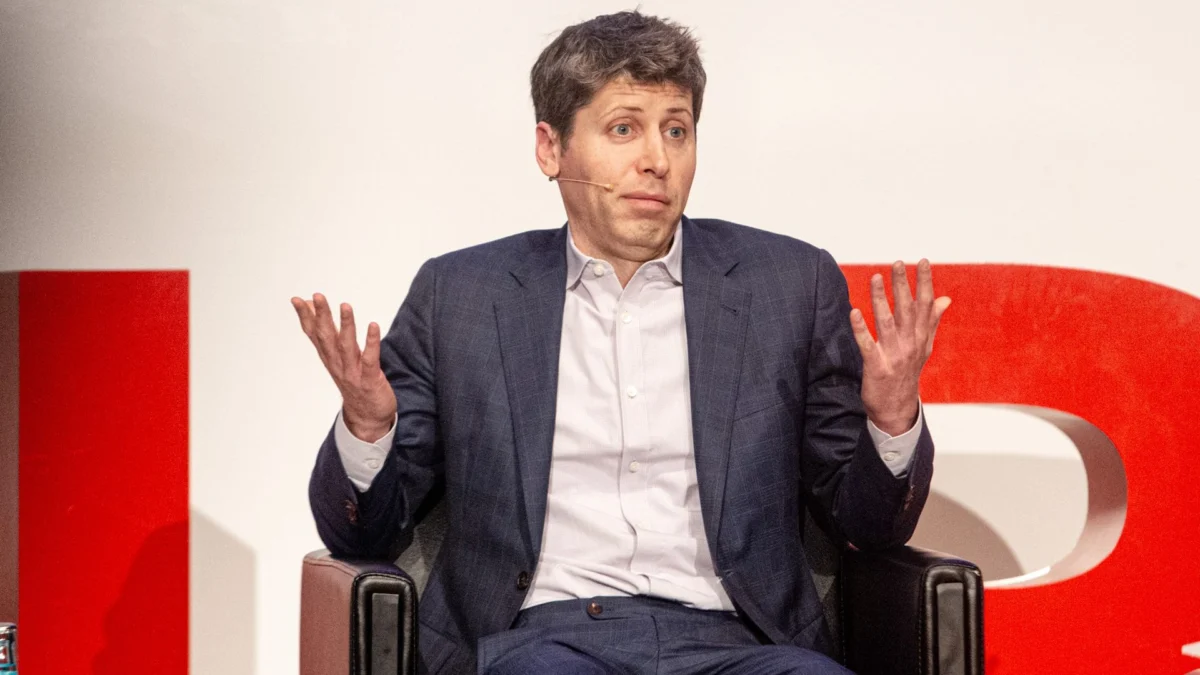
If there is one unifying characteristic shared by the architects of the modern artificial intelligence era, it is a curious, almost performative paradox. These industry leaders oscillate between the intoxicating heights of multi-billion-dollar valuations and the dark, existential warnings that the very software powering their balance sheets might one day dismantle civilization.
It is a narrative strategy that has become increasingly familiar: "AI is an existential threat to humanity. Now, could you please authorize the power grid expansion for our next data center?"
This cycle of doom-mongering and capital-chasing has birthed a lexicon of "thought leadership" designed to simultaneously justify massive R&D spending and explain why, despite years of breathless promises, the "sentient" AI we were promised remains perpetually over the horizon. As these companies shift their goalposts, we have launched a running log—a documentation of the buzzwords, the contradictions, and the astronomical claims that define an industry currently betting the future of humanity on the premise that large language models are both our ultimate saviors and our inevitable executioners.
The Myth of the "AGI" Promised Land
At the heart of this movement lies the concept of Artificial General Intelligence (AGI)—a term spoken with almost religious reverence. OpenAI, one of the primary architects of this narrative, frames AGI not just as a product, but as a societal panacea:
"If AGI is successfully created, this technology could help us elevate humanity by increasing abundance, turbocharging the global economy, and aiding in the discovery of new scientific knowledge that changes the limits of possibility."
Yet, in the same breath, the company acknowledges that this "force multiplier for human ingenuity" carries the risk of "drastic accidents and societal disruption." This dual-track messaging—the promise of utopia tempered by the threat of apocalypse—has become the industry’s primary tool for securing regulatory leniency and public patience. By framing the development of AGI as an inevitability that cannot be stopped, developers position themselves not as reckless innovators, but as necessary stewards of a dangerous future.
Chronology of the Goalpost Shift: A Timeline of Evolving Rhetoric
To understand the current state of AI, one must look at how the industry moves the target. When a specific benchmark—like passing a standardized test or coding a website—is achieved, the definition of "advanced AI" is immediately recalibrated to something slightly more unreachable.
September 2026: The "Surgical" Necessity
In a recent appearance, Nvidia CEO Jensen Huang drew a jarring analogy regarding the cost of progress. Addressing the energy-intensive nature of AI, Huang likened the current reliance on fossil fuels to the necessity of surgery:
"It’s kind of like, in order to save you, they’ve got to hurt you first—that’s the nature of surgery… They’ve got to inflict an enormous amount of pain and suffering on you so that they can save you. And so I think AI’s kind of like that."

This framing suggests that the environmental degradation and economic disruption caused by AI infrastructure are merely "surgical" costs to be borne for the greater good of a post-AI future.
September 2026: The Admission of Uncertainty
On September 8, 2026, the rhetoric took a turn toward the blunt. In a candid admission on social media, industry figures acknowledged a startling lack of progress in safety protocols: "We really do earnestly believe AI could kill all humans! I personally think it is >10% within the next decade. I believe [the company] is trying its best, but we do not yet have a plan to solve alignment for superintelligence and are not clearly on track to."
This admission highlights a fundamental tension: the industry is scaling technology that its own leaders admit they do not fully understand or control.
Buzzword Deep-Dive: The New Lexicon of AI
The industry relies heavily on jargon to maintain momentum when tangible breakthroughs seem to stall. Two terms have emerged in the latter half of 2026 as the primary vehicles for this narrative.
Recursive Self-Improvement
What it means: The theoretical point where an AI system becomes capable of designing and developing its own superior successor, effectively removing human engineers from the loop.
The Catalyst: As the industry moves away from the vague promises of AGI, "recursive self-improvement" has become the new "promised land." In June 2026, Anthropic published a manifesto titled "When AI builds itself," which argued:
"Taken far enough, and given enough compute, that trend points to an AI system capable of fully autonomously designing and developing its own successor. We are not there yet, and recursive self-improvement is not inevitable. But it could come sooner than most institutions are prepared for."
By shifting the focus to "self-improvement," the industry creates a scenario where human oversight becomes inherently limited, thereby shifting the responsibility for "safety" from the developers to the machine itself.
"Pace the Frontier"
What it means: A call to slow the rate of AI advancement, purportedly because current progress is moving at a speed that exceeds our ability to mitigate risk.

The Catalyst: In July 2026, over 1,300 employees from major AI firms signed a statement titled "Pacing the Frontier," requesting government intervention. The irony, however, is palpable: the very companies fueling the race are now calling for a "paced" approach, which often functions as a moat to prevent smaller competitors or open-source projects from catching up to their proprietary "frontier" models.
Implications: A Society in the Hands of "Black Boxes"
The implications of this trajectory are profound. By consistently framing AI as a "black box" that is simultaneously all-powerful and potentially lethal, the industry achieves two goals:
- Regulatory Capture: By convincing governments that the technology is too complex and dangerous for the average person to understand, these companies effectively become the only entities capable of defining the safety standards for their own products.
- Infinite Funding: If the goal is "superintelligence," there is no limit to the amount of compute, energy, and data that can be requested. Every failure to reach a milestone is simply framed as a need for "more data centers" or "more compute" to bridge the gap.
The Economic Reality
The massive valuations of these firms are not currently based on profit in the traditional sense, but on the potential of the models to change the global economy. This creates a "valuation trap." If these companies were to admit that AGI is decades away or that the current architecture has hit a plateau, their stock prices—and their ability to recruit top-tier talent—would plummet. Therefore, the "hype cycle" is not just a marketing tactic; it is an economic necessity for their survival.
A Call for Skepticism
As we look toward the remainder of 2026 and beyond, the public should remain cautious of the shifting goalposts. Whether the industry is discussing "AGI," "recursive self-improvement," or "pacing the frontier," the common thread remains the same: the creation of a narrative that elevates the technology to a level of mythological importance.
The industry leaders are, in effect, selling us a story where they are the only ones capable of preventing the catastrophe they are currently building. It is a brilliant, albeit cynical, business model. However, as the gap between the marketing rhetoric and the actual capability of these systems continues to widen, the pressure will mount for these companies to produce results that match the scale of their promises.
Until then, we will continue to monitor the quotes, the jargon, and the inevitable shifts in direction. In an industry where the only constant is the next pivot, the most valuable asset is not the AI model itself—it is the ability to keep the world guessing.

