

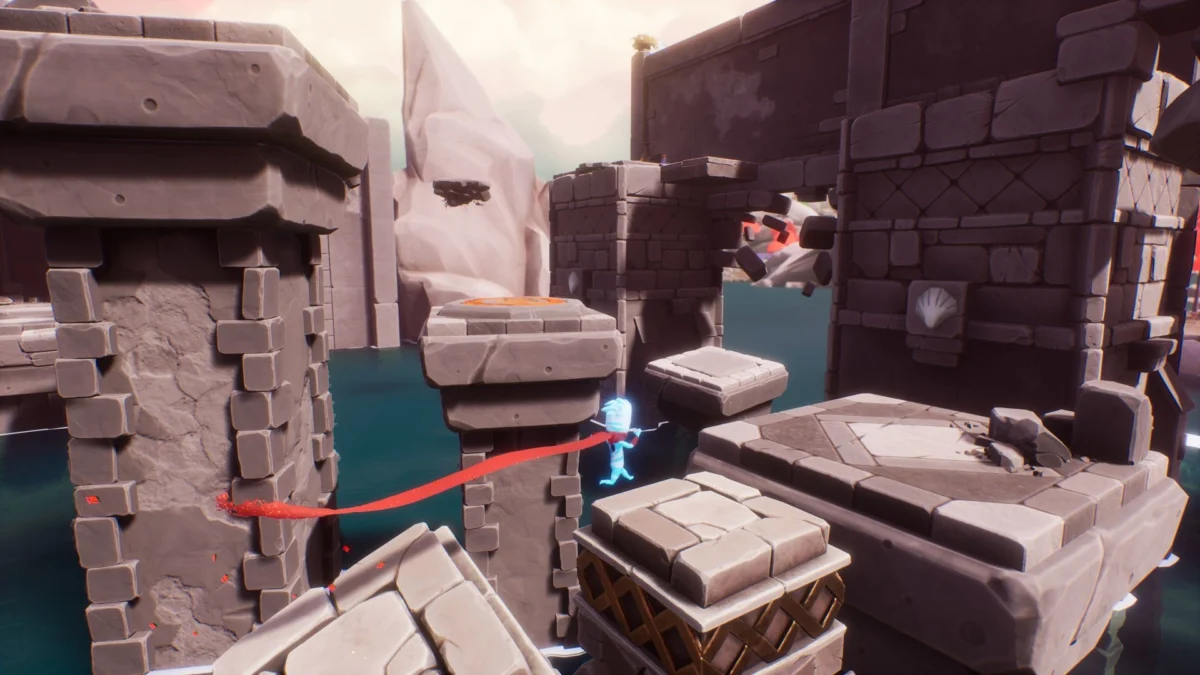
In the crowded landscape of independent adventure games, few titles manage to capture the elusive, melancholic magic of 2012’s Journey. Yet, Scarf, a visually arresting platformer, does not merely mimic its predecessors; it adopts their design ethos while weaving its own distinct narrative tapestry. Released in late 2021, Scarf invites players into a surreal, painterly universe where the central mechanic—a symbiotic relationship between a nomad and a sentient, dragon-shaped garment—serves as both a puzzle-solving tool and an emotional anchor.
The Genesis of a Journey: Core Narrative and Premise
The premise of Scarf is deceptively simple, echoing the stripped-back storytelling traditions of its genre. Players step into the role of a nameless nomad, a wanderer traversing an ancient, fragmented world. However, the protagonist is never truly alone. They are accompanied by a polymorphic, dragon-like entity that manifests as a scarf. This creature has been forcibly separated from its mother, and the duo’s primary objective is to traverse various biomes to recover fragments of a cosmic portal. Activating this gateway is the only path to reuniting the child with its parent.
This narrative setup provides the engine for the entire experience. It is a story of companionship, loss, and the inherent drive to restore balance to a fractured world. By positioning the scarf not merely as an item of clothing but as an active, living participant in the adventure, the developers have crafted a narrative that relies on non-verbal communication and shared experience rather than traditional dialogue-heavy exposition.
A Visual and Auditory Tapestry
The aesthetic of Scarf is perhaps its most immediate triumph. The game utilizes a matte, vibrant color palette that feels like a living painting. It manages to be visually stimulating without inducing fatigue, maintaining a consistent artistic vision across its sprawling, diverse landscapes. From lush, verdant forests to desolate, sun-bleached deserts, the environments are distinct and carefully crafted to evoke a sense of awe and scale.

Complementing this visual feast is an adaptive orchestral score. The music does not simply loop in the background; it breathes with the player’s actions. In open vistas, the score swells to fill the void, creating a sense of majesty. In the quiet, claustrophobic moments of exploration within cavernous ruins, the music recedes, allowing the crisp, tactile ambient sounds—the rustle of the scarf, the crunch of sand, the distant echo of wind—to take center stage. This synergy between sight and sound is what elevates Scarf from a standard platformer to a meditative, atmospheric experience.
Gameplay Mechanics: The Evolution of the Scarf
While the platforming elements in Scarf are foundational, the game’s true innovation lies in the versatility of its titular companion. As players progress, the scarf gains the ability to shapeshift, transforming into various tools that grant access to otherwise unreachable areas. These mechanics are seamlessly integrated into the movement system. One moment, the player might be using the scarf as a glider to traverse a massive canyon; the next, they are manipulating it into a hook to ascend a vertical wall.
The transition between these abilities is fluid and intuitive. More importantly, the game designers have made the scarf a reactive entity. It investigates the environment independently, occasionally unwinding from the nomad to inspect a point of interest. This creates a powerful mechanical and emotional beat: when the scarf is taken away, the player loses all their special abilities. This temporary stripping of agency forces the player to feel the weight of that absence, making the eventual reunion with the companion feel earned and genuinely impactful.
Chronology of the Adventure: Structure and Pacing
The structure of Scarf is divided into distinct, biome-based levels. The game follows a clear, progressive arc:

- The Awakening: The player begins in a tutorialized environment, learning the basics of movement and the initial bond with the scarf.
- The Gathering: As the player enters the core biomes, the "collect-a-thon" aspect comes into play. Players must navigate obstacles to recover portal fragments and sigils.
- The Revelation: Through the discovery of collectible lore fragments—presented as neolithic-style cave paintings—the narrative complexity deepens.
- The Climax: The final stages of the game bring all the acquired abilities together for a series of high-stakes platforming challenges.
- The Resolution: The final confrontation of the narrative, which challenges the player’s perception of the world and their role within it.
The pacing is deliberately slow, favoring introspection over the adrenaline-fueled sprints typical of the genre. While some players may find the cycle of "find item A to unlock gate B" repetitive, the game compensates for this with its atmosphere and the emotional payoff of its late-game plot twist.
Supporting Data: Addressing the Critique of Difficulty
It is important to acknowledge the game’s mechanical accessibility. Scarf is not a game designed to test the player’s reflexes or to punish failure. The platforming is forgiving, with generous checkpoints that ensure missing a jump never results in significant loss of progress. Puzzles, which involve standard tropes like weight switches and water physics, are designed to be approachable rather than cryptic.
This design choice has sparked a debate within the gaming community. Some critics argue that the lack of challenge renders the gameplay "rudimentary." However, the developers clearly intended for the experience to be accessible. By removing the threat of death or the frustration of complex combat, they ensure that the player’s focus remains firmly on the narrative and the emotional journey of the nomad and their companion. The omission of a combat system is particularly noteworthy; it aligns perfectly with the game’s peaceful, restorative themes.
Official Perspectives and Intent
In various post-launch discussions, the development team has emphasized that Scarf was created as a "meditative exploration." The goal was to provide a space where the player could reflect on themes of freedom, ecology, and the cyclical nature of life. The "heel turn" in the narrative—where the player realizes the true nature of the world they have been "fixing"—is the heart of this message. It transforms the game from a simple quest into a poignant commentary on how we impact our environment and the consequences of blind obedience to established systems.

Implications: A Lasting Impression
What does Scarf signify for the future of the genre? It serves as a reminder that the "indie adventure" space is far from saturated. By focusing on the emotional bond between characters and the environmental storytelling, Scarf carves out a niche that prioritizes player feeling over player performance.
For those who enjoy the "cozy game" aesthetic, Scarf is a masterclass in tone. It is a game that can be completed in a single, immersive sitting, making it an ideal experience for players who value narrative depth and artistic integrity. While it may not break new ground in terms of platforming mechanics, it succeeds in its primary directive: to tell a heartfelt, beautiful story that stays with the player long after the credits roll.
In conclusion, Scarf is a testament to the power of simplicity. It manages to be a game about connection, discovery, and the courage to question the status quo, all wrapped in a gorgeous,, colorful package. Whether one is a veteran of platformers or a casual player looking for a brief escape into a surreal world, Scarf offers an experience that is as rewarding as it is beautiful. It is, quite literally, a story you wear around your neck—a constant reminder that, even in a vast, empty world, we are never truly alone if we have something to care for.

