

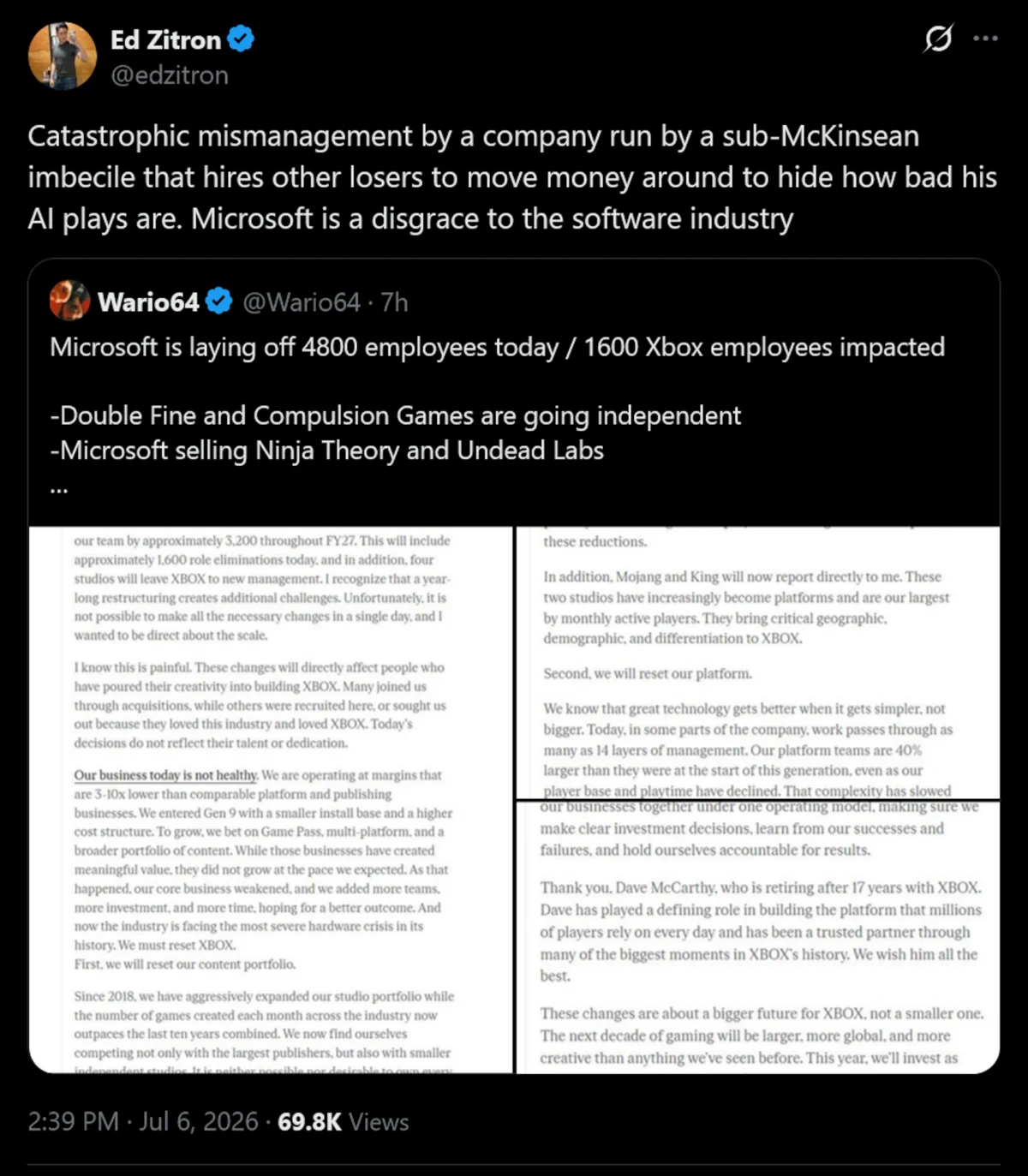
The gaming industry is currently reeling from one of the most significant labor reductions in its history. Microsoft’s Xbox division has announced a staggering plan to lay off approximately 3,200 employees. This sweeping workforce reduction, partitioned into an immediate wave of 1,600 departures followed by another 1,600 to be phased out over the coming fiscal year, marks a dark inflection point for a company that only recently positioned itself as the preeminent powerhouse of interactive entertainment.
The restructuring involves more than just headcount reductions; it fundamentally alters the landscape of game development. Four prominent studios—Compulsion, Double Fine, Ninja Theory, and Undead Labs—have been impacted, with some transitioning to independent status while others are shifted under new ownership structures. As the dust settles, the industry is left grappling with the human cost, the erosion of institutional knowledge, and a pervasive sense of distrust regarding the strategic direction of Microsoft’s gaming leadership.
The Chronology of a Corporate Collapse
To understand the severity of this moment, one must look at the timeline of the last two years. Since Microsoft finalized its monumental acquisition of Activision Blizzard in 2024, the gaming division has existed in a state of perpetual instability.

The current announcement follows a pattern of "surprising" shifts in policy. For many employees, the news arrived not as a strategic pivot, but as a jarring contradiction. Griffin DeClaire, a developer at Bethesda Game Studios, shared a sentiment echoed by many: he had been notified of an upcoming raise just days before his position was eliminated. This disconnect between internal performance assessments and corporate headcount targets highlights a breakdown in communication that has left veteran staff feeling blindsided and expendable.
The "slow-roll" approach to these layoffs—where 1,600 people are let go immediately and another 1,600 are essentially placed on an indefinite notice period for the next year—has been roundly criticized. Industry analysts and former employees describe this as a psychological endurance test. By creating a prolonged state of uncertainty, the company has effectively crippled morale, leaving those who remain in a constant state of "survivor’s guilt" and perpetual anxiety, waiting for the "other shoe to drop."
A Pattern of Inconsistency
The irony of the current situation is not lost on industry observers. Only a year ago, Microsoft leadership, including Phil Spencer, was publicly declaring that the company’s "platform, hardware, and game roadmap have never looked stronger." The rapid descent from that optimistic proclamation to the current admission that the business is "not healthy" suggests a profound failure in long-term planning and fiscal oversight.

The impact has rippled through studios once thought to be shielded from such volatility. Obsidian Entertainment, a studio revered for its narrative-driven RPGs, was initially believed to be safe. That illusion was shattered when narrative lead Kate Dollarhyde revealed on Bluesky that the studio had lost a significant number of "excellent developers." Among them was Daniel Alpert, an art director who had been with the studio since 2005. Alpert’s departure—after two decades of contribution—serves as a grim reminder that in the current climate, longevity and legacy offer no protection against the bottom-line mandates of a massive conglomerate.
Official Responses and Industry Backlash
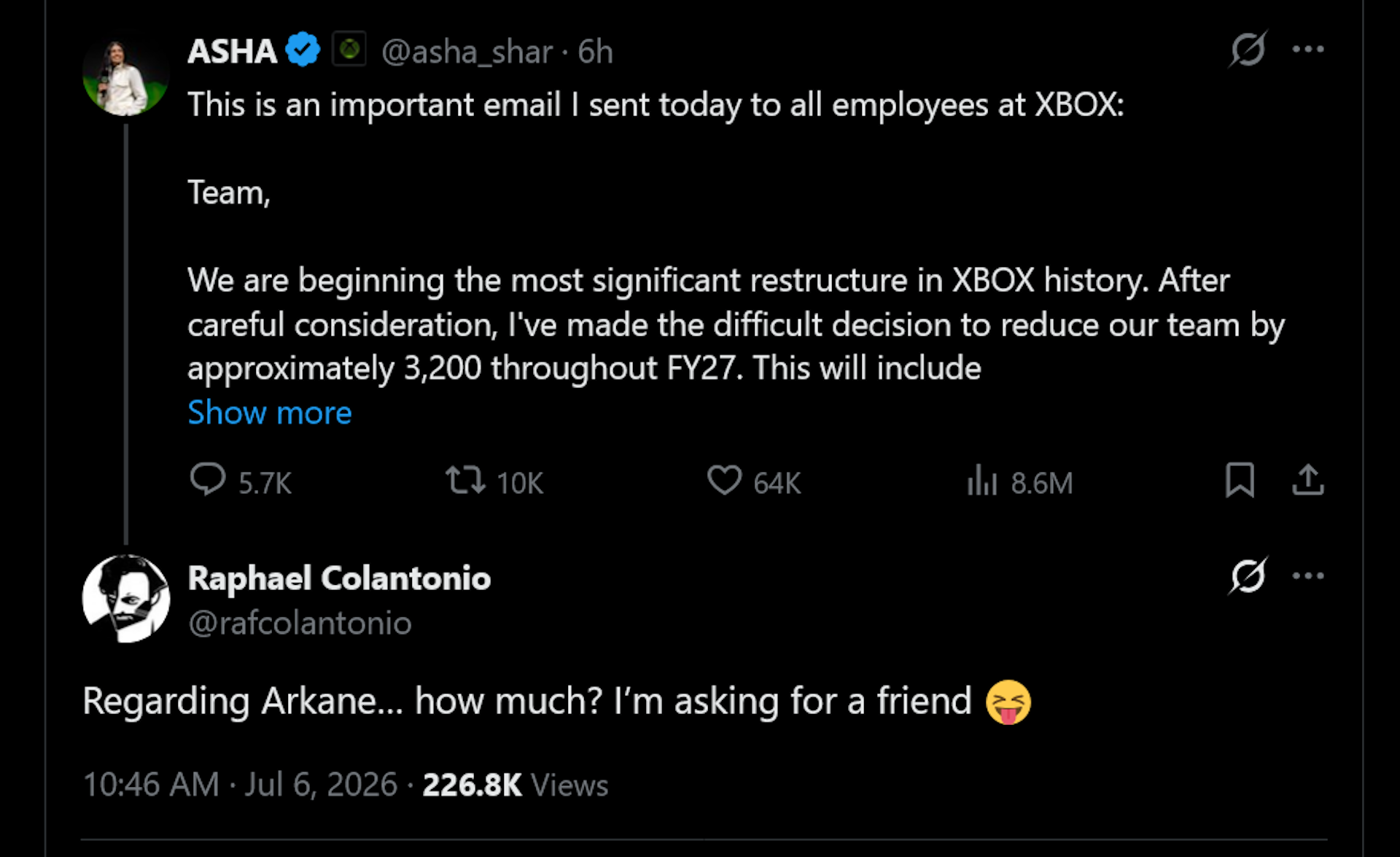
Public reactions to the news have ranged from cynical humor to profound outrage. Raphael Colantonio, the founder of Arkane, took to social media with a biting critique, mocking the company’s handling of the situation. Meanwhile, Michael Douse, the publishing director at Larian Studios, voiced a sentiment shared by many in the developer community: genuine shock at the administrative realities of the organization. "They didn’t have a Chief Operating Officer?" Douse asked, pointing to a glaring gap in the executive structure that arguably contributed to the current mismanagement.
The absurdity of the situation is compounded by the stated goals of current Xbox leadership. CEO Asha Sharma has spoken of a vision to cater to "more than a billion people each day." Critics have labeled this target as delusional, noting that it represents a user base 24 times larger than the peak concurrent population of Steam. When executives use such hyperbolic metrics to justify the existence of their division, the resulting layoffs feel less like a necessary correction and more like a disconnect from the reality of game development.
The AI Obsession and Resource Misallocation
Perhaps the most contentious aspect of these layoffs is the simultaneous, aggressive pivot toward Artificial Intelligence. While thousands of skilled human workers are being discarded, Microsoft continues to pour billions of dollars into AI initiatives, such as the struggle to make Copilot a viable, profitable product.
Critics like Ed Zitron have been vocal about the mismanagement at the top, characterizing the current regime as "sub-McKinsean," focused on moving money around to mask the failure of their AI investments rather than investing in the creative core of their business. This is not merely an opinion; the data supports a shift in priorities. Employees who were focused on actual software and game development are being replaced—or at least out-prioritized—by resources funneled into speculative AI ventures that, to date, have shown little in the way of consumer demand or profitability.
Even employees working directly on AI integration have not been spared. Kevin Flynn, a product manager who successfully increased AI adoption within his department by 79% in just three months, was included in the layoff notices. This suggests that for Microsoft, the goal is not merely "efficiency through technology," but a top-down dismantling of headcount regardless of individual contribution or technological success.

Implications for the Future of Gaming
The implications of these mass layoffs extend far beyond the immediate financial losses for the individuals involved.
- Loss of Institutional Knowledge: The industry is hemorrhaging talent. When a developer with 20 years of experience like Daniel Alpert is let go, the collective memory and craft expertise of the industry vanish with them. This "brain drain" will undoubtedly lead to a decline in the quality and complexity of future titles.
- The "Pre-Announcement" Effect: By announcing layoffs that will take place over a full fiscal year, companies are creating a toxic work environment. Productivity naturally plummets when staff members are forced to work while waiting to see if they will be terminated in the next quarterly wave.
- The Dystopian Pivot: The industry is increasingly being steered by executives who view gaming as a "content feed" rather than an art form. The focus on massive, daily active user counts at the expense of studio culture suggests a move toward a model where games are treated as disposable commodities rather than cultural touchstones.
- Market Saturation and Sustainability: As noted by industry veterans like Scott Maclean, the current trend is unprecedented in the last 25 years. The industry is reaching a point where it can no longer reabsorb the talent being displaced. This creates a permanent class of "lost" developers, forcing skilled individuals to leave the sector entirely.
Conclusion: A Turning Point
We are witnessing a fundamental shift in the video game industry. The era of the "studio" as a stable, creative home is being replaced by the era of the "asset" that can be liquidated at the first sign of a quarterly dip. The disconnect between the rhetoric of "stronger than ever" roadmaps and the reality of 3,200 empty desks is a damning indictment of current leadership.
As the industry continues to "howl into the social media void," one must wonder if there is any mechanism left to stop this trend. The current path is unsustainable. By prioritizing short-term AI gains and "delusional" growth metrics over the people who actually build the products, companies like Microsoft are not just losing employees—they are losing the very foundation of what makes their games valuable in the first place.
If this is the new normal, the gaming industry faces a decade of stagnation, marked by the loss of its most talented voices and the erosion of the creative integrity that once defined it. The challenge for the future is not just to build better games, but to rebuild a culture that values the human beings responsible for their existence. Until then, the cycle of layoffs and "restructuring" will continue to cast a long, dark shadow over the entire interactive entertainment sector.

