

In a decision that marks a seismic shift for the gaming industry, Sony Interactive Entertainment has officially announced that it will discontinue the production of physical game discs for all PlayStation consoles, effective January 2028. The news, delivered via a succinct post on the official PlayStation Blog, signals the end of a decades-long tradition of tangible media ownership in the console space.
As the digital transformation of entertainment accelerates, Sony’s pivot toward an exclusively digital distribution model positions the company at the vanguard of a controversial industry trend. While the transition promises streamlined storefronts and immediate access for players, it has ignited a firestorm of debate regarding the future of digital preservation, consumer rights, and the long-term viability of media ownership.
The Facts: A Mandated Digital Horizon
Beginning in January 2028, the PlayStation ecosystem will transition entirely to a digital-only software delivery model. This mandate applies to all new software releases, including major AAA titles, indie games, and—notably—experiences designed for PlayStation’s virtual reality headsets.
Under the new policy, physical retail stores will no longer receive shipments of game discs. Instead, consumers will be directed exclusively to the PlayStation Store for digital downloads, or to retail partners that facilitate digital-only sales. Sony has clarified that titles released prior to the January 2028 cutoff will remain unaffected; these physical copies will continue to function, and the secondary market for pre-2028 games will remain open. However, from the specified date onward, the prospect of purchasing a game in a tangible, shelf-ready format will effectively vanish from the PlayStation landscape.
A Chronological Shift: How We Arrived at the Digital Precipice
To understand the magnitude of this decision, one must look at the gradual erosion of physical media over the last fifteen years.
The Era of Physical Dominance (Pre-2010s)
For the first three decades of home console gaming, the disc (or cartridge) was the king of the industry. It represented total ownership, the ability to trade, sell, or loan games to friends, and a guarantee that a game could be played offline indefinitely.
The Rise of Digital Storefronts (2010–2020)
The introduction of the PlayStation Store allowed for the convenience of downloading titles from the comfort of one’s home. Initially, this served as an alternative to physical media. However, with the launch of the PlayStation 5, Sony introduced a "Digital Edition" console, signaling that the company was testing consumer appetite for a disc-less future.
The Acceleration (2020–2026)
The COVID-19 pandemic catalyzed a massive surge in digital game sales, as lockdowns forced retail closures and normalized remote purchasing. During this period, companies saw massive profit margins from digital sales, as they eliminated the costs associated with manufacturing, shipping, and retailer profit-sharing.
The Finality (2026–2028)
Following years of incremental shifts, Sony’s 2026 announcement acts as the final nail in the coffin. By providing an eighteen-month lead time, the company is attempting to soften the blow for developers and retail partners, though the industry at large recognizes this as the definitive end of the physical console market.
Supporting Data: The Case for Digital vs. The Reality of Ownership
Sony’s justification for this move rests on "consumer preferences." Market data from the past five years supports the notion that the majority of modern gamers have opted for the convenience of digital libraries. Monthly active user (MAU) metrics for the PlayStation Store have consistently trended upward, often dwarfing physical retail sales for major software releases.
However, the "convenience" argument hides a growing, well-documented crisis: The Delisting Phenomenon.
According to organizations such as Delisted Games, there has been an alarming increase in the number of digital titles removed from storefronts due to licensing expirations, server shutdowns, or publisher bankruptcy. When a digital game is pulled, it often becomes impossible for even those who purchased the title to re-download it. Unlike a physical disc, which remains playable regardless of server status or licensing agreements, digital titles exist as "licenses" that can be revoked by the platform holder at any time.
For VR enthusiasts, this transition is particularly painful. PlayStation has historically maintained a niche but dedicated library of physical VR and VR2 titles, such as Vertigo 2, Tetris Effect: Connected, and The Last Worker. Once 2028 hits, the physical preservation of these VR experiences—which are often more susceptible to "abandonware" status than flat-screen games—will become entirely dependent on Sony’s internal servers.
Official Responses and the Public Outcry
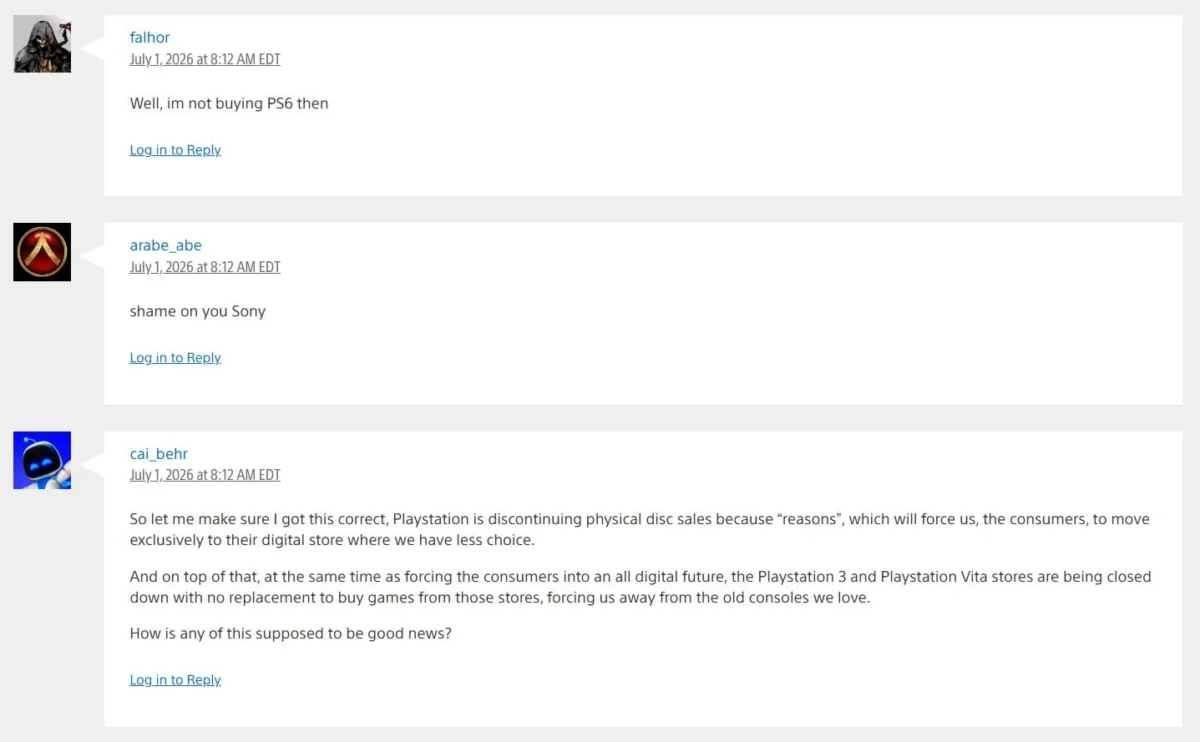
The reaction to Sony’s blog post was immediate and overwhelmingly negative. The comments section of the PlayStation Blog, typically a space for discussing new hardware features or game updates, became a forum for collective frustration.
The Community Sentiment
Users expressed deep concern regarding the loss of value. Without the ability to trade or resell games, the total cost of ownership for a gamer increases significantly. Furthermore, collectors who have built libraries over decades view this as a direct assault on the preservation of gaming history.
The Developer Perspective
While many developers favor digital distribution due to the lack of manufacturing overhead, some indie creators have voiced concerns. Physical releases often provide a "second wind" for titles through limited, boutique releases (such as those from Limited Run Games). These physical editions serve as a way for developers to celebrate their work and generate additional revenue from collectors. With the 2028 cutoff, this revenue stream and cultural touchstone will be eliminated.
Sony, for its part, has remained firm. In subsequent, limited statements, company representatives have reiterated that this shift is necessary to ensure the "longevity and scalability" of the PlayStation network, promising that the transition will allow for more seamless updates and a more unified user experience.
Implications: A Future Without Physical Media
The decision to abandon physical discs has wide-reaching implications for the gaming industry, the retail sector, and the legal framework of consumer rights.
1. The Death of the Secondary Market
The used game market has long been a staple of the industry. It allowed lower-income players to access games at a discount and fostered a robust community of collectors. By moving to digital-only, Sony effectively creates a walled garden where they maintain total control over pricing. Players will no longer be able to buy a cheaper used copy of a game from a local shop or trade games with friends.
2. Digital Preservation and "Dead" Games
Perhaps the most significant long-term consequence is the threat to gaming history. If a game exists only on a server, what happens when that server is inevitably shut down? History shows that companies prioritize cost-cutting over archiving. Without physical media, we risk a "Digital Dark Age" where thousands of titles simply cease to exist once the platform holder decides they are no longer profitable.
3. Impact on Retailers
Retail giants like GameStop, Walmart, and Target will face a significant shift in their business models. The physical game aisle has long been a destination for foot traffic. As gaming transitions to digital, retailers will be forced to rely entirely on gift cards and peripheral sales, further weakening their role in the gaming ecosystem.
4. Consumer Rights and Ownership
This move highlights a fundamental legal ambiguity in the digital age: do we own our games, or are we merely renting them? Sony’s terms of service have always leaned toward the latter, but the removal of the physical option makes this reality unavoidable. This may trigger future legislative scrutiny, as consumer advocacy groups have begun to argue that digital storefronts should be subject to more stringent requirements regarding permanent access to purchased media.
Conclusion: A New Frontier
As we approach January 2028, the industry stands at a crossroads. While Sony’s decision is undoubtedly motivated by efficiency, profit margins, and modern consumer habits, it comes at a cost that is difficult to quantify: the loss of tangible ownership.
The era of the disc has provided millions of players with a sense of security and a tactile connection to the art they love. As that era draws to a close, the burden of preservation shifts from the consumer to the corporation. Whether Sony can prove that its digital ecosystem is a reliable guardian of gaming history remains to be seen. For now, players have three years to build their physical libraries before the doors close on the format forever. The industry is moving forward, but for many, the path ahead looks significantly more fragile than the one left behind.

