

Published: December 20, 2021
In the vast, often saturated landscape of indie adventure gaming, titles frequently struggle to carve out an identity distinct from the titans that preceded them. Yet, every so often, a game emerges that wears its influences on its sleeve—or, in this particular case, wrapped snugly around its neck. Scarf, a 3D puzzle-platformer, is a title that embraces its spiritual kinship with 2012’s critically acclaimed Journey while simultaneously weaving its own unique tapestry of mechanics, narrative depth, and emotional resonance.
The Core Premise: A Bond Beyond Words
At its heart, Scarf presents a deceptively simple premise. Players step into the shoes of a nameless nomad wandering through a beautifully rendered, ancient world. However, the nomad is not traveling alone. They are accompanied by a polymorphic, dragon-shaped scarf that has been forcibly separated from its mother. The objective is clear: the nomad and the scarf must traverse a series of interconnected landscapes, retrieving fragments of a mystical portal. Once activated, this portal serves as the catalyst to reunite the young creature with its parent.
This narrative setup—a silent protagonist and a non-human companion—immediately draws comparisons to the minimalist storytelling of Journey. Yet, Scarf distinguishes itself through the intimacy of its central relationship. The scarf is not merely a cosmetic accessory; it is a sentient, reactive entity that serves as the player’s primary means of interaction with the world.
A Chronology of Discovery: Navigating the Landscape
The gameplay loop in Scarf is designed to be accessible, prioritizing a sense of wonder and discovery over punishing mechanical difficulty.
Phase 1: Exploration and Orientation
The game opens with the player discovering the scarf. Initially, the nomad is limited in their movement, but as the partnership grows, the environment opens up. The game utilizes a clever system of visual signposting; light particles drift toward points of interest, subtly guiding the player forward without the need for intrusive HUD elements or objective markers. This fosters a sense of agency that allows the player to feel as though they are exploring the world at their own pace.

Phase 2: Mechanic Integration
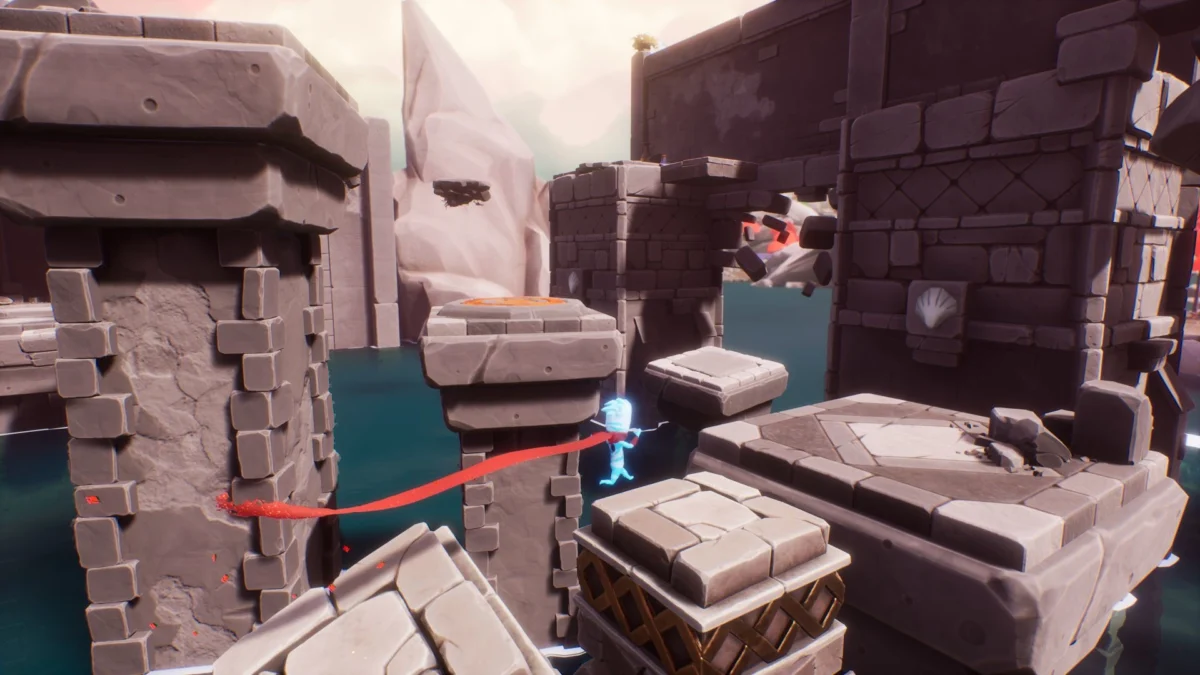
As the player progresses through forests, deserts, and surreal floating islands, the scarf begins to evolve. It shapeshifts into various tools—wings for gliding, a grappling hook for traversal, or a buoy for aquatic navigation. This progression is handled seamlessly, with the game introducing new mechanics just as the player begins to master the previous ones. The platforming controls are smooth and responsive, characterized by a slightly "floaty" aesthetic that mirrors the ethereal nature of the world.
Phase 3: The Narrative Shift
Midway through the journey, the game introduces "lore fragments"—collectable cutscenes stylized as neolithic cave art. These vignettes, interpreted by a somber narrator, initially seem disconnected. However, as the player gathers more fragments, the overarching story undergoes a profound transformation. What begins as a heartwarming tale of family reunion evolves into a sobering, allegorical commentary on ecology, the nature of freedom, and the consequences of human intervention in the natural order.
Supporting Data: Visuals, Sound, and Mechanics
The production values of Scarf are a testament to the care poured into its development. The visual style is defined by a "matte vibrancy"—a color palette that feels like a living painting, remaining visually stimulating even after extended play sessions.
Orchestral Adaptation
The sound design is perhaps the most impressive technical feat of the game. It features an adaptive orchestral score that dynamically shifts based on the player’s location. In vast, open vistas, the music swells to capture the grandeur of the environment, while in the quiet of a cavern, the score recedes, allowing the crisp ambient sounds of the world—the rustle of wind, the drip of water, the faint hum of the scarf—to take center stage.
The "No-Combat" Philosophy
Scarf intentionally omits a combat system. While some might view this as a lack of complexity, it is, in fact, a deliberate design choice. By removing the need for violence, the developers ensure that the player’s focus remains entirely on exploration and problem-solving. There are no enemies to slay, only mysteries to unravel, which keeps the experience focused on the emotional journey rather than the mechanics of conflict.
Accessibility and Pacing
The game is explicitly designed to be non-frustrating. The platforming requires minimal precision, and the penalty for failure is negligible; missing a jump results in an immediate respawn on the nearest ledge. This "forgiving" design philosophy encourages experimentation, allowing players who might be intimidated by traditional platformers to engage fully with the narrative.

Official Perspectives: The Developer’s Vision
While the studio behind Scarf has remained modest in its public discourse, the design of the game speaks volumes. In various interviews, the developers have emphasized that they wanted to create a "breathing" world where the companion feels like a living entity.
The mechanic of the scarf occasionally "unwinding" from the nomad to explore the world on its own serves a dual purpose. It forces the player to prioritize environmental puzzles, but it also reinforces the scarf’s status as a distinct character. When the scarf is absent, the player loses their primary abilities, creating a tangible sense of loss. This mechanic effectively forces the player to empathize with the bond between the two, transforming the scarf from a "tool" into a "partner."
Implications and Critical Reflection
Despite its many strengths, Scarf is not without its hurdles. It is, by definition, a "collect-a-thon." Players are tasked with gathering portal fragments, sigils, and orbs, often backtracking through environments to complete these objectives. This can lead to a sense of repetition, particularly for players who prefer a more linear, fast-paced experience.
The pacing is deliberately slow, which may alienate those looking for high-octane thrills. Furthermore, veteran platforming enthusiasts may find the puzzle solutions—ranging from weight switches to basic physics manipulation—to be somewhat elementary.
However, to dismiss Scarf as "just another platformer" is to miss the forest for the trees. Its true value lies in its ability to deliver a coherent, emotionally resonant message in a single, accessible sitting.
The Weight of the Message
The "heel turn" in the game’s narrative—the realization of the environmental and social consequences of the nomad’s actions—is the true crux of the experience. By forcing the player to reflect on the nature of their quest, the game elevates itself from a simple adventure to a poignant exploration of responsibility.

The decision to include a replayable menu for the lore fragments shows that the developers want the player to synthesize the meaning behind the story. It is a game that respects the player’s intelligence, inviting them to piece together the history of a dying world and understand their role in its potential salvation.
Conclusion
Scarf is a rare example of a game that understands the power of minimalism. It does not need to reinvent the wheel to make an impact. By focusing on a tight, heartfelt narrative, a beautiful aesthetic, and a bond between two characters that transcends dialogue, it achieves a rare level of intimacy.
For the average player, Scarf offers a relaxing, introspective, and satisfying experience. For the critic, it serves as a reminder that the most compelling games are not necessarily those that challenge our reflexes, but those that challenge our perspectives. It is a journey well worth taking, provided you are willing to slow down, look at the paintings, and listen to the music as the scarf guides you through the silence of an ancient world. Whether you are a veteran of the genre or a newcomer to digital landscapes, Scarf offers a warm, thought-provoking embrace that lingers long after the final credits roll.

