

In the late 1990s, Nintendo found itself at a crossroads. The Legend of Zelda series was critically acclaimed, yet the company faced a logistical challenge: how to expand the franchise’s reach to a younger audience while maintaining the high standards of its home console offerings. The solution did not come from within Nintendo’s internal development teams, but rather from a surprising partnership with Capcom. Twenty-five years later, The Legend of Zelda: Oracle of Ages and Oracle of Seasons stand as the most inventive and structurally daring 2D entries in the franchise’s long and storied history.
The Genesis of an Unlikely Partnership
By 1999, the Zelda series was grappling with how to translate its epic scope into the portable market. Nintendo, eager to leverage the Game Boy Color, sought a fresh perspective. Capcom screenwriter Yoshiki Okamoto proposed an ambitious plan to his superiors: a trilogy of Zelda games that would push the hardware to its absolute limit.
Okamoto pitched the idea to series creator Shigeru Miyamoto, who was initially skeptical of a third-party developer handling such a crown jewel of the Nintendo library. However, the project was greenlit under Capcom’s then-new subsidiary, Flagship. The development process was notoriously grueling. The original plan—a remake of the original NES Zelda followed by two original titles—was eventually trimmed due to technical constraints. After years of development, the vision coalesced into the two distinct, yet interconnected, adventures we know today: Oracle of Ages and Oracle of Seasons, released in 2001.
Chronology: From Concept to Console
The development of the Oracle titles is a fascinating study in collaboration. Between 1999 and 2001, the Flagship team, led by Hidemaro Fujibayashi (who would later go on to direct Breath of the Wild and Tears of the Kingdom), worked closely with Nintendo to ensure the "Zelda feel" remained intact while pushing for mechanical innovation.
- 1999: The concept is pitched by Yoshiki Okamoto to Shigeru Miyamoto. The project is officially codenamed "The Triforce Trilogy."
- 2000: Technical difficulties force the team to abandon the remake aspect of the project, focusing instead on the dual-title system.
- 2001: Oracle of Ages and Oracle of Seasons are released for the Game Boy Color, offering a "linked" system that allowed players to carry progress and secret codes from one game to the other.
- Present Day: The games remain cult classics, frequently cited as the pinnacle of 2D Zelda design, influencing a generation of indie developers and puzzle-platformer designers.
A Tale of Two Worlds: Labrynna and Holodrum
The brilliance of the Oracle games lies in their world-building. While previous titles often felt like isolated corridors of dungeons, Oracle of Ages and Oracle of Seasons presented living, breathing societies.

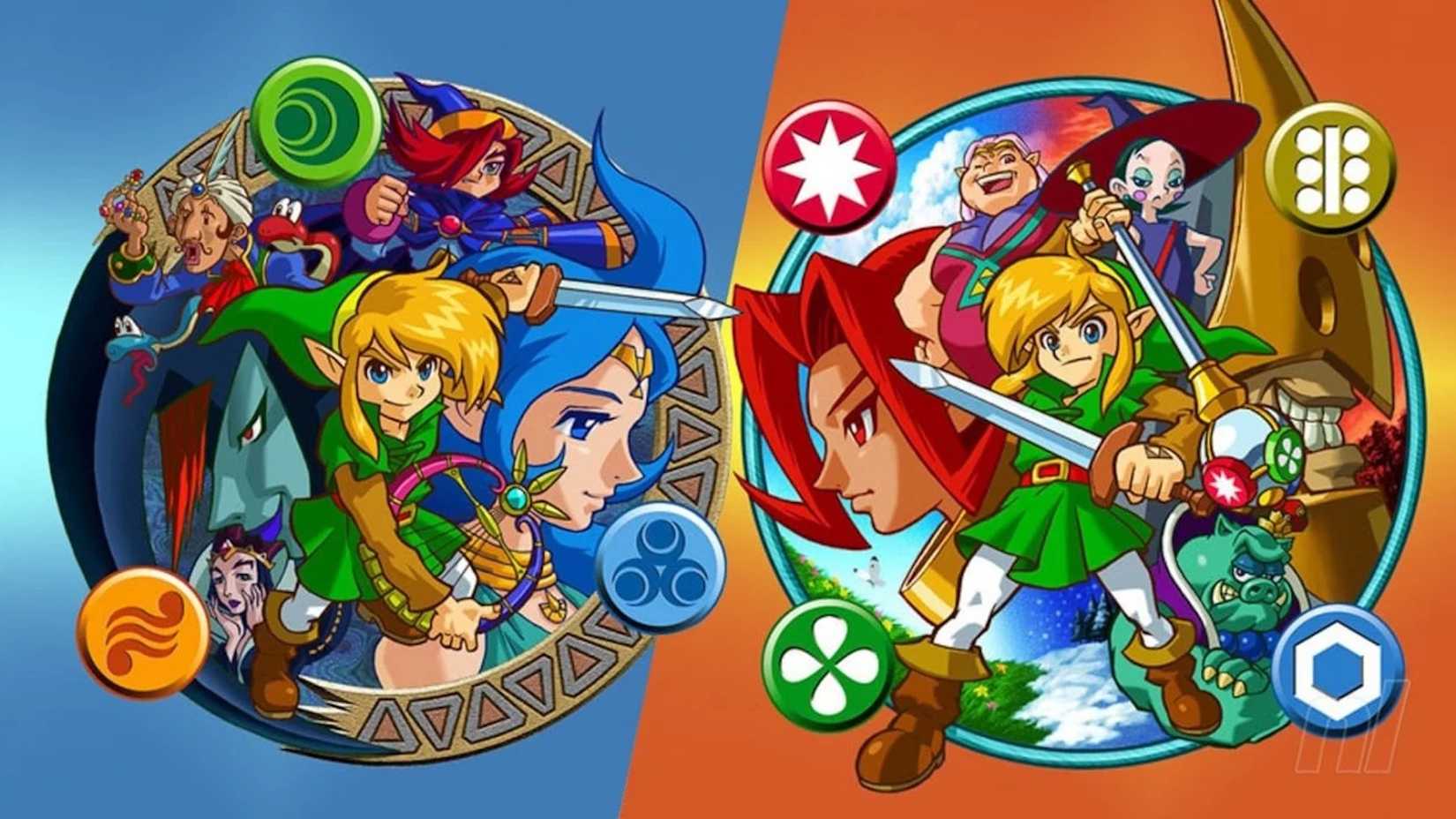
In Oracle of Seasons, players explore the land of Holodrum, a vibrant world where the seasons can be manipulated to change the environment. In Oracle of Ages, the focus shifts to Labrynna, where Link navigates the flow of time between the past and the present. These were not merely gimmicks; they were the foundation for complex, interconnected puzzle-solving that forced players to think across spatial and temporal planes.
Beyond the mechanics, the population of these lands felt distinct. The games introduced a cast of characters that transcended the standard "damsel in distress" tropes. From the underground cities of dance-obsessed citizens to the pirate-filled seas and the Moblin fortresses, these worlds felt lived-in. The inclusion of Tingle, the eccentric mapmaker, and a robust trading system added layers of personality that made the environment feel like a true fantasy ecosystem rather than a collection of levels.
Implications: The "Majora’s Mask" of 2D Gaming
Retrospectively, the Oracle games act as a 2D counterpart to the experimental nature of Majora’s Mask. While they utilize the traditional top-down perspective, they abandon the rigid, predictable structure of the Hylian status quo. There is a refreshing sense of independence here; Link is not always the "Chosen One" burdened by a centuries-old prophecy. He is an adventurer who happens to be in the right place at the right time, responding to local crises with bravery rather than destiny.
This shift in narrative weight allowed for more creative storytelling. By removing the baggage of the Triforce and the constant looming presence of Ganon (until the very end, via the linked game mechanic), Capcom was free to explore smaller, more intimate stories. The "linked game" feature—where completing one game provided a password to unlock the true conclusion in the other—was an industry-leading use of connectivity, rewarding players for their dedication in a way few games had ever attempted before.
Official Stance and Historical Reception
Nintendo’s willingness to outsource such a vital franchise was a rare move, but one that paid dividends in terms of prestige. In historical interviews, Shigeru Miyamoto noted that the Oracle project helped validate his trust in outside developers. The technical proficiency required to make two games interact so seamlessly on 8-bit hardware was, at the time, unprecedented.

Critics at the time of release praised the games for their "dense design." While some noted that the dungeons lacked the iconic status of those in A Link to the Past, they were almost universally lauded for their overworld complexity and the sheer volume of content packed onto a tiny Game Boy cartridge.
The Lasting Legacy
As we look back 25 years later, the Oracle games serve as a masterclass in design economy. They prove that a title does not need a massive open world to feel "expansive." By focusing on tight mechanics—the changing seasons in Holodrum and the time-traveling shifts in Labrynna—the developers created a sense of scale that felt meaningful and deliberate.
Furthermore, these games established a blueprint for future Zelda titles. Hidemaro Fujibayashi’s experience on the Oracle team was foundational to his later work. The emphasis on environmental interaction and the ability to solve problems in non-linear ways can be traced back to the seeds planted in these two 8-bit adventures.
Why They Remain the Best
Many fans argue that the Oracle games are the "best" 2D Zelda entries because they represent the series at its most uninhibited. They were not tasked with redefining the genre, but rather with perfecting it. They took the established "Zelda formula"—acquire item, enter dungeon, defeat boss—and infused it with a sense of wonder, cultural depth, and mechanical variety that hasn’t been matched since.
Even the flaws—such as the sometimes cryptic nature of the puzzles or the repetitive nature of certain dungeon themes—are viewed through a lens of nostalgia as part of their charm. They were games that didn’t hold the player’s hand, forcing them to engage with the world, talk to the NPCs, and truly observe the environment.
Conclusion: A Timeless Adventure
Twenty-five years later, Oracle of Ages and Oracle of Seasons remain essential pillars of the Zelda franchise. They stand as a testament to what can be achieved when a talented studio is given the freedom to innovate within a beloved framework.
For modern gamers, these titles offer a glimpse into a time when Zelda was not just about the destination, but the myriad of strange, wonderful, and challenging paths taken to get there. Whether you are navigating the autumn winds of Holodrum or deciphering the clockwork history of Labrynna, the Oracle games continue to prove that even on the smallest of screens, a legend can be truly, monumentally grand. As the series continues to evolve into the vast, open-world epics of the modern era, it is worth remembering the two games that proved that sometimes, the most profound adventures are found by simply looking at the world from a different season, or a different time.

