

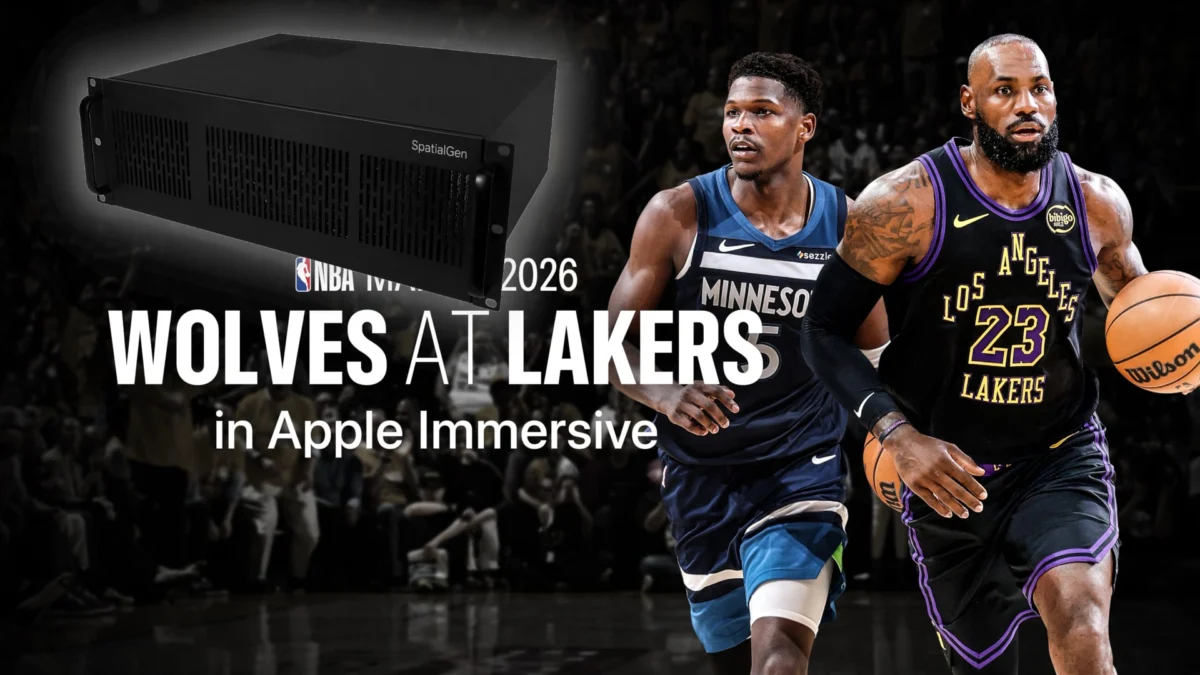
The frontier of digital entertainment is no longer defined merely by screen resolution, but by presence. As Apple’s Vision Pro continues to redefine the boundaries of spatial computing, the challenge for broadcasters has shifted from simple delivery to managing the colossal data demands of high-fidelity immersive video. Enter SpatialGen’s Zeus, a purpose-built, 3U rack-mounted powerhouse designed to ingest, encode, package, and distribute the heavy-duty ProRes streams required for premium immersive experiences.
While viewers enjoy the seamless clarity of a courtside Lakers game in their headsets, the "invisible infrastructure" behind the scenes—a complex choreography of codecs, pipelines, and high-speed throughput—is often the most daunting barrier to mass adoption. With Zeus, SpatialGen is positioning itself as the foundational layer for this new era of live media.
Main Facts: What is Zeus?
SpatialGen Zeus is not a consumer device; it is a high-performance production ecosystem contained within a standard 3U rack form factor. Designed specifically for the rigorous demands of Apple Immersive Video, Zeus functions as the "brain" of the live production pipeline.
At its core, the system is engineered to handle the massive bandwidth requirements of ProRes 2110. The hardware enables:
- 16K Ingest Capability: Supporting the next generation of professional-grade 3D camera sensors.
- High Frame Rate Performance: Capable of sustained 90+ FPS, ensuring that motion remains fluid to prevent nausea and maintain immersion.
- Extreme Throughput: Delivering 100 Gb/s peak sustained throughput, necessary for the dense, uncompressed, or lightly compressed data streams of 180-degree stereoscopic video.
- Cloud-Agnostic Distribution: Native integration with leading content delivery networks (CDNs) including AWS CloudFront, Microsoft Azure, Google Cloud Platform, and Akamai, alongside SpatialGen’s proprietary distribution network.
The system is sold as a "full-stack" service. Each purchase includes the physical hardware, a perpetual software license, and one year of direct-access engineering support. This "white-glove" approach acknowledges the fragility of live immersive production, where a single packet loss or encoding error can shatter the illusion of presence for thousands of viewers simultaneously.
Chronology: The Evolution of the Immersive Pipeline
The journey to Zeus is a reflection of the broader industry shift toward "Spatial Reality."
Phase 1: The Experimental Era (2018–2022)
Early attempts at live VR streaming were largely disjointed. Production crews relied on "one-off" technical experiments, often stitching together disparate hardware and software solutions that were never designed for real-time 3D delivery. Latency was high, resolution was low, and the "screen door effect" was an inescapable reality.
Phase 2: The Standardization Push (2023)
With the announcement of the Apple Vision Pro, the industry faced a pivot. Apple introduced a standard for "Apple Immersive Video"—180-degree 3D footage with high-dynamic-range (HDR) and spatial audio. This established a new "gold standard," but it also introduced a massive hurdle: the files were too large for standard streaming protocols to handle in real-time.
Phase 3: The Infrastructure Breakthrough (2024–Present)
SpatialGen began to emerge as the lead architect for this new standard. During the recent AWE (Augmented World Expo), the company revealed that it is currently responsible for streaming more than 90% of third-party immersive video content found on the Apple Vision Pro. The launch of the Zeus system represents the formalization of this expertise into a commercial product, moving the technology from bespoke lab work to a scalable, professional broadcast tool.
Supporting Data: Why ProRes 2110 Matters
To understand why Zeus is a technological breakthrough, one must look at the math behind the stream. Traditional 2D video compression is well-optimized; we have been streaming 4K video for over a decade. However, Apple Immersive Video requires two high-resolution streams (one for each eye) to be perfectly synchronized, mapped to a 180-degree field of view, and delivered with HDR metadata.
- The Throughput Challenge: A single 8K stereoscopic feed at 90 frames per second generates data at a rate that would overwhelm standard consumer routers and most existing broadcast encoders.
- The Blackmagic Integration: Zeus specifically supports the Blackmagic URSA Cine Immersive 100G camera. This camera is the industry’s first to offer an 8K stereoscopic capture system natively tuned for the Vision Pro. By integrating directly with this hardware, Zeus removes the bottleneck between the sensor and the cloud.
- Real-World Application: The efficacy of this pipeline was proven during the recent live broadcast of Los Angeles Lakers games on Spectrum Front Row. Viewers were able to witness the game with an unprecedented sense of scale, a feat made possible only because the ingest, encoding, and distribution pipeline could handle the multi-terabyte requirements of the ProRes footage without significant latency.
Official Responses and Engineering Philosophy
SpatialGen’s leadership emphasizes that the complexity of live immersive production is often underestimated. During a recent briefing, company representatives noted that "live immersive production involves a web of dependencies—different cameras, routing, encoding targets, digital rights management (DRM), and monitoring needs."
The company’s philosophy is that you cannot "hack together" a live 3D experience. By providing a unified hardware and software stack, SpatialGen is attempting to remove the friction that prevents sports leagues, concert promoters, and event organizers from adopting immersive formats. The inclusion of one year of direct access to SpatialGen engineers is a testament to this commitment; in the world of live sports, there is no "undo" button for a failed broadcast.
Implications: The Invisible Infrastructure of Tomorrow
The impact of the Zeus system extends far beyond the technical specifications of a rack-mounted server. It signals a shift in how we perceive "broadcast television."
The Death of the "One-Off" Experiment
For years, immersive broadcasting was treated as a marketing gimmick. A company would spend six months planning a single "VR experience" that would be watched by a few thousand people. Zeus aims to turn this into a repeatable, automated, and professional workflow. When a production house can plug in a Blackmagic camera, route it through a Zeus box, and push it to a global CDN with the same reliability as a traditional satellite feed, the barrier to entry for immersive content drops significantly.
A New Standard for Sports and Live Events
Live sports remain the primary driver for high-end video infrastructure. The success of the Lakers broadcasts on the NBA app and Spectrum SportsNet is the "proof of concept" for the entire spatial computing industry. If the infrastructure can handle the fast-paced, high-motion environment of a basketball game—where the camera moves constantly and the lighting changes rapidly—it can handle almost anything.
The Vision Pro as a Mass-Market Window
While Zeus is a professional tool, its existence is vital for the Vision Pro owner. For the average user, the quality of their experience is entirely dependent on the quality of the stream. If the "middle-man"—the encoding and distribution pipeline—is slow or lossy, the headset’s high-resolution displays are wasted. By hardening this infrastructure, SpatialGen is essentially "future-proofing" the Apple Vision Pro as a viable alternative to the traditional television set.
Looking Toward the Future
As we look toward a future of immersive concerts, remote education, and global ceremonies, the role of "invisible infrastructure" will only grow. We are entering an era where the hardware in the server rack is just as important as the hardware on the user’s face. With Zeus, SpatialGen has provided a clear roadmap for how high-fidelity immersive content will move from the production studio to the living room, effectively bridging the gap between the camera lens and the human eye.
The transition from 2D flat video to 3D spatial presence is arguably the most significant change in media since the introduction of color television. Systems like Zeus ensure that this transition isn’t just a technical possibility, but a reliable, daily reality.

