

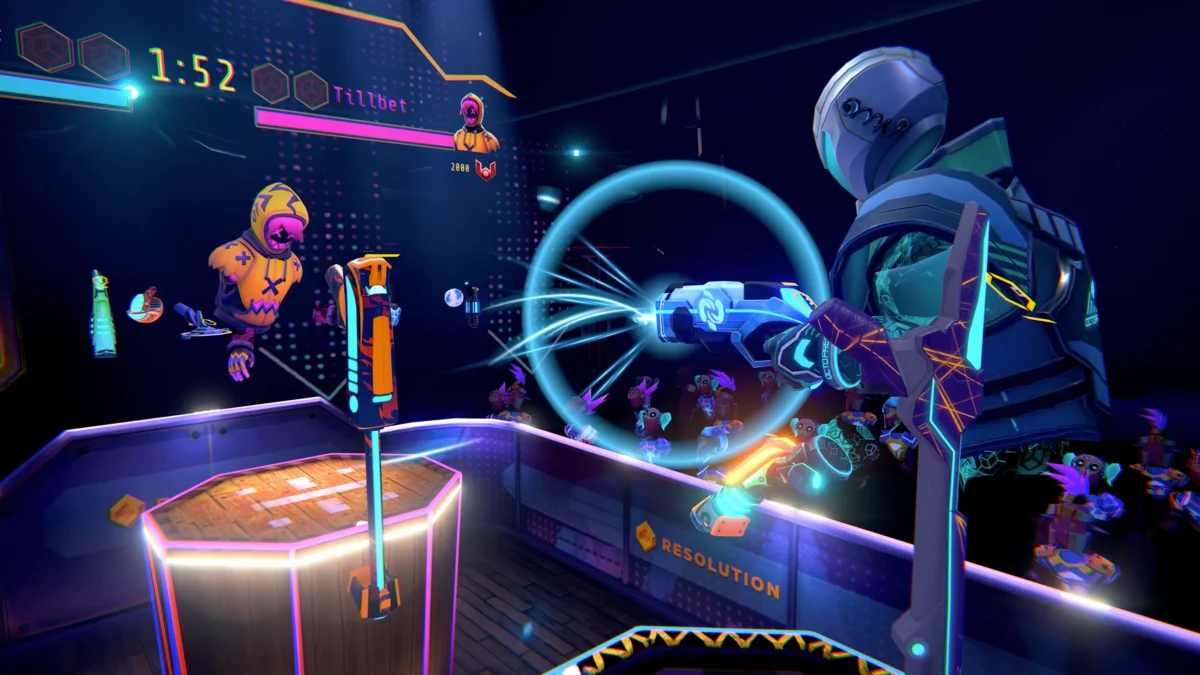
In the rapidly evolving landscape of Virtual Reality, developers are constantly grappling with a fundamental paradox: how to make a digital experience feel physically consequential. While sprawling open-world RPGs and high-fidelity flight simulators capture the imagination, there is a specific, primal satisfaction found in the "arena brawler." Enter Blaston, the competitive dueling title from Resolution Games that has quietly become a staple for VR enthusiasts looking for a visceral, high-intensity workout that demands both mental acuity and physical agility.
For those who have recently entered the VR ecosystem—or those simply looking for a title that justifies the hardware investment—Blaston offers a compelling argument for the medium’s potential to marry traditional arcade sensibilities with cutting-edge motion tracking.
The Core Concept: Tactical Dueling in Three Dimensions
At its heart, Blaston is a 1v1 dueling simulator that strips away the complexity of traditional shooters to focus on the purity of movement and positioning. Unlike conventional first-person shooters that rely on joystick-driven strafing, Blaston forces players to occupy a small, fixed-position arena. This design choice is not a limitation; it is the game’s primary mechanic.
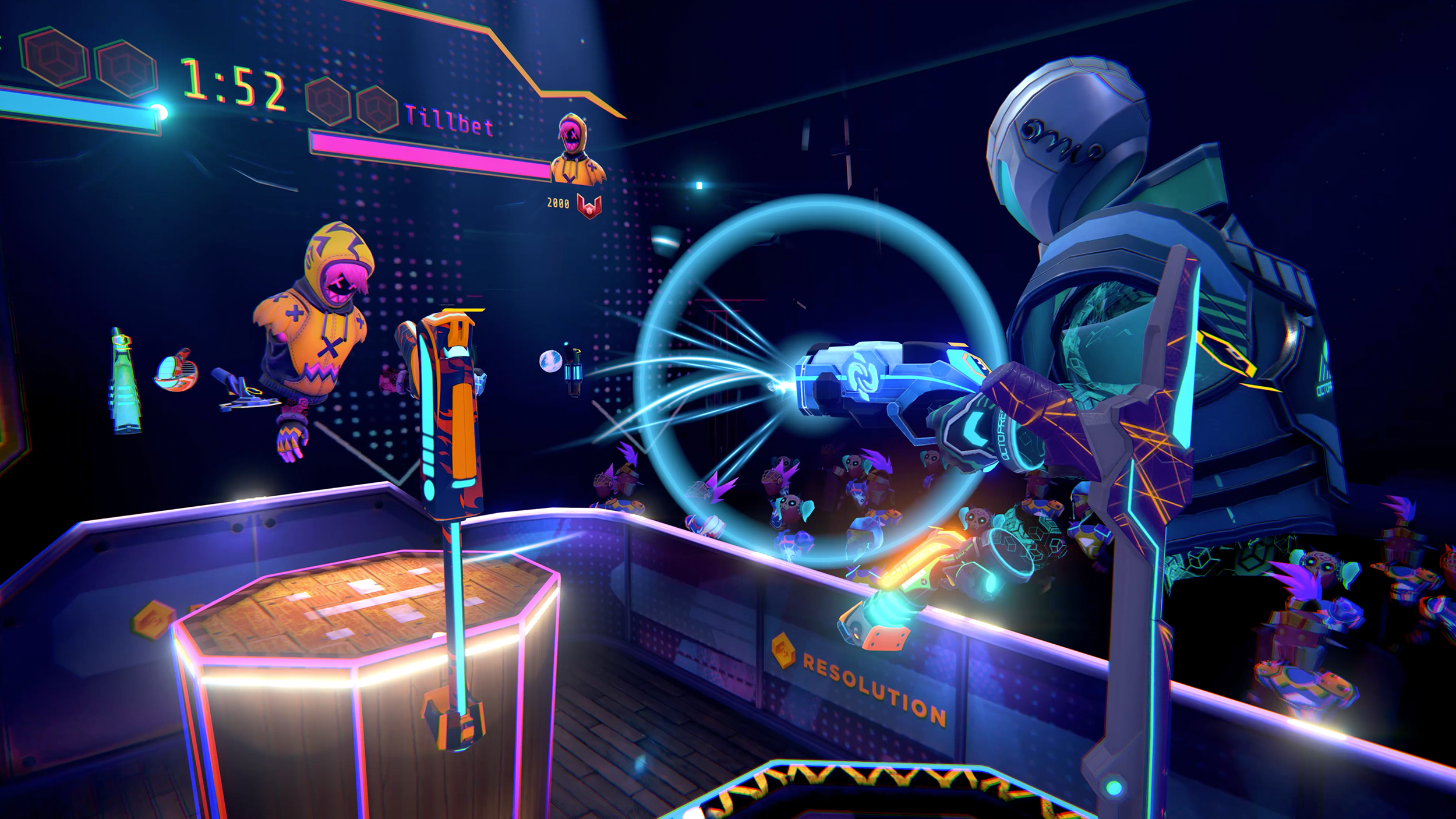
Players face off against an opponent with a singular goal: deplete the enemy’s health bar to zero. However, this is not a game of twitch-reflex aiming in the traditional sense. It is a game of "spatial control." Weapons do not spawn in your inventory; they appear on racks distributed around the player’s immediate vicinity. To arm yourself, you must physically reach out and grab these weapons, which are then yours to deploy.
The brilliance of this design lies in the unpredictability. Because weapons spawn in one of six distinct spots around the player, you are constantly forced to rotate your body, squat, reach, and weave. It turns every match into a kinetic ballet—a series of rapid, high-stakes decisions where the environment itself is the primary tactical variable.
Chronology of a Cult Phenomenon
Blaston did not arrive with the fanfare of a AAA blockbuster, yet its growth has been organic and sustained.
- Initial Launch (2020): Developed by Resolution Games, Blaston was designed specifically for standalone VR headsets like the Meta (formerly Oculus) Quest. The goal was to solve the "motion sickness" problem often associated with VR shooters by keeping the player stationary while the action remained dynamic.
- Post-Launch Iteration: Throughout 2021, the developers engaged in a rigorous update cycle, introducing new weapon types, balancing patches, and refined matchmaking systems.
- The "Discovery" Phase (Late 2021): By the final quarter of 2021, a surge of new VR adopters began to discover the title. As noted by early proponents of the game, its accessibility—being a low-entry-price title often found on sale—allowed it to bypass the typical barrier to entry for competitive multiplayer games.
- The Present: Today, Blaston serves as a benchmark for how to build a competitive ecosystem in VR without needing hyper-realistic graphics or complex control schemes.
Supporting Data: Why It Works
The success of Blaston can be attributed to its "low floor, high ceiling" design philosophy. Supporting data from player engagement metrics suggests that the game excels in three specific areas:
- Retention Rates: Because the rounds are short and intense, the game avoids the "fatigue loop" found in longer VR sessions. Players report playing for hours at a time, not because of a narrative hook, but because the gameplay loop is inherently addictive.
- Physical Exertion: Studies in VR fitness often highlight Blaston as a "hidden gem" of the genre. Because players are forced to physically dodge slow-moving projectiles—a mechanic known as "bullet hell" dodging—the game provides a substantial cardiovascular workout that is far more engaging than traditional treadmill exercise.
- Weapon Diversity: There are no "overpowered" weapons in a vacuum. A weapon that deals massive damage might be slow to fire, while a light, rapid-fire weapon might be used to force an opponent into a corner. This balance ensures that no single strategy dominates the meta, keeping the skill ceiling remarkably high.
The Strategic Depth: Controlling the Arena
The tactical layer of Blaston is deeper than it appears to the casual observer. The weapons are not just tools for damage; they are tools for spatial denial.
For instance, one of the most effective strategies involves the use of electrical beam weapons. These beams create a persistent hazard in the arena. Even if the beam doesn’t hit the opponent, it effectively "gates off" a portion of the map, forcing the opponent to move into a disadvantageous position.
This creates a psychological game of chess. If you know your opponent prefers to dodge to the left, you can use a secondary weapon to "paint" the left side of their arena with traps, forcing them to move into the path of your primary projectile. It is this marriage of physical movement and tactical foresight that distinguishes Blaston from the myriad of "wave shooter" games that currently saturate the VR marketplace.
Official Perspective and Design Philosophy
Resolution Games has consistently emphasized that Blaston was born out of a desire to create a "fair" competitive environment. By removing the ability to move freely across a map, they eliminated the "camping" meta that plagues many traditional shooters.
In various developer diaries and community updates, the team at Resolution has noted:
"Our goal was to ensure that every player has the same tools at their disposal. The winner isn’t the one with the better hardware or the faster connection, but the one who can best manage the space around them."
This philosophy has fostered a healthy, albeit intense, community. The developers have successfully pivoted the game toward a more accessible model, recently transitioning to a free-to-play structure to ensure the matchmaking pool remains vibrant and diverse.
Implications: The Future of VR Esports
The success of Blaston has significant implications for the future of VR as an esport. Historically, VR games have struggled to find a foothold in the competitive scene due to issues with latency, physical space requirements, and player comfort. Blaston bypasses these issues by design.
By keeping the player stationary, it eliminates the need for expensive "omni-directional treadmills" or massive room-scale setups. It proves that the "esport" of the future might not require a PC tower and a keyboard; it might just require a headset and a desire to move.
Furthermore, Blaston serves as a blueprint for "bite-sized" gaming. As VR becomes a more household technology, the demand for games that can be picked up for 15 minutes of high-intensity action is likely to grow. It is the perfect antidote to the "extraordinarily rubbish year" many have faced—a way to disconnect from the complexities of the physical world by fully immersing oneself in a digital arena where the only thing that matters is the next shot.
Conclusion: A Must-Play for the VR Library
Whether you are a competitive gamer looking for your next challenge or a casual user hoping to get a bit more utility out of your headset, Blaston is an essential experience. It is a rare example of a game that understands its medium perfectly. It does not try to be a 100-hour narrative epic; it simply tries to be the best dueling game possible.
In a world where we are increasingly glued to our screens—both digital and physical—Blaston offers a rare form of catharsis. It forces you to stand up, move your body, think tactically, and engage with a human opponent in a way that feels meaningful. If you have the hardware, do yourself a favor: step into the arena, pick up your weapons, and experience the kinetic thrill for yourself. It is, quite simply, one of the most rewarding experiences currently available in the virtual reality space.

