

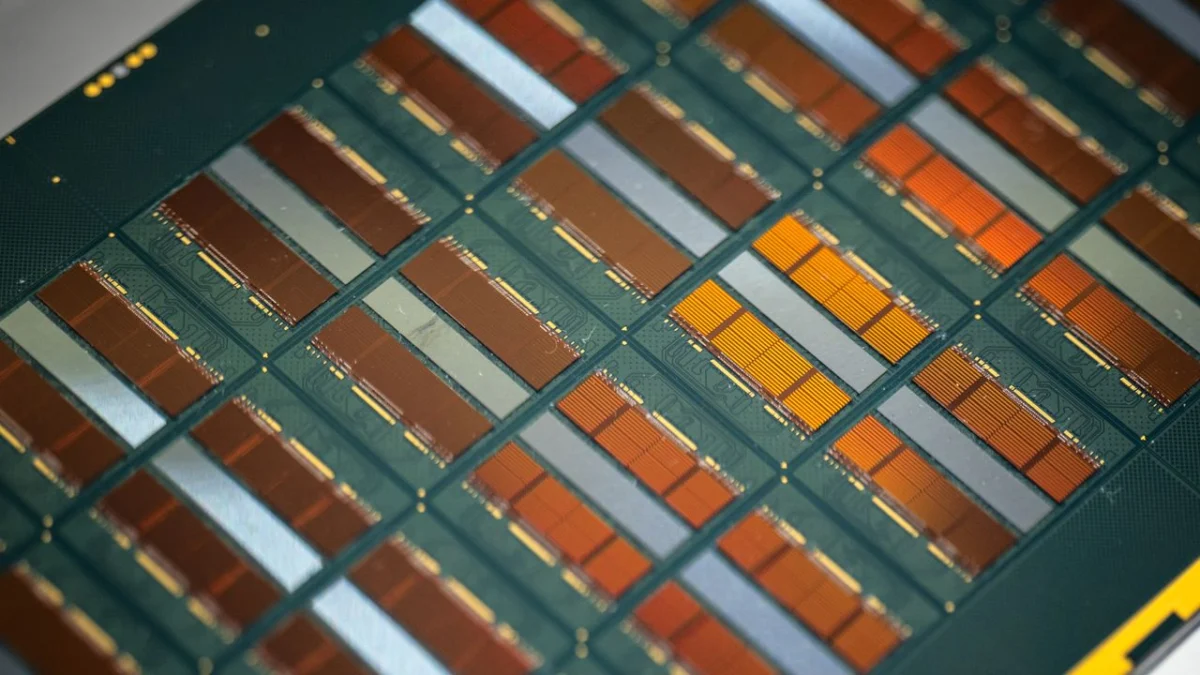
TAIPEI — In a milestone debut highlighting the surging global appetite for specialized artificial intelligence semiconductor architecture, PieceMakers Technology Inc., a specialized DRAM designer backed by memory giant Nanya Technology, officially began trading on Taiwan’s Emerging Stock Board. The company’s shares commenced trading at a reference price of NT$740 ($23.3 USD approx.), capturing immediate attention from institutional investors and retail traders alike amid an ongoing paradigm shift in AI hardware development.
With approximately 60.4 million shares outstanding, the NT$740 reference price initially valued PieceMakers at roughly NT$44.7 billion—translating to a valuation of approximately $1.4 billion USD. However, the market’s reception far exceeded baseline expectations. During its inaugural trading session, PieceMakers shares surged out of the gate, opening at NT$1,035, climbing as high as NT$1,205, and ultimately closing the session at NT$915. This marked a robust 23.6% premium over its initial reference price, underscoring intense market confidence in the firm’s non-traditional approach to memory design for AI workloads.
Rather than competing directly in the heavily crowded High Bandwidth Memory (HBM) market dominated by titans like SK Hynix, Samsung, and Micron, PieceMakers has carved out a distinct technological niche. The fabless designer is betting heavily that the memory requirements for AI inference will fundamentally diverge from those required for AI training. By pioneering DRAM stacked directly onto processors utilizing advanced hybrid bonding technologies, PieceMakers aims to bridge a critical architectural gap between ultra-fast, SRAM-only configurations—such as Nvidia’s Groq LPU approach—and traditional high-capacity HBM stacks.
Main Facts and Market Debut Overview
The debut of PieceMakers on Taiwan’s pre-listing market marks a significant inflection point for the island’s thriving semiconductor ecosystem. Taiwan’s Emerging Stock Board functions as a rigorous pre-IPO trading venue managed by the Taipei Exchange, allowing companies to establish a public market valuation and liquidity baseline through designated market makers before filing for a formal primary board listing.
- Company Name: PieceMakers Technology Inc.
- Key Backer: Nanya Technology Corporation
- Market Entry: Taiwan Emerging Stock Board (Pre-listing market)
- Debut Date: September 16
- Reference Price: NT$740 per share
- Total Shares Outstanding: ~60.4 million
- Initial Market Capitalization: ~NT$44.7 billion ($1.4 billion USD)
- First-Day Trading Range: Opened at NT$1,035, peaked at NT$1,205, closed at NT$915 (+23.6%)
- Current Revenue Drivers: AI custom-design services and engineering fees (~40% of H1 revenue)
- Volume Production Outlook: Financial contributions from the first major volume customer program slated for 2027 at the earliest.
The valuation achieved on day one places PieceMakers firmly on the map as one of the most closely watched boutique semiconductor design houses in Asia. While the firm’s long-term thesis rests on high-volume silicon manufacturing, its current financial engine is fueled by specialized engineering services and custom design fees rather than mass-market chip shipments.
Chronology of Events and Corporate Milestones
To understand how PieceMakers reached its multi-billion-dollar pre-listing valuation, it is necessary to examine the chronological progression of the firm’s strategic pivots, technological developments, and capital market preparations.
Phase 1: Foundation and the Nanya Partnership
PieceMakers was established to address a looming bottleneck in computing architecture: the "memory wall." As artificial intelligence models scaled exponentially in parameter size and complexity, standard von Neumann architecture bottlenecks—where data transfer speeds between processor and memory lag behind raw compute capacity—became the primary performance inhibitor.
Backed strategically by Nanya Technology, one of Taiwan’s premier DRAM manufacturers, PieceMakers gained crucial access to advanced memory manufacturing know-how, packaging ecosystems, and supply chain synergies. This partnership allowed the startup to bypass the prohibitively high capital expenditure barriers typically associated with memory design, focusing instead on advanced architectural innovation.
Phase 2: Shifting Focus from Training to Inference
As the generative AI boom accelerated through 2023 and 2024, the semiconductor industry poured billions into HBM development to support massive LLM (Large Language Model) training workloads. However, industry leadership at PieceMakers recognized that the market was bifurcating.
While training demands massive parallel bandwidth and immense memory capacity, inference—the act of deploying models to generate real-time responses—presents distinct latency, power, and cost constraints. PieceMakers pivoted its core roadmap toward inference-optimized memory solutions. The company calculated that standard HBM, while exceptional for training, would prove too costly, power-hungry, or architecturally misaligned for ubiquitous, high-efficiency edge and data-center inference applications.
Phase 3: Transitioning to Custom AI Design Services
Recognizing that silicon development cycles require substantial runway before yielding mass-production revenue, PieceMakers adopted a dual-revenue model. Alongside developing its proprietary memory-on-logic stacking technology, the company aggressively pursued custom AI ASIC (Application-Specific Integrated Circuit) design contracts.
By offering specialized design services to global tech giants and system architects, PieceMakers successfully monetized its engineering talent early. By the first half of 2026, custom AI design work accounted for approximately 40% of the company’s total revenue, providing a stable financial cushion while its flagship hardware solutions matured through prototyping and testing phases.
Phase 4: Pre-Listing Preparation and Market Debut
In late summer 2026, financial disclosures and trade reports from specialized technology outlets such as Cnyes and TechNews revealed that PieceMakers was laying the groundwork for a public market entry. Leadership confirmed plans to join Taiwan’s Emerging Stock Board at an aggressive reference price of NT$740. On September 16, the company officially commenced trading, shattering initial conservative estimates as shares breached the NT$1,200 threshold during intraday volatility before closing up over 23%.
Supporting Data and Financial Health
An analysis of PieceMakers’ financial architecture reveals a company operating in a transitional phase typical of high-end semiconductor innovators. The firm’s current financial statements reflect a heavy reliance on intellectual property (IP) monetization and engineering services rather than physical product shipments.
Revenue Breakdown and Engineering Fees
During the first half of 2026, engineering and custom design fees served as the primary lifeblood of the company’s top line, contributing roughly 40% of total revenues. This reflects a growing industry trend where fabless semiconductor companies license their expertise or undertake custom co-design projects for hyperscalers and system vendors seeking proprietary hardware acceleration.
Volume Production Horizon
Despite the massive market valuation of NT$44.7 billion and enthusiastic trading performance, corporate leadership has remained notably transparent regarding near-term hardware revenue. According to statements made by PieceMakers Chairman Joseph Ting to TechNews, the company’s first major volume customer program is still moving through qualification and integration pipelines. Consequently, mass-production shipments from this initial volume program are not expected to make a meaningful financial contribution to the company’s balance sheet until 2027 at the earliest.
Capital Structure and Shareholder Base
With roughly 60.4 million shares outstanding, the company’s ownership structure reflects a strategic balance between institutional backing and venture capital. Nanya Technology’s foundational support has provided both financial stability and technological credibility. The successful debut on the Emerging Stock Board provides PieceMakers with a liquid currency and expanded access to public capital markets, ensuring the firm can fund its intensive research and development (R&D) roadmap well into the late 2020s.
Official Responses and Strategic Vision
Leadership insights shed light on the core philosophy driving PieceMakers’ market strategy. In interviews with industry publications, President Lee Hsiao-wen and Chairman Joseph Ting articulated a clear vision that challenges conventional industry wisdom regarding memory hierarchies.
President Lee Hsiao-wen on the Inference Memory Divergence
Addressing reporters ahead of the market debut, President Lee Hsiao-wen emphasized that the industry is making a fundamental mistake by treating AI memory as a monolith.
"PieceMakers is not an HBM company," Lee stated bluntly during his briefing with Cnyes. "We bet that inference memory diverges from training memory."
Lee explained that while HBM remains the undisputed king for massive cluster training, AI inference workloads—which dominate operational usage in everyday enterprise applications—require a different architectural philosophy. To solve the memory wall for inference, PieceMakers is championing DRAM stacked directly onto the processor utilizing advanced hybrid bonding techniques.
By integrating memory at the microscopic level directly above or adjacent to the compute logic, this configuration effectively eliminates traditional board-level routing delays and bandwidth bottlenecks. Lee positions PieceMakers’ technology as sitting squarely in the "sweet spot" between Nvidia’s ultra-fast, SRAM-only Groq LPU approach—which suffers from strict capacity limitations due to the physical constraints of on-die SRAM—and high-capacity, high-cost HBM stacks.
Chairman Joseph Ting on Long-Term Monetization
While the technological ambition is vast, Chairman Joseph Ting has maintained a disciplined, realistic timeline regarding commercialization. In his discussions with TechNews, Ting addressed investor expectations concerning immediate hardware sales, explicitly noting that volume production programs require rigorous validation cycles.
Ting reiterated that while custom-design fees are successfully sustaining the company’s financial growth in the interim, true mass-market silicon deployment tied to their flagship architecture will materialize in 2027. This measured guidance aims to ground investor enthusiasm in the realities of semiconductor manufacturing lead times, even as market participants bid up the stock during its initial public exposure.
Industry Implications and Future Outlook
PieceMakers’ successful entry onto Taiwan’s Emerging Stock Board carries profound implications for the global semiconductor landscape, particularly within the specialized domains of AI hardware, advanced packaging, and memory design.
1. Challenging the HBM Monopoly
For years, the narrative surrounding AI memory has been entirely dominated by High Bandwidth Memory. As hyperscalers and AI developers face escalating costs associated with HBM-equipped accelerators, alternative memory architectures are gaining serious traction. PieceMakers’ hybrid-bonding DRAM approach offers a compelling blueprint for reducing power consumption and latency without sacrificing the capacity needed for large-scale inference models. If successful, this technology could disrupt the pricing power of traditional memory vendors and offer system architects a new tier of cost-effective performance.
2. The Rise of Custom Silicon and Co-Design
The fact that 40% of PieceMakers’ revenue is currently driven by custom design fees illustrates a broader shift in the semiconductor industry. System builders—including cloud service providers (CSPs) and enterprise software giants—are increasingly moving away from off-the-shelf accelerators in favor of bespoke silicon tailored to their specific neural network topologies. By acting as a specialized design partner, PieceMakers has positioned itself at the epicenter of this custom ASIC gold rush.
3. The Strategic Importance of Taiwan’s Semiconductor Cluster
The enthusiastic public reception—pushing the stock to a high of NT$1,205 before settling at NT$915—underscores the unmatched depth of Taiwan’s capital markets and technical ecosystem when it comes to semiconductor innovation. Backed by Nanya and operating within arm’s reach of the world’s most advanced foundry and packaging ecosystems (such as TSMC and ASE), PieceMakers possesses the geographic and supply-chain advantages necessary to bring complex 3D-stacked memory solutions from the drawing board to mass production.
Looking Ahead to 2027 and Beyond
As PieceMakers transitions from a design-services boutique into a full-fledged silicon product provider over the next 12 to 18 months, all eyes will be on its execution milestones. The real test of the company’s $1.4 billion valuation will not be opening-day trading euphoria, but the successful commercial rollout of its volume customer programs in 2027. If the company can prove that hybrid-bonded inference memory can scale economically in data centers worldwide, PieceMakers may well redefine how the world powers the next generation of artificial intelligence.

