

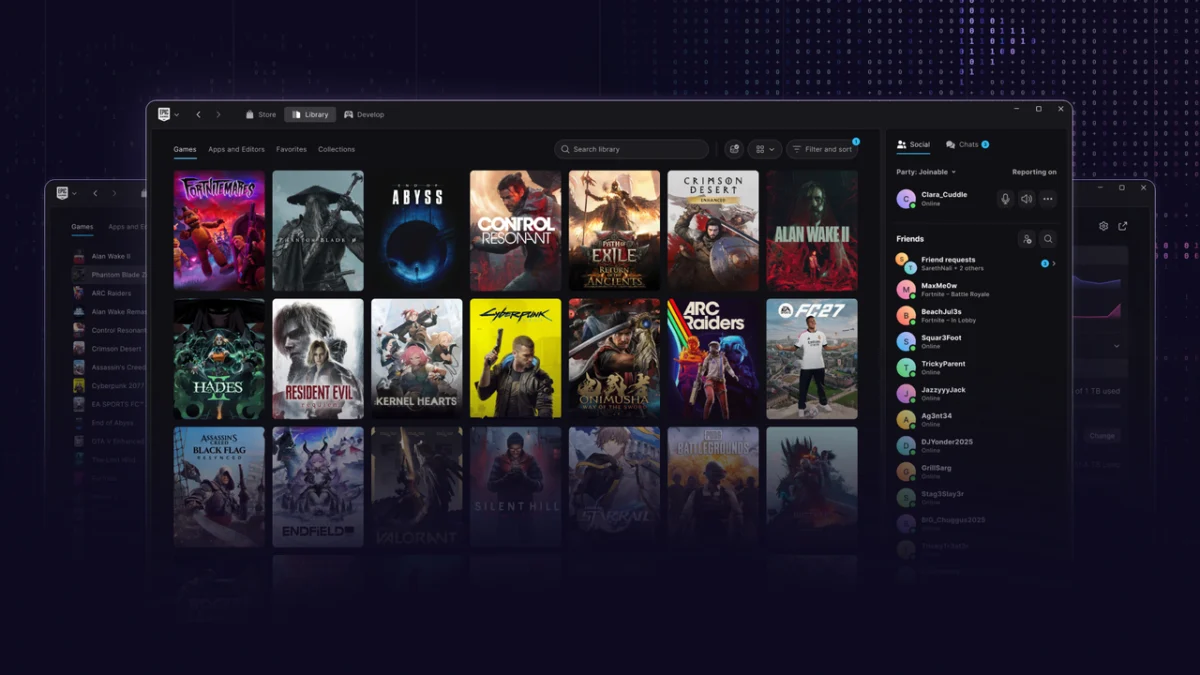
SAN FRANCISCO — In a move that signals a seismic shift in how software engineering might be approached in the artificial intelligence era, Epic Games has officially released a preview version of its completely redesigned PC client. Available for public download as an open beta via the company’s dedicated landing page, the new Epic Games Launcher has been built from the ground up using advanced AI tools—a process the company jokingly yet revealingly describes as having "vibe coded" the entire application.
According to internal benchmarks released alongside the preview, this experimental client is not only dramatically faster and more responsive than its predecessor, but it also reportedly boots up 46% faster than Valve’s dominant industry standard, Steam. While the software is currently sitting in a preliminary testing phase while developers gather critical user telemetry and community critiques, the implications of its creation stretch far beyond the gaming ecosystem, touching on the very future of how applications are conceptualized, written, and maintained.
Main Facts
The core announcement centers around the public rollout of an early-access preview build for the next-generation Epic Games Launcher. For years, the gaming community has heavily criticized the legacy Epic Games client for being sluggish, resource-heavy, and frustratingly slow to navigate compared to older, more optimized storefronts like Steam. By pivoting toward an AI-assisted development workflow, Epic Games has attempted to directly address these historical pain points.
Key highlights of the new launcher include:
- AI-Assisted Architecture: Built heavily with the assistance of generative AI coding assistants, bypassing traditional, manual, line-by-line coding bottlenecks for large portions of the interface and backend logic.
- Performance Enhancements: Dramatically reduced memory footprint, smoother navigation, and vastly improved responsiveness.
- Startup Speed Claims: Epic Games asserts that the new preview launcher launches an astonishing 46% faster than Steam, addressing one of the most persistent performance metrics in the PC gaming landscape.
- Current Status: Released as an open preview/beta. Anyone can download the software immediately to test its features and provide feedback, with a permanent, stable rollout planned after iterative patches.
Chronology of Development: From Sluggish Legacy to AI Overhaul
To understand the significance of this release, it is necessary to examine the historical trajectory of the Epic Games Launcher and the rapid evolution of software tooling that made "vibe coding" possible.
The Legacy Era (2018–2023)
When Epic Games launched its PC storefront in December 2018 to challenge Valve’s Steam monopoly, the primary focus was on securing exclusive game titles, offering aggressive developer revenue splits (88/12), and running weekly free game promotions. Consequently, the client software itself was treated largely as a functional necessity rather than a polished user experience. Over the years, users across Reddit, specialized hardware forums, and social media routinely complained that the launcher felt bloated, took an excessive amount of time to load web elements, and suffered from input lag. Despite incremental patches, the architectural foundation of the legacy client remained heavy.
The Rise of Generative AI in Software Engineering (2023–2025)
Throughout 2023 and 2024, tools like GitHub Copilot, OpenAI’s GPT models, Anthropic’s Claude, and specialized development environments transformed from novelty writing assistants into core enterprise engineering infrastructure. Programmers began utilizing large language models not just for autocomplete functions, but to generate entire UI components, refactor legacy codebases, and optimize asynchronous processes.
The "Vibe Coding" Pivot (Late 2024–Early 2026)
Sometime within the past year, Epic Games’ engineering teams decided to test the limits of modern AI coding assistants on a notoriously difficult enterprise project: rebuilding their own desktop client. Recognizing that manual front-end and back-end integration is notoriously tedious, developers leaned into high-level prompt engineering and architectural guidance—informally dubbed "vibe coding"—allowing generative AI tools to handle the heavy lifting of boilerplate generation, logic mapping, and framework structuring.
The result of this internal experiment is the preview launcher now sitting in the hands of the public, representing one of the first major consumer software applications of its scale to openly attribute its core existence to AI-driven generation.
Supporting Data and Performance Metrics
In the world of PC gaming infrastructure, milliseconds and startup seconds matter immensely. Users frequently keep launchers running in the system tray, but an unoptimized cold boot can deter players from quickly jumping into titles like Fortnite, Rocket League, or newly purchased third-party releases.
Comparative Startup Benchmarks
While independent third-party testers are still putting the preview build through rigorous cross-hardware benchmarking, Epic Games’ initial telemetry points to staggering efficiency gains:
- Vs. Legacy Epic Launcher: The new client drops memory usage significantly and eliminates the stutter associated with loading dynamic web-based store components.
- Vs. Steam: Epic’s bold claim that the new launcher starts up 46% faster than Steam is perhaps the most provocative metric in the announcement. Steam, while feature-rich, has accumulated two decades of legacy code, making its client notoriously heavy during cold starts. By utilizing a modern, AI-optimized tech stack, Epic claims to have leapfrogged its primary competitor in pure startup velocity.
User Interface and Responsiveness
Beyond cold-boot speeds, early adopters have noted several qualitative improvements:
- Fluid Animations: Navigation menus, library grids, and store pages render with significantly reduced latency.
- Cleaner Aesthetic: The visual layout has been streamlined, reducing visual clutter and prioritizing fast access to the user’s game library, friends list, and store discounts.
- Resource Management: Background CPU utilization during idle states has reportedly plummeted, a crucial fix for laptop users and budget gaming rigs sensitive to background bloatware.
Official Responses and Industry Context
Epic Games did not shy away from the unconventional nature of how this software was created. In an official blog post detailing the preview rollout, the company addressed its user base with a mixture of dark humor and radical transparency.
The Official Statement
"Programming is hard. So, instead of doing that, we vibe coded a new Epic Games Launcher that’s way faster and more responsive than the current one, and has a new look," Epic Games wrote in their official community announcement.
This casual acknowledgment highlights a broader cultural shift within tech companies. Rather than hiding the use of artificial intelligence behind corporate doublespeak, Epic leaned directly into internet slang ("vibe coding"—a term used to describe guiding AI models through prompts rather than writing syntax manually) to connect with its younger, digitally native audience.
The Open Preview Strategy
Epic is deliberately treating this release as an open beta. By framing it as a "preview," the company has built a feedback loop directly into the deployment pipeline:
- Public Ingestion: Anyone can visit the official landing page and download the executable file alongside the legacy version.
- Telemetry Collection: Automated error tracking and performance analytics feed back into Epic’s servers.
- Iterative Patching: Developers—augmented by AI assistants—can rapidly patch bugs reported by the community in real time.
- Stable Transition: Once stability benchmarks are met globally, the preview build will completely replace the legacy launcher across all supported Windows and macOS installations.
Broader Implications: What "Vibe Coding" Means for the Software Industry
The release of the Epic Games Launcher preview is much more than a routine software update for gamers; it serves as a fascinating case study for the entire software development industry. As artificial intelligence models become increasingly capable of understanding complex, multi-file codebases, the definition of a "software engineer" is actively evolving.
1. The Redefinition of Software Development
When Epic Games states they "vibe coded" the application because "programming is hard," they are touching on a profound truth about modern development. The friction of writing boilerplate code, configuring build pipelines, and debugging syntax errors is increasingly being abstracted away by AI. Human developers are shifting from coders to architects and directors, steering AI agents to build complex applications through high-level intent and prompt direction.
2. Competitive Pressures on Steam and Other Platforms
Valve’s Steam has maintained an iron grip on the PC digital distribution market for over twenty years. While competitors like EA App, Ubisoft Connect, and Battle.net have struggled to capture user loyalty—often due to clunky, resource-heavy desktop clients—Epic Games has consistently poured millions into trying to erode Steam’s monopoly through free games and exclusive deals. If Epic can now claim a superior, faster, and lighter desktop client built largely through AI-accelerated workflows, it removes one of the primary consumer complaints historically leveraged against the Epic ecosystem.
3. Potential Pitfalls and Technical Debt
While the performance gains of the new launcher are undeniable in early testing, computer science purists have raised valid questions regarding the long-term maintainability of AI-generated codebases. When an AI writes thousands of lines of code based on high-level prompts, understanding the underlying architecture can sometimes prove challenging for human engineers if unexpected bugs or deep-seated security vulnerabilities emerge down the line. How Epic Games manages the maintenance phase of this launcher will serve as a crucial bellwether for enterprise software development moving forward.
4. Consumer Reception and the Road Ahead
Early reactions across social media, gaming forums, and tech blogs have been overwhelmingly positive regarding the speed improvements, though many users remain cautious, waiting to see how the software behaves under heavy load when millions of users simultaneously update their libraries or log in during major seasonal sales.
Conclusion
Epic Games has taken a bold, unconventional gamble. By publicly leaning into generative AI tooling to completely rebuild one of the most high-profile desktop clients in gaming, they have delivered a launcher that is not only significantly faster than its predecessor but allegedly outpaces industry titan Steam in startup metrics by nearly 50%.
As the gaming community tests the preview build and submits feedback, the broader tech world will be watching closely. Whether "vibe coding" becomes the gold standard for rapid enterprise software development or introduces unique challenges of its own, Epic Games has undeniably fired a fascinating new shot in the ongoing evolution of software engineering and digital storefront dominance.
Users interested in testing the new client can visit the official Epic Games Launcher landing page to download the preview build and participate in shaping the future of the platform.

