

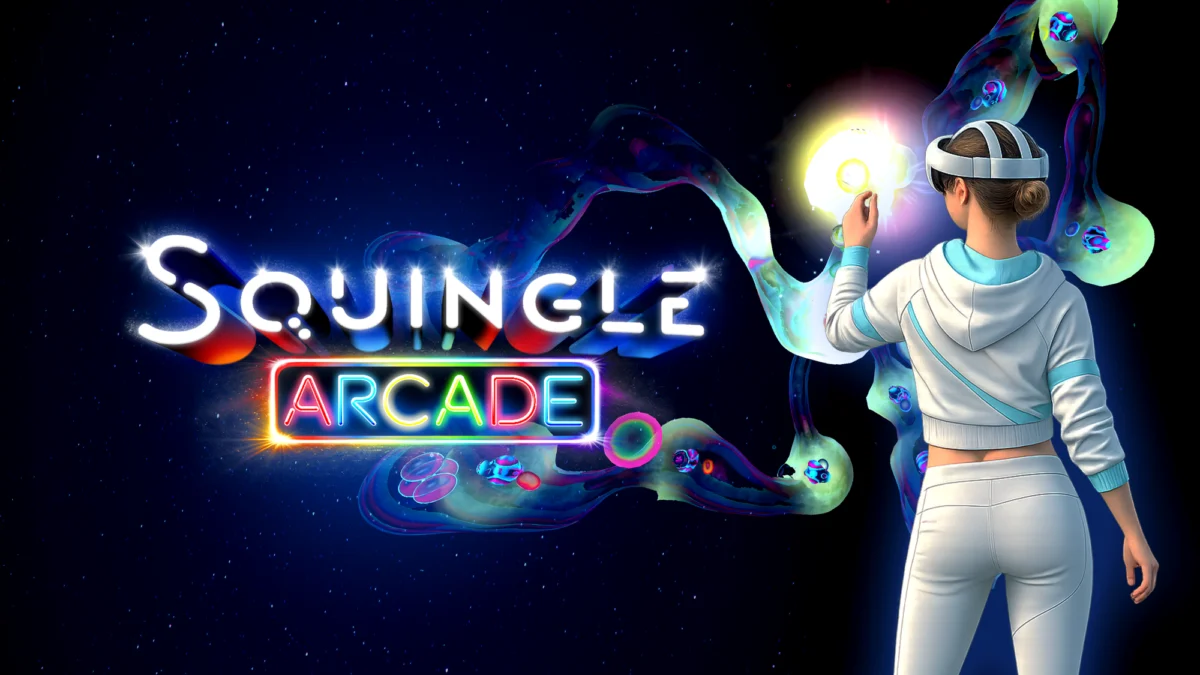
VR GAMING — The virtual reality landscape has long been a proving ground for innovative spatial mechanics, but few titles blend sensory-rich psychedelia with tactile puzzle-solving quite like Squingle. Originally launched as a cerebral, award-winning fluid-maze puzzler, the franchise has spent recent months courting a faster, more arcade-oriented audience. Following its successful rollout on Meta Quest earlier this year, developer Dr. Benjamin Outram has officially brought Squingle Arcade to PC VR users via SteamVR.
Available completely free of charge, this standalone, rapid-fire iteration retains the DNA of its predecessor while sharpening its focus on competitive leaderboards, dynamic spatial scalability, and instant-gratification gameplay loops. As virtual reality hardware continues to mature, releases like Squingle Arcade highlight a growing industry appetite for accessible, highly replayable arcade experiences that leverage the unique spatial immersion of VR.
Main Facts: What Is Squingle Arcade?
At its core, Squingle Arcade is a free-to-play, fast-paced spatial action puzzle game designed specifically for virtual reality platforms. It adapts the unique maze-navigation mechanics of the original Squingle and streamlines them into rapid, bite-sized gameplay sessions.
Players are tasked with guiding glowing orbs through complex, amorphous, gel-like structures. Success requires a steady hand and quick reflexes as players collect color pods, fend off and defeat intruding enemies, and carefully navigate around lethal environmental hazards to reach the goal. Upon completing a maze, players are rewarded with "Star Orbs"—an in-game currency that can be strategically cashed in to acquire perks such as extended run times or extra energy reserves, as well as cosmetic skins to personalize the experience.
Key features of the SteamVR release include:
- Over 60 Unique Levels: Ranging from introductory trials to brain-melting difficulties that test spatial awareness.
- Asynchronous Multiplayer and Ghost Racing: Allows solo players to race against the recorded ghost runs of friends or global leaderboard champions.
- Scalable Play Spaces: A rare and flexible mechanical feature that lets players physically resize the puzzle environment.
- Cost-Free Access: Available at zero financial barrier of entry on both SteamVR and Meta Quest.
Chronology: From Award-Winning Puzzler to Free-to-Play Arcade Phenomenon
To understand the trajectory of Squingle Arcade, it is necessary to examine how the franchise has evolved from its conceptual origins to its current cross-platform presence.
The Original Squingle Vision
The Squingle franchise first established its reputation within the indie VR community as a hypnotic, meditative puzzle experience. It earned critical acclaim and industry awards for its unique tactile approach to virtual reality. Rather than relying on standard controller inputs or flat-screen puzzle translations, the original game forced players to physically manipulate glowing pathways through three-dimensional space. However, as the VR market matured, developer Dr. Benjamin Outram identified a distinct gap for a quicker, more competitive iteration—one that could cater to players seeking fast-paced score-chasing sessions rather than long, methodical puzzle campaigns.
The Meta Quest Launch
Earlier this year, that vision materialized with the release of Squingle Arcade on the Meta Quest platform. Transitioning to a free-to-play model, the arcade variant stripped away barriers to entry, inviting a broad spectrum of standalone VR users to experience its fluid-maze mechanics. The Quest launch served as a crucial testing ground, validating the rapid-fire gameplay loop, asynchronous ghost racing features, and monetization-free accessibility framework.
The SteamVR Expansion
Building upon the momentum of the Quest release, the launch on SteamVR brings the title to PC-powered virtual reality headsets. Leveraging the graphical fidelity and tracking precision of high-end PC VR setups, the SteamVR version offers the definitive desktop-tethered experience. Alongside the launch, the developer has confirmed an ongoing roadmap, highlighted by an upcoming free downloadable content (DLC) expansion pack slated to drop in the near future.
Supporting Data and Technical Mechanics
Behind its colorful, gel-like aesthetic, Squingle Arcade incorporates sophisticated spatial computing mechanics that set it apart from traditional video game puzzles.
Scalable Environments and Ergonomics
One of the most notable technical and design achievements of Squingle Arcade is its fully scalable play space—a feature rarely executed with this level of fluidity in modern VR titles. Players are given direct control over the physical dimensions of the maze itself.
By grabbing the corners of the puzzle, a player can:
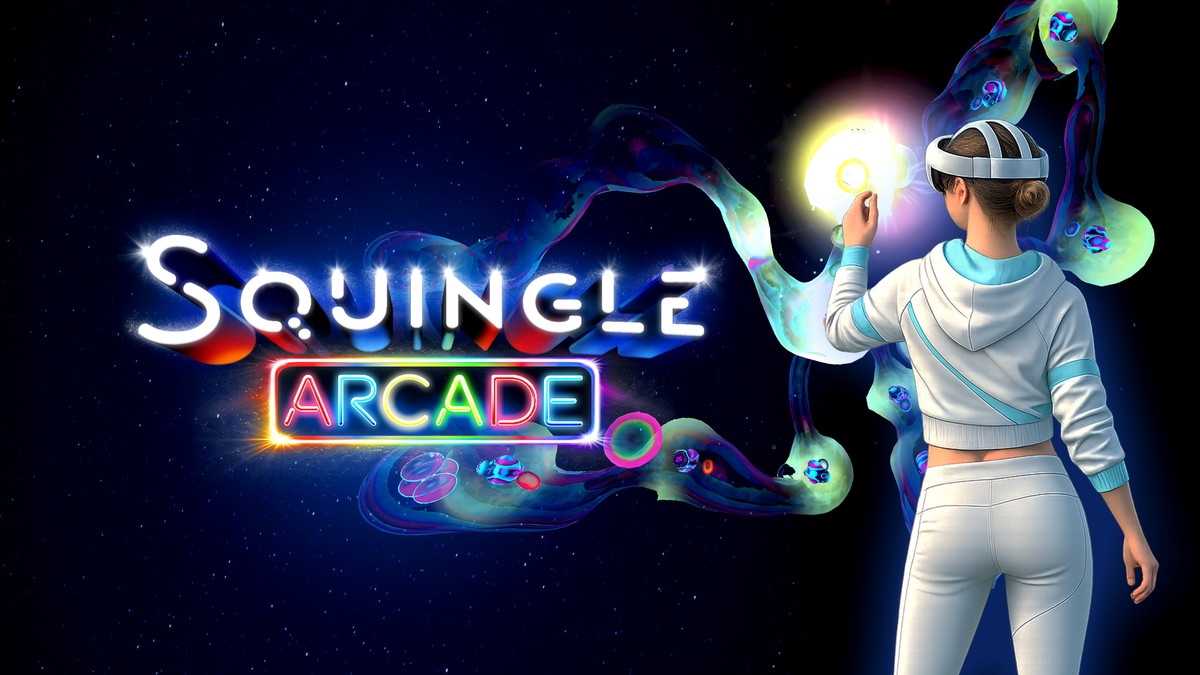
- Expand the Maze: Scale the structure up until it fills the entire room-scale play space. In this mode, players must physically "walk" the orb to the finish line, stepping around, ducking under, and dynamically twisting their bodies to navigate the labyrinth.
- Shrink the Maze: Scale the structure down until it hovers directly over a desktop or lap. This transforms the game into a more relaxed, seated, wrist-and-hand-centric puzzle experience.
This adaptability addresses one of VR’s most persistent design challenges: accommodating different physical spaces, play styles, and accessibility needs without compromising core gameplay integrity.
Content Volume and Post-Launch Support
At launch, the title boasts a robust lineup of over 60 distinct levels spanning a wide gradient of difficulty. However, the development team has signaled strong long-term support for the platform. According to official statements from creator Dr. Benjamin Outram, a comprehensive free DLC pack featuring more than 20 additional levels is already deep in development and expected to release shortly.
Furthermore, the integration of asynchronous multiplayer ensures high long-term engagement. By caching ghost data from top global performers and friends, players can continually challenge ghosts, turning a solitary puzzle game into a perpetually active community competition.
Official Responses and Developer Insights
The transition of the Squingle intellectual property into the arcade and free-to-play space has been driven by a distinct design philosophy centered on accessibility, community, and player agency.
Reflecting on the motivations behind the arcade spin-off, developer Dr. Benjamin Outram emphasized the importance of removing friction for players entering virtual reality. By opting for a free-to-play distribution model across both Meta Quest and SteamVR, the development team aimed to democratize access to high-quality spatial puzzle mechanics, ensuring that curious gamers could dive in without hesitation.
In discussions surrounding the technical hurdles of VR game design, Outram and his team highlighted the importance of physical immersion. The decision to implement scalable mazes was born out of a desire to bridge the gap between room-scale physical exertion and seated comfort. "We wanted to ensure that whether you are looking for an active, room-filling workout where you step through the geometry, or a quick puzzle to unwind at your desk, the game accommodates your exact physical reality," production notes indicate.
Moreover, the announcement of the upcoming 20-level free DLC pack underscores the developer’s commitment to maintaining an active player base. Rather than locking future content behind paywalls, the studio is leveraging the free-to-play foundation to build a loyal community centered around leaderboard competition and ongoing content updates.
Implications for the VR Industry and Player Community
The release of Squingle Arcade on SteamVR carries broader implications for the indie VR development ecosystem, the ongoing debate surrounding monetization models, and the evolution of spatial puzzle design.
The Rise of Free-to-Play Indie VR
For years, the premium upfront-cost model was the standard expectation for virtual reality software. While this model successfully sustained early software development, it often created a high barrier to entry that stifled community growth—especially for niche or arcade-style titles. By adopting a free-to-play model for Squingle Arcade, Dr. Benjamin Outram and similar indie developers are demonstrating that alternative distribution strategies can thrive in the VR sector. By removing the financial gate, games can build massive, engaged player bases that subsequently drive community-driven metrics like leaderboard competition, social sharing, and word-of-mouth growth.
Setting a Benchmark for Spatial Scalability
As mixed reality (MR) and advanced VR headsets continue to blur the lines between virtual and physical environments, spatial flexibility has become a crucial design metric. Squingle Arcade serves as a textbook example of how developers can design mechanics that respect the diversity of players’ physical environments. By allowing users to seamlessly transition from a macro room-scale workout to a micro desktop puzzle, the game sets a high standard for ergonomic adaptability in future spatial computing titles.
Sustaining Long-Term Engagement Through Asynchronous Design
In the fast-paced landscape of modern gaming, retaining player interest post-launch is a formidable challenge for indie developers. Traditional single-player puzzle games often suffer from a "one-and-done" syndrome: once a player beats the levels, there is little incentive to return. Squingle Arcade counters this phenomenon by weaponizing asynchronous multiplayer and ghost racing. By enabling players to perpetually chase the ghost data of friends and elite global competitors, the game transforms a static puzzle solver into an infinitely repeatable competitive sport.
Conclusion
Squingle Arcade represents more than just a port or a spin-off; it is a refined evolution of spatial puzzle design. By successfully executing a free-to-play model, introducing innovative scalable environments, and bolstering the experience with robust ghost-racing leaderboards and upcoming DLC expansions, the title cements its place as a must-play experience for virtual reality enthusiasts. Whether accessed via Meta Quest or the newly supported SteamVR platform, Squingle Arcade invites players to twist, turn, and immerse themselves in one of the most mechanically inventive puzzle loops currently available in the VR space.

