

The world of indie gaming is often defined by its ability to blend whimsical aesthetics with deep, cerebral mechanics. Triomatica Games, the award-winning studio that captured players’ hearts with the critically acclaimed puzzle title Boxville, has returned to the spotlight. Following their August announcement of the ambitious theatre-themed logic puzzler I Want to Play the Villain!, the studio has surprised the community with a strategic pre-release: the immediate launch of Villain! for mobile platforms.
Serving as both a standalone experience and a comprehensive demo for the upcoming flagship title, Villain! provides players with a bite-sized, yet intellectually demanding, introduction to the complex mechanics of the theatre-management genre. As anticipation builds for the full release of I Want to Play the Villain! in early 2027, this mobile release acts as a vital bridge, inviting players into the director’s chair years before the final curtain rises.
The Main Facts: A Sneak Peek into the Spotlight
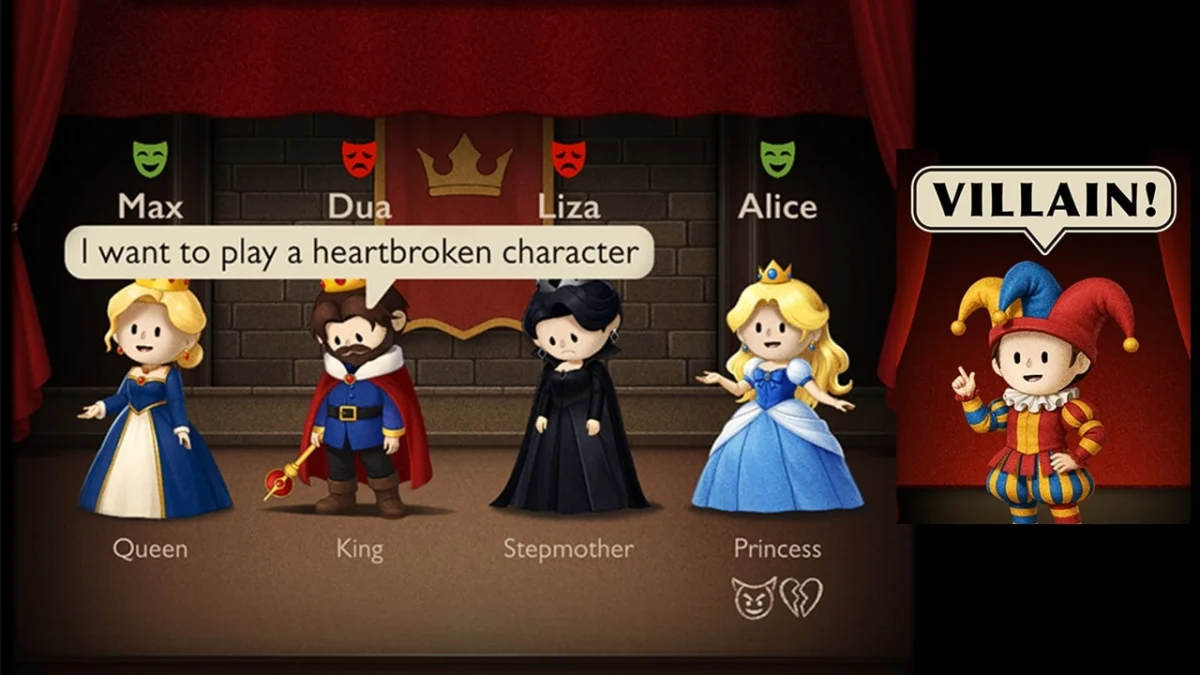
Villain! is not merely a marketing tool; it is a fully functional, standalone mobile experience that includes all 18 unique challenges featured in the first chapter of the main game. Designed for accessibility without sacrificing the studio’s signature complexity, the game challenges players to orchestrate the perfect theatre performance.
The core premise revolves around the intricate social and professional dynamics of a stage cast. Each actor is a complex entity, possessing a specific set of ambitions, deeply held fears, idiosyncratic preferences, and distinct personality traits. The player’s objective is to manage these variables by rearranging the cast, altering costumes, pairing actors with compatible partners, and, ultimately, steering the narrative trajectory of the play.
Currently available for free on the Google Play Store, the mobile release establishes a clear precedent for the quality and art direction expected from the full 2027 launch, which is slated to arrive across a massive spectrum of hardware, including PC, PlayStation 4/5, Xbox One/Series X/S, and the current and next-generation Nintendo Switch consoles.
Chronology of Development: From Boxville to the Stage
The journey of I Want to Play the Villain! began in the shadow of the studio’s previous success. After the widespread praise for Boxville—a game celebrated for its silent storytelling and intricate environmental puzzles—Triomatica Games faced the classic "sophomore slump" challenge: how to evolve their design philosophy without alienating their established fanbase.
- August 2024: Triomatica Games officially unveiled I Want to Play the Villain!, showcasing a departure from the industrial, box-filled world of their previous title toward a warm, cinematic, and theatre-centric aesthetic.
- Late 2024: Recognizing the long development lead time required for such a mechanics-heavy game, the team pivoted to a phased release strategy. By isolating the first chapter, they created Villain!, an app that allows for real-time player feedback while maintaining momentum for the 2027 launch.
- The 2027 Horizon: The studio has committed to a multi-platform release window in early 2027, aiming for simultaneous availability across virtually every major gaming platform, marking a significant step up in production scale for the indie team.
The Mechanics of Management: Beneath the Surface
At its heart, I Want to Play the Villain! is a study in "modular logic." Unlike traditional puzzle games that often feature a singular "correct" solution, Triomatica’s latest project embraces the chaos of human behavior.
The Psychology of Performance
The depth of the game lies in its management of the cast’s emotional state. In a typical level, the player might find that an actor refuses to perform because they have been cast in a role they despise, or because their co-star is someone they fear. By manipulating the cast list—placing a rival in the shadows or swapping an actor’s costume to reflect their true personality—the player can influence the outcome of the performance.
Nonlinear Narrative Outcomes
This structure leads to a highly replayable system. Because every performance can turn out differently based on the player’s choices, the game avoids the stagnation often found in logic puzzles. The story is not fixed; it is a byproduct of the player’s ability to balance the egos and fears of their actors. Sometimes, the "right" choice is to give an actor their dream role, but other times, the optimal path is a calculated suppression of an actor’s desire to keep the rest of the production from crumbling.
Official Responses and Studio Vision
Triomatica Games has maintained a reputation for being remarkably transparent with their development process. In recent communications, the studio emphasized that Villain! was developed to prove a concept. "We wanted to ensure that the logic of our theatre management system felt intuitive yet challenging," a representative noted.
The studio’s commitment to their "hand-drawn, 2D animated style" remains a cornerstone of their brand identity. By prioritizing a "warm, cinematic aesthetic," they are intentionally distancing themselves from the hyper-realistic or pixel-art trends that dominate much of the indie market. This aesthetic choice is intended to evoke the feeling of a classic, high-budget theatre production, mirroring the subject matter of the game itself.
Implications for the Indie Industry
The release of Villain! as a standalone demo/prelude serves as a fascinating case study for indie developers. In an era where "Early Access" is the norm, Triomatica is opting for a more curated approach. By releasing a polished, high-quality slice of the game years ahead of the full launch, they are achieving three key objectives:
- Community Building: They are building a loyal base of players who can provide actionable feedback long before the core mechanics are locked in.
- Brand Longevity: By keeping their name in the news cycle during a long development period, they prevent the "forgotten project" syndrome that plagues many indie titles.
- Market Validation: If Villain! performs well on mobile, it provides the studio with data on which logic puzzles resonate most with players, allowing them to refine the 18 challenges in the full game to match audience preferences.
Furthermore, the decision to support a wide range of platforms—including the Nintendo Switch 2—suggests that Triomatica is aiming for a level of polish that matches the longevity of their previous work. Their focus on cross-platform accessibility ensures that, regardless of the player’s hardware preference, the barrier to entry for their unique brand of theatre-logic puzzles remains low.
The Road Ahead: What to Expect by 2027
As we look toward 2027, the success of I Want to Play the Villain! will likely hinge on the studio’s ability to maintain the delicate balance between the "fun" of character management and the "frustration" of logic puzzles. If they can continue to deliver the charm and depth seen in Villain!, they are well-positioned to cement their status as a tier-one indie studio.
For those eager to dive into the world of stage management, the Villain! mobile app is an essential starting point. It offers a glimpse into a world where every decision matters, and where the difference between a standing ovation and a catastrophic failure rests entirely on the director’s ability to understand the human (and occasionally, the villainous) element.
As the industry watches, Triomatica Games is proving that you don’t need a massive marketing budget or a sprawling open world to create an impact. Sometimes, all you need is a stage, a group of difficult actors, and the perfect puzzle to bring the house down.
For those interested in exploring more from the indie scene, be sure to keep an eye on our ongoing coverage of emerging titles, including the recently released turn-based roguelike auto-battler, Knightica.

