

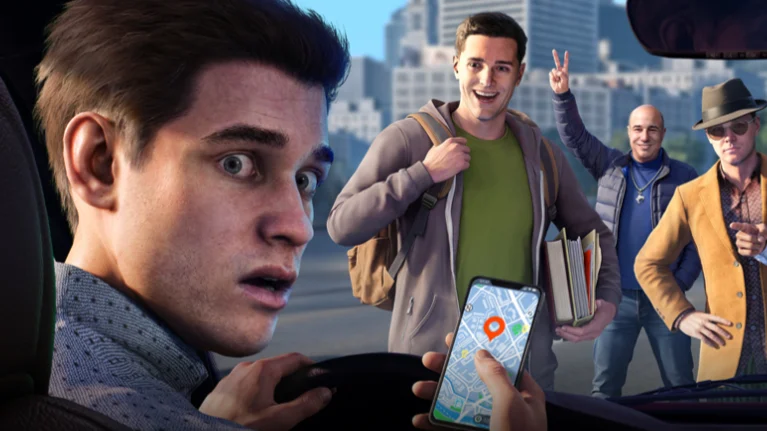
The gaming industry is currently locked in a precarious debate regarding the role of generative artificial intelligence in creative pipelines. At the center of this firestorm is Saber Interactive, a prominent studio currently embroiled in a public controversy involving allegations of replacing human talent with AI tools. While the debate highlights the friction between technological ambition and labor concerns, the company’s leadership maintains that their commitment to human-led storytelling remains unshaken, even as they push forward with experimental integration.
A Public Fallout: The Accusations and the Response
The controversy began in August when writer Stella Sacco alleged that she had been replaced by ChatGPT while serving as the lead writer for Rideshare Stimulator, an upcoming title from Saber Interactive. The claim struck a nerve within the industry, where anxieties regarding job security in the face of generative AI have reached a fever pitch.
The response from Saber Interactive’s CEO, Matthew Karch, was notably combative. In a public statement that drew immediate criticism for its tone, Karch denied the allegations and openly questioned Sacco’s role at the company. "Stella who? I had to ask Claude because I have never spoken to her or seen her," Karch stated, adding that Sacco was "replaced by someone more talented and terminated for a variety of reasons a few months later."
Sacco did not remain silent, labeling Karch’s statement as "remarkably pathetic" for a high-level executive. The exchange quickly transcended a simple labor dispute, becoming a focal point for broader discussions on corporate communication and the ethics of AI implementation in creative fields.
Tim Willits Enters the Fray: Clarifying the Studio’s Stance
During Gamescom, the industry’s premier trade event, Tim Willits—Saber Interactive’s Chief Creative Officer—addressed the controversy in an effort to provide a more nuanced perspective. When asked about Karch’s aggressive public rebuttal, Willits characterized it as a byproduct of the CEO’s characteristic sarcasm.
"That’s just Matt’s sarcasm, that’s all," Willits noted, attempting to pivot the conversation toward the company’s technical reality. "But the important thing is that we’ve never replaced anybody with AI. That’s crazy. And we don’t use generative AI in Space Marine, and Hellraiser, and Stuntman, and everything."
Willits emphasized that while Saber is undeniably experimenting with AI, it is not currently a replacement for human creative labor in their core titles. He clarified that the company is taking a cautious, iterative approach to see where the technology provides genuine value to players and developers alike.
Chronology of the Rideshare Stimulator Disclosure
To understand the nature of Saber’s AI usage, one must look at the specific disclosures provided for Rideshare Stimulator. The project serves as a case study for how developers are currently balancing traditional production with AI-assisted tools.
The Human-First Commitment
According to the official Steam page for Rideshare Stimulator, the narrative foundation of the game—including the main campaign story, character development, and primary dialogue—was penned entirely by human writers. This distinction is critical, as it serves as the studio’s primary defense against claims that they are abandoning human creativity.
Strategic AI Integration
The studio has been transparent, however, regarding where AI plays a role:
- Voice and Localization: AI tools are utilized for voice generation and specific localization tasks, likely to streamline the production of multilingual support.
- Optional Content: The "Free Ride" mode—a secondary, optional feature—utilizes AI to generate passenger missions and localized dialogue.
- Audio Composition: The game’s radio stations incorporate a mix of traditional, human-composed music and AI-generated tracks.
By segmenting the AI usage into optional or supporting roles, Saber Interactive is attempting to frame the technology as a supplementary utility rather than a core creative replacement.
The Philosophical Divide: Technology as an Experiment
Willits’ comments at Gamescom suggest that the studio views AI not as a singular threat, but as a complex new tool in the developer’s arsenal. He drew parallels to historical technological shifts, noting that just as industries once struggled to integrate the internet or digital asset creation, the gaming industry is currently in a phase of "discovery."
"We are experimenting with it, because we don’t know where in the industry it’s going to be effective, where people will like it, where it’s useful," Willits explained. He further noted that the company does not utilize generative AI in its production pipelines for fundamental elements such as game code, complex environments, or high-fidelity texture creation.
The "Clever Use Case" Threshold
Willits posits that the industry is waiting for a "lightbulb moment"—a moment where a developer finds such a brilliant and intuitive use for AI that the current skepticism dissolves into widespread understanding. Until that time, he views the current landscape as one of trial and error. "When [new technologies] first come out, people are like, ‘What are we going to do with this technology? How’s it going to work?’ And then we all discover that it’ll fit into everyday life."
The Future of AI at Gamescom and Beyond
The most striking takeaway from Willits’ interview is his prediction for the immediate future of the industry. He believes that the discourse around AI will shift from defensive debates to practical, feature-focused showcases within the next year.
"I bet at next year’s Gamescom, I think we’ll have some bigger games that actually focus on [AI]," Willits said. He expressed a personal curiosity regarding how the audience will receive the AI integrations in Rideshare Stimulator, treating the game as a significant "experiment" that will inform the studio’s future strategy.
Implications for the Gaming Industry
The situation at Saber Interactive carries significant weight for several reasons:
1. The Burden of Transparency
As developers begin to integrate AI, the necessity for clear disclosures—like those found on the Rideshare Stimulator Steam page—becomes paramount. Players are increasingly sensitive to the distinction between "AI-assisted" and "AI-generated," and studios that fail to communicate clearly risk the kind of backlash that Saber has faced.
2. Labor Relations in the Age of Automation
The conflict between Sacco and Karch underscores the precarious nature of creative labor in an era where AI can generate text. Writers and artists are understandably fearful that corporate efficiency will be prioritized over human expertise. Companies that navigate this transition without clear, respectful labor policies risk significant reputational damage and the loss of institutional knowledge.
3. The Definition of "Creative"
Willits’ assertion that AI is not used in "core" production highlights an emerging industry consensus: there is a red line between technical assistance and creative authorship. As the technology matures, the industry will need to define where that line lies. If a side mission is written by an AI, is the game still "human-made"? As players continue to engage with these titles, their spending habits and feedback will ultimately dictate the market’s tolerance for AI-generated content.
Conclusion
The controversy surrounding Saber Interactive is not an isolated incident; it is a manifestation of a fundamental shift in how interactive entertainment is produced. While the studio’s leadership, specifically Tim Willits, has attempted to delineate between productive experimentation and the displacement of human staff, the friction remains palpable.
As Saber Interactive continues to refine its use of AI in Rideshare Stimulator, the industry will be watching closely. Whether this experiment serves as a blueprint for the future of efficient game development or as a cautionary tale about the pitfalls of rapid technological adoption remains to be seen. What is clear, however, is that the integration of AI is no longer a theoretical debate—it is an active, ongoing process that is fundamentally changing the relationship between developers, their tools, and the audiences they serve.

