

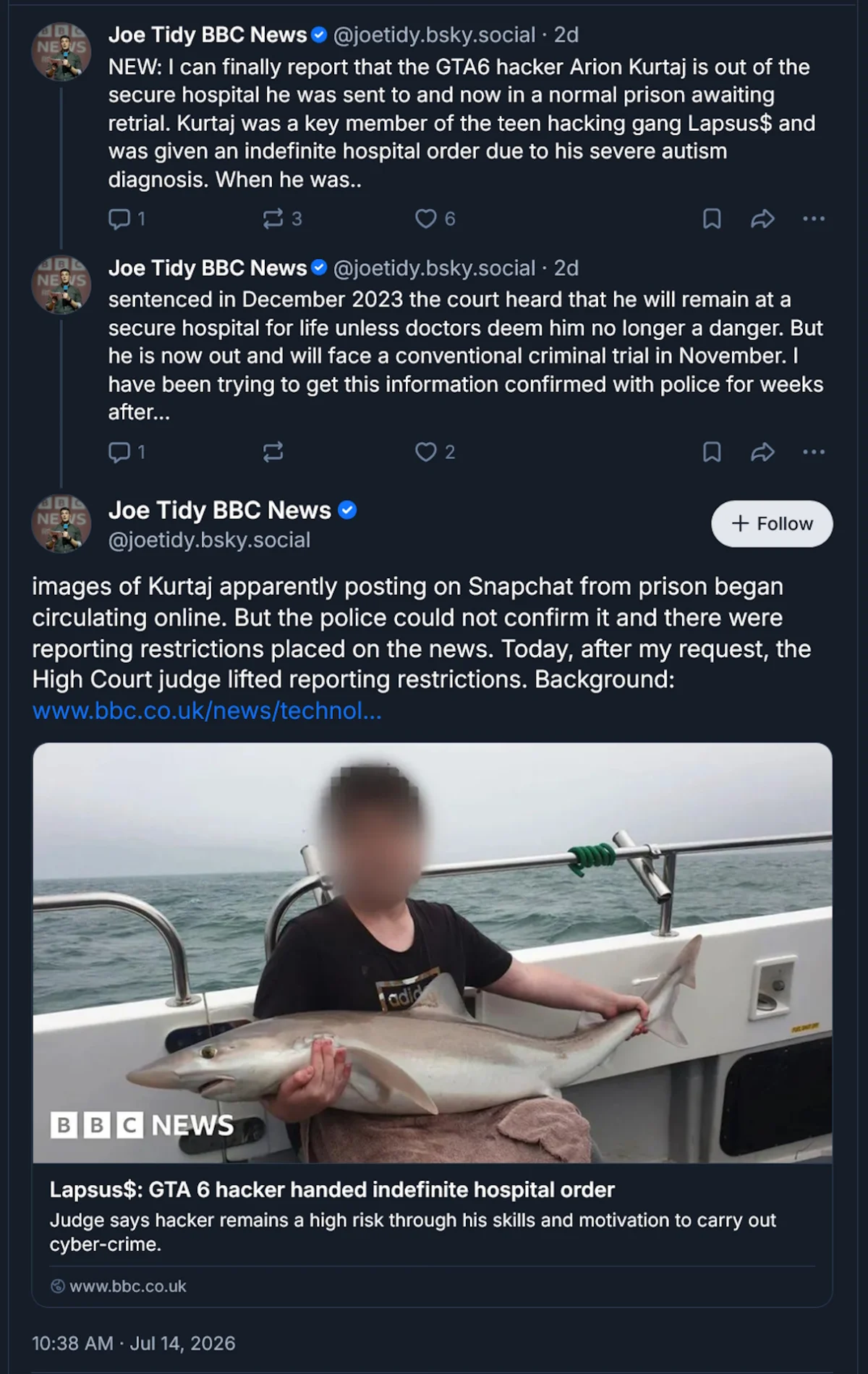
The saga of Arion Kurtaj, the teenage hacker who orchestrated one of the most audacious and damaging security breaches in the history of the video game industry, has entered a new and unexpected chapter. After spending over a year in a secure hospital facility, the former Lapsus$ hacking group member has been transferred to a conventional prison, where he awaits a fresh criminal trial scheduled for this November.
This development marks a significant shift in the legal handling of a case that has captivated the tech world, not only due to the scale of the intellectual property theft involved but also because of the unorthodox circumstances under which the crimes were committed.
Main Facts: A Landmark Case in Cybersecurity
Arion Kurtaj was the key figure behind the 2022 breach of Rockstar Games, which resulted in the unauthorized release of 90 videos showcasing early, unpolished gameplay footage of Grand Theft Auto 6. The leak was seismic; at the time, the game was perhaps the most anticipated piece of entertainment media in development, and the breach offered a rare, unfiltered look at internal development assets.
However, the Rockstar hack was merely the tip of the iceberg. Kurtaj, then 18, was a prominent member of Lapsus$, a decentralized cybercriminal collective known for targeting tech giants with a mixture of social engineering, SIM-swapping, and brute-force attacks. Before the GTA 6 incident, the group had already compromised systems belonging to Nvidia, Uber, and BT, causing millions of dollars in damages and exposing sensitive data.
Following his initial apprehension, psychiatric evaluations revealed that Kurtaj suffered from "acute autism." The court found that his condition, combined with his unwavering "intent to return to cybercrime," rendered him a persistent danger to the public. Consequently, he was handed an indefinite sentence to a secure hospital, where he was to remain until such a time as medical professionals determined he no longer posed a threat. That determination has now been made, triggering his move to the general prison population.
Chronology of the Lapsus$ Breach
The timeline of Kurtaj’s criminal activity highlights a brazen disregard for law enforcement that eventually became a central point of the prosecution’s argument.
- 2021–Early 2022: The Lapsus$ group gains notoriety for high-profile intrusions into major tech companies. Kurtaj establishes himself as a technical linchpin of the organization.
- September 2022: While already under police protection at a Travelodge hotel—a measure taken following a previous arrest—Kurtaj manages to bypass restrictions. Using only an Amazon Firestick, a television, and a mobile phone, he successfully breaches Rockstar Games’ internal servers.
- September 18, 2022: The "biggest leak in videogame history" occurs. 90 videos of GTA 6 are uploaded to the GTAForums fan site, sending shockwaves through the industry.
- December 2023: A UK court finds Kurtaj liable for the hacks. Due to his autism diagnosis and his stated desire to resume hacking, he is sentenced to a secure hospital for an indefinite period.
- Late 2024: Following rumors sparked by alleged social media activity from within custody, it is confirmed that Kurtaj has been moved to a standard prison.
- November 2025 (Projected): A new trial is scheduled, coinciding with the official console launch of Grand Theft Auto 6.
The "Travelodge" Anomaly
Perhaps the most bizarre detail of the entire investigation is that Kurtaj executed the Rockstar breach while under police guard. After his initial arrest, authorities placed him in a Travelodge hotel for his own protection, assuming he was isolated from the infrastructure necessary to conduct cyber-attacks.
Kurtaj proved them wrong. By exploiting the hotel’s television and his own Amazon Firestick, he bypassed security protocols, illustrating a level of technical ingenuity that surprised even seasoned cybersecurity experts. The incident highlighted a glaring gap in the criminal justice system’s ability to manage "digital natives" who do not require a high-end workstation to cause massive corporate disruption. It served as a stark reminder that in the modern era, an internet-connected screen is as lethal as a weapon in the right hands.
Supporting Data and Technical Context
The Lapsus$ attacks were notable for their lack of sophistication in terms of traditional malware; they relied heavily on "living off the land" tactics—using legitimate tools for malicious purposes. By social-engineering help-desk employees to gain multi-factor authentication (MFA) tokens, the group essentially walked through the front door of major corporations.
In the case of Rockstar, the impact was not just financial but also operational. The leak forced Rockstar to pull developers from other projects to mitigate the damage and reset internal security protocols. While the company eventually recovered, the incident served as a wake-up call for the gaming industry regarding the vulnerabilities inherent in remote work environments and third-party service integration.
Official Responses and Reporting Constraints
Information regarding Kurtaj’s status has been notoriously difficult to obtain. BBC technology correspondent Joe Tidy, who has extensively covered the case, noted that confirming the transfer was "like getting blood out of a stone."
For weeks, local law enforcement and the judicial system maintained strict silence, likely due to reporting restrictions that prevented the public from knowing that a convicted hacker had been moved from a medical facility to a prison. The lifting of these restrictions by a High Court judge finally allowed for the confirmation of his current status. As of now, police and government agencies have offered no comment on the specifics of the retrial or the justification for moving a defendant once deemed too unstable for prison into the general population.
Implications for Legal Precedent
The transfer of Kurtaj raises profound questions about the intersection of neurodiversity and criminal culpability. Critics of the original sentencing argued that an "indefinite" sentence for a teenager, based partly on his autism diagnosis, was overly punitive. Conversely, the prosecution maintained that the threat he posed was real and that his lack of remorse necessitated long-term containment.
The upcoming retrial creates a legal gray area: Can a defendant be held fully accountable for actions taken when his mental health state was deemed to require intensive institutionalization? Legal scholars are currently watching the case closely, as the outcome could set a precedent for how the UK courts handle "cyber-offenders" with similar diagnoses.
Furthermore, the irony of the trial date—November 2025, the same month Grand Theft Auto 6 is slated for release—is not lost on the gaming community. It serves as a bookend to a multi-year drama that began with the theft of the game’s assets and will conclude with the product’s long-awaited debut.
Conclusion: A Lingering Threat
While Arion Kurtaj is now physically removed from the digital world, the implications of his actions remain. The Lapsus$ case proved that massive, multi-billion-dollar corporations are essentially defenseless against a determined individual with enough persistence. As the legal system prepares for a new trial, the tech industry continues to harden its defenses, forever changed by the teenager who, from a Travelodge room, managed to bring the biggest game in the world to its knees.
Whether the upcoming trial results in a more definitive sentencing or a re-evaluation of the initial psychiatric findings, one thing is certain: the legacy of the GTA 6 leak will be studied by cybersecurity experts and legal professionals for years to come. The digital world is no longer just a place of commerce—it is a battlefield, and the authorities are still learning how to fight an enemy that operates from within the palm of their hand.

