

Main Facts
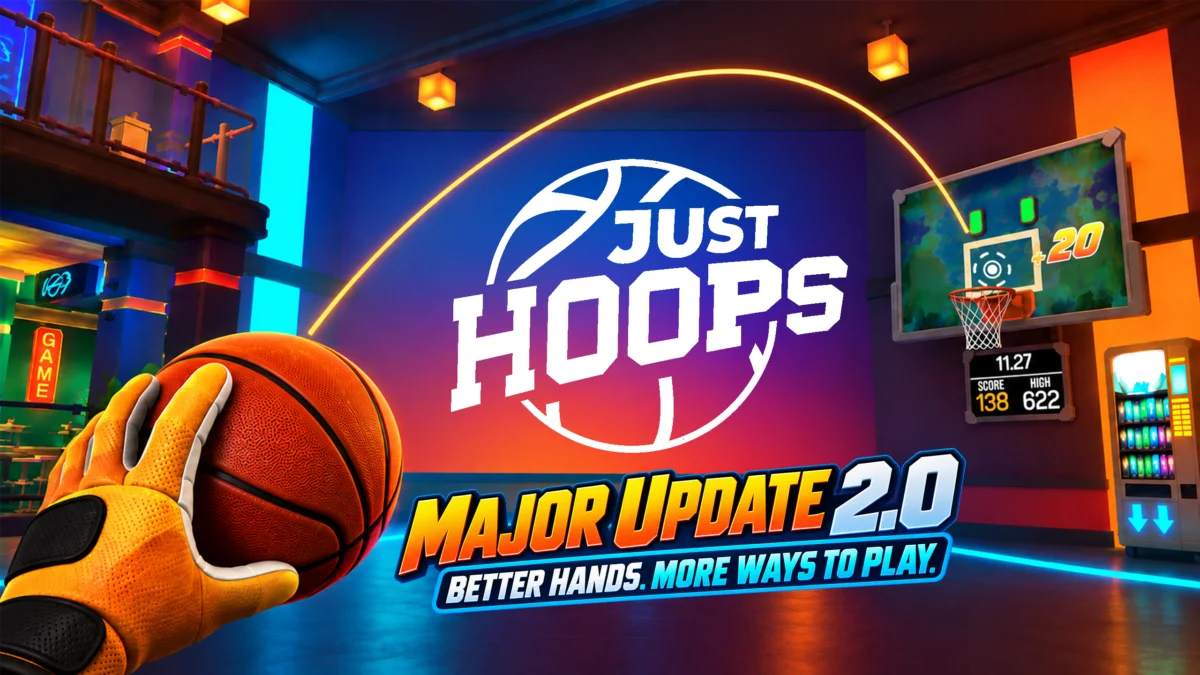
Developer Realcast has officially launched the massive 2.0 update for its acclaimed virtual reality basketball title, Just Hoops. Dropping in tandem with Meta Connect, this new iteration represents a watershed moment for the game, shifting its core design philosophy toward robust hand-tracking capabilities and significantly lowered barriers to entry.
Developed over the course of a year, the update leverages direct player feedback and benefits from technical support by Meta. This collaboration arrives precisely as Meta pivots toward a controller-free ecosystem, underscored by the simultaneous announcement of the upcoming Meta VR Glasses.
The headline additions in Just Hoops 2.0 include:
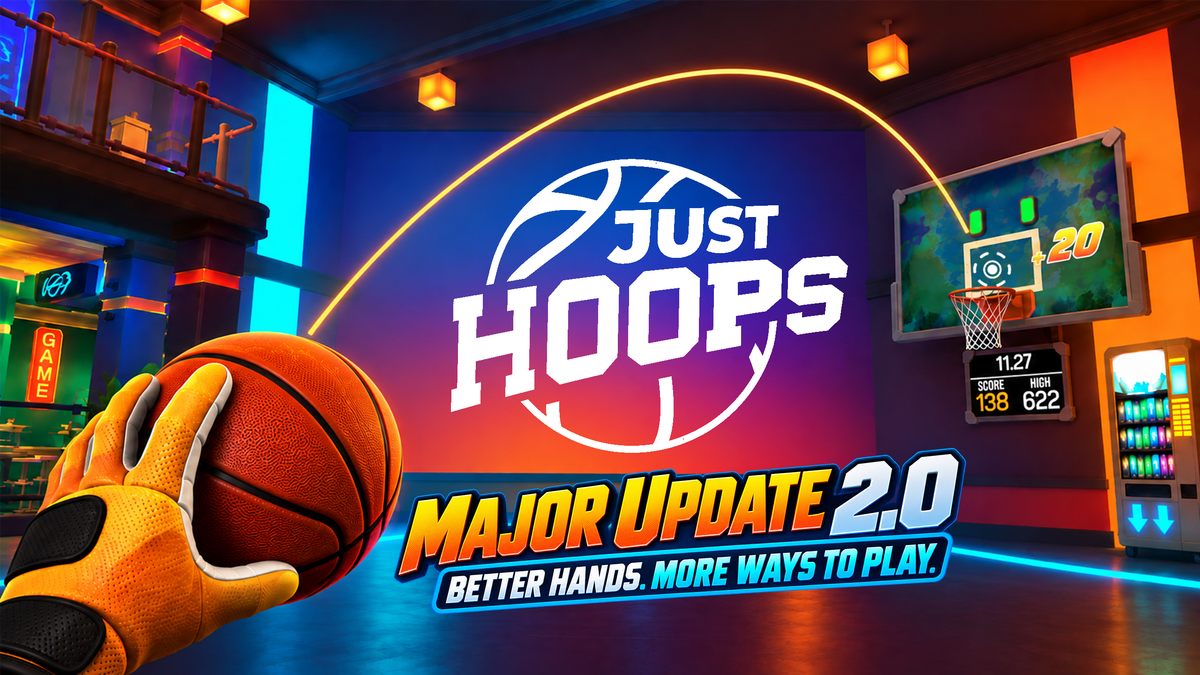
- Dual Shooting Mechanics: Featuring both a physics-based "Natural Shot" with progressive scoring multipliers and a gesture-driven "Pointer Shot" designed for casual accessibility.
- Mixed Reality Trickshots: A mode allowing players to map virtual hoops and obstacles directly onto their physical room environments.
- Multiplayer Expansion: Online matchmaking and private rooms supporting up to four players.
- Quality-of-Life Enhancements: A timer-free "Zen Mode," a restructured progression system, a 1970s-inspired retro environment, and a completely redesigned user interface.
While the update is currently live for Meta Quest users, the developer has yet to confirm whether these controller-free and mixed-reality features will migrate to the SteamVR version.
Chronology of Development and Release
The journey to Just Hoops 2.0 spans more than twelve months of intensive development, driven by an evolving virtual reality landscape and direct community engagement.
Phase 1: Foundation and Initial Feedback (Late 2024 – Early 2025)
Following the initial success of Just Hoops, Realcast established a continuous feedback loop with its player base. While the game was praised for its arcade-style approach to virtual basketball, early iterations relied heavily on traditional VR controllers. As standalone headsets grew more powerful and consumer demand for untethered, natural interactions increased, the development team identified hand tracking as the next critical frontier.
Phase 2: The Meta Partnership and Hardware Alignment (Mid 2025 – Mid 2026)
Realcast initiated a year-long overhaul of the game’s physics engine and input systems. During this period, Meta—anticipating its hardware roadmap centered around controller-free interactions—extended direct support to Realcast. This partnership allowed the studio to optimize its hand-tracking algorithms to minimize latency and improve gesture recognition, ensuring that the software would be ready to capitalize on the next generation of Meta’s spatial computing hardware unveiled at Meta Connect.
Phase 3: The 2.0 Launch (September 2026)
Released concurrently with Meta Connect, the 2.0 update represents the most comprehensive revision in the title’s history. By timing the release with major ecosystem announcements, Realcast positioned Just Hoops at the forefront of the industry’s push toward controller-free spatial computing.
Supporting Data and Feature Breakdown
The 2.0 update introduces a suite of technical and gameplay enhancements designed to accommodate various player types, ranging from casual arcade fans to hardcore competitive sharpshooters.
The Evolution of Shooting Mechanics
Virtual reality basketball has historically struggled with the tactile disconnect of throwing objects without physical resistance. Realcast has addressed this through a nuanced, dual-path shooting system:
- Natural Shot (Unassisted & Assisted):
- Mechanic: Players reach out with their bare hands, grasp a virtual basketball, and execute a physical shooting motion.
- Incentive Structure: To reward mastery over the inherent difficulties of unassisted VR throwing, the game employs a dynamic scoring system. Players can earn up to eight points per basket depending on the absence of assists. This scales downward as players opt for varying degrees of trajectory and release assistance, encouraging skill progression.
- Pointer Shot:
- Mechanic: A streamlined alternative where players aim with their hand and execute a simple gesture to release the ball.
- Accessibility: Tailored for seated play, fatigue reduction, and non-competitive users, this mode awards a flat two points per basket, ensuring casual players can still actively participate without mastering complex physics throws.
Spatial Computing and Mixed Reality Integration
The inclusion of mixed reality fundamentally alters how players interact with their physical spaces. The Trickshots mode transforms living rooms, offices, and bedrooms into customized basketball courts. By anchoring virtual hoops, backboards, and obstacles to real-world surfaces, players can invent complex trick shots that weave around furniture and walls. Industry observers have drawn nostalgic parallels to the iconic 1990s television commercials featuring Michael Jordan and Larry Bird playing elaborate trick shots across sprawling architectural spaces.
Multiplayer and Progression Redesign
- Multiplayer Architecture: The update standardizes social play through public matchmaking queues and secure, four-player private rooms, fostering tighter community engagement.
- Progression and Zen Mode: For solo users seeking a low-stress environment, Zen Mode strips away timers and scoring pressures. Concurrently, a restructured campaign progression provides clearer pathways to unlock new series, levels, and challenges, solving previous user onboarding friction.
- Aesthetic Overhaul: A brand-new 1970s arcade-inspired environment, updated tutorials, and a completely rebuilt user interface round out the technical package, establishing a cohesive visual identity for the franchise.
Official Responses and Developer Perspective
Speaking on the motivations behind the update, representatives from Realcast emphasized that the 2.0 patch was built directly upon the pillars of community feedback and emerging hardware standards.
"We spent the last year listening closely to what our players wanted: more intuitive access, deeper challenges, and a way to play that feels as close to a real basketball experience as possible without holding a piece of plastic," noted a Realcast spokesperson during the Meta Connect window.
The developer also acknowledged the vital role played by Meta’s engineering teams. With Meta heavily promoting controller-free hardware ecosystems—culminating in the reveal of the Meta VR Glasses—studios like Realcast are uniquely positioned as early adopters. By refining hand-tracking fidelity before mass consumer adoption of pure gesture-based headsets, Realcast aims to set the gold standard for sports simulations in mixed reality.
Platform holders have similarly championed titles that showcase the removal of peripheral barriers. Integrating robust hand-tracking into an arcade sports game validates the consumer readiness of optical tracking algorithms for fast-paced, high-precision movements.
Implications for the VR Industry
The release of Just Hoops 2.0 carries significant implications for the broader virtual reality landscape, particularly regarding input methodologies and game design philosophy.
The Shift Toward Controller-Free Interactions
For years, VR motion controllers have been the default standard for interaction, providing haptic feedback and reliable button inputs. However, the maturation of machine-learning-assisted hand tracking—accelerated by hardware announcements at Meta Connect—signals a paradigm shift. Titles like Just Hoops prove that fast-paced, physics-dependent sports games can transition away from controllers entirely, opening the medium to demographic groups put off by peripheral hardware.
Mixed Reality as a Core Retention Tool
By turning real-world rooms into interactive playgrounds via mixed reality, Realcast taps into the growing consumer appetite for passthrough gaming. Rather than isolating players in entirely virtual environments, mixed-reality features in sports titles encourage longer session times by integrating gaming into the user’s immediate physical reality. This reduces friction and makes VR hardware feel more like a seamless extension of home entertainment.
The PCVR Disconnect
Despite the excitement surrounding the Quest release, the absence of a confirmed SteamVR roadmap highlights a persistent challenge in cross-platform VR development. As standalone ecosystems like Meta’s increasingly fund and prioritize features tailored to their proprietary hardware stacks (such as advanced hand-tracking libraries and mixed-reality frameworks), PC-based VR users risk receiving fragmented or delayed feature parity. Whether Realcast eventually bridges this gap for Steam users remains a critical question for the PCVR community.
Conclusion
Just Hoops 2.0 is more than a simple content patch; it is a tactical evolution aligned with the future of spatial computing. By successfully implementing dual-tier shooting mechanics, sophisticated mixed-reality room mapping, and a streamlined arcade structure, Realcast has future-proofed its franchise while delivering a deeply engaging sports experience for both casual and hardcore virtual reality enthusiasts.

